
Iran plans to impose fees on submarine cables in Strait of Hormuz
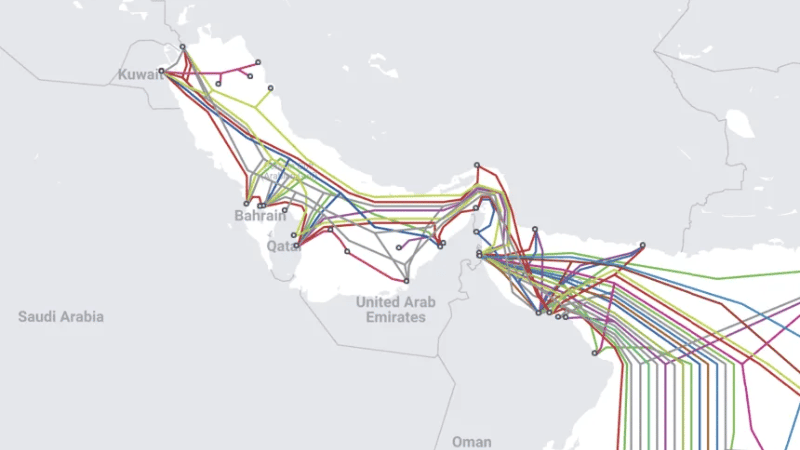

After a successful wartime blockade of the Strait of Hormuz, Iran is now eyeing a secret artery of the global economy. Tehran wants to use the submarine cables that run under the waterway—which carry vast amounts of internet and financial data between Europe, Asia and the Persian Gulf—as a strategic tool.
According to a CNN report, Iranian lawmakers recently discussed a plan to impose fees or tariffs on the world's largest technology companies for using submarine internet cables that run under the Strait of Hormuz and the Persian Gulf. Iranian military spokesman Ebrahim Zolfaghari announced live on social media, “We will impose fees on internet cables.”
According to media outlets affiliated with the Iranian Revolutionary Guards (IRGC), the plan would require companies like Google, Microsoft, Meta and Amazon to comply with Iranian law. The cable companies would have to pay license fees and grant Iranian companies exclusive rights to repair and maintain them. There have also been indirect threats to disrupt internet traffic if the money is not paid.
However, due to US sanctions, it is legally impossible for these tech giants to pay Iran any money. As a result, many companies see the move as an empty threat or political stance rather than a real policy.
What if the cable is damaged?
Although international operators usually avoid Iranian waters and lay cables towards Oman due to security risks, two major cables, the ‘Falcon’ and the ‘Gulf Bridge International’ (GBI), have passed through Iranian waters. Any attack by the IRGC’s combat divers, small submarines and underwater drones could cause a massive ‘digital disaster’.
This disaster could severely disrupt internet connectivity in the Persian Gulf countries, directly affecting their oil and gas exports and banking sectors. India’s vast outsourcing industry could suffer billions of dollars in losses. The connection between Asian data hubs like Singapore and cable stations in Europe would slow down, disrupting financial transactions between Europe and Asia. There is even a threat of internet blackouts in parts of East Africa. As a comparative example, in 2024, three submarine cables were damaged in an attack by Houthi rebels in the Red Sea, disrupting 25 percent of internet traffic in the region.
According to Telegeography, although less than one percent of the world’s international bandwidth passes through the Strait of Hormuz, the impact would be severe for countries in the Middle East and Asia.
International Law Issues
Iranian media outlets have claimed that the proposal to charge fees for cables passing through their territorial waters is in line with the 1982 United Nations Convention on the Law of the Sea (UNCLOS). Article 79 of the convention states that coastal states can set conditions for the passage of cables through their territorial waters.
Iran has also cited Egypt as an example. Egypt uses the strategic location of the Suez Canal to generate millions of dollars in annual transit and license fees from submarine cables. However, experts have reminded that the Suez Canal is an artificial waterway dug on Egyptian territory, while the Strait of Hormuz is a natural channel that operates under a completely different legal framework.
Irini Papanikolaou, a professor of international law at the University of London, said that Iran must comply with previous agreements for existing cables, but that it has the right to impose any conditions for the installation of new cables.
Dina Esfandiari, head of Middle East at Bloomberg Economics, believes that Iran wants to impose such a high price on the global economy through this war that no one will dare to attack Iran in the future. Analysts believe that Tehran has now found a huge economic and strategic tool beyond military power by exploiting the geographical location of the Strait of Hormuz.
Leave A Comment