

Iran protests spread to more areas
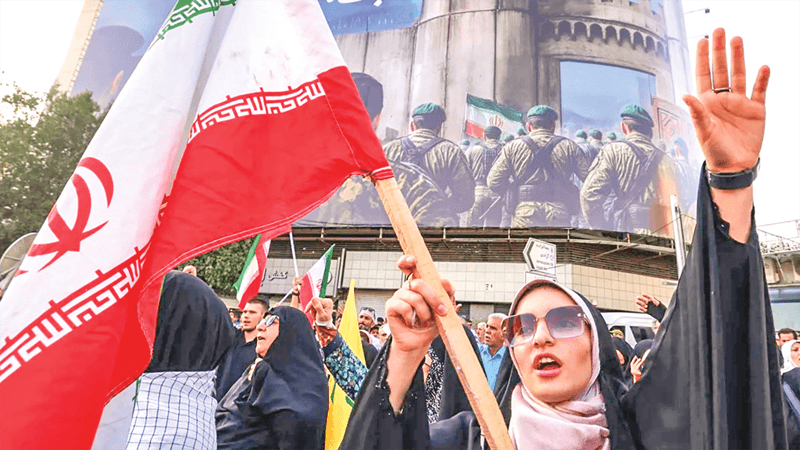

There were violent clashes between anti-government protesters and security forces in several locations in Iran on Wednesday, as a wave of unrest sparked by the country's economic crisis continued for an 11th day.
Iran's semi-official Fars news agency, which is close to the Revolutionary Guards, said two policemen were shot and killed by armed individuals in the south-western town of Lordegan.
Videos posted on social media showed a tense stand-off between protesters and security forces, with the sound of gunfire in the background.
In footage from several other areas, security forces appear to fire guns and tear gas towards crowds of protesters, some of whom are throwing stones.
The protests have so far spread to 111 cities and towns across all 31 provinces, according to the US-based Human Rights Activist News Agency (HRANA).
It has reported that at least 34 protesters and four security personnel have been killed during the unrest, and that 2,200 protesters have been arrested.
BBC Persian has confirmed the deaths and identities of 21 people, while Iranian authorities have reported the deaths of five security personnel.
The protests began on 28 December, when shopkeepers took to the streets of the capital, Tehran, to express their anger at another sharp fall in the value of the Iranian currency, the rial, against the US dollar on the open market.
The rial has sunk to a record low over the past year and inflation has soared to 40% as sanctions over Iran's nuclear programme squeeze an economy also weakened by government mismanagement and corruption.
University students soon joined the protests and they began spreading to other cities, with crowds frequently heard chanting slogans against the country's Supreme Leader, Ayatollah Ali Khamenei, and sometimes in support of Reza Pahlavi, the exiled son of Iran's late former shah.
Following a cabinet meeting on Wednesday, Vice-President for Executive Affairs Mohammad Jafar Qaempanah said President Masoud Pezeshkian had ordered that "no security measures" be taken against peaceful protesters.
"Those who carry firearms, knives and machetes and who attack police stations and military sites are rioters, and we must distinguish protesters from rioters," he added.
State media also reported that the government had begun paying 71 million citizens a new monthly allowance equivalent to $7 (£5) to ease the pain of the high cost of living.
Meanwhile, judiciary chief Gholamhossein Mohseni Ejei told police commanders that "rioters" would face "rapid" prosecution and punishment in order to serve as a deterrent.
Khamenei - who, as supreme leader, has ultimate power in Iran - said on Saturday that authorities should "speak with the protesters" but that "rioters should be put in their place".
His comments came after Trump threatened that the US would intervene if Iranian security forces killed peaceful protesters, saying: "We are locked and loaded."
Dr Sanam Vakil, director of the Middle East programme at the London-based think tank Chatham House, told the BBC that the protests had quickly become political and were being driven by deep-seated anger among the public.
"People are fed up. They have no prospects for the future. Day-to-day life is becoming much more difficult," she said.
"If there is more momentum and if more people come out, [the protests] will be more serious and, of course, there the government response becomes more violent."
Sadegh Zibakalam, a political science professor at the University of Tehran, said the Iranian authorities might be resisting a harsher crackdown because of Trump's threats.
"Some Iranian leaders - Revolutionary Guard commanders and security forces - maybe they are a bit more cautious and are not in a hurry to suppress the crowd this time fearing it may create an American intervention," he told the BBC.
The protests have been the most widespread since an uprising in 2022 sparked by the death in custody of Mahsa Amini, a young Kurdish woman who was detained by morality police for allegedly not wearing her hijab properly.
More than 550 people were killed and 20,000 detained in a violent crackdown on those protests by security forces, according to human rights groups.
Leave A Comment
You need login first to leave a comment