
Irene Khan reiterates PM's call to resolve Rohingya crisis
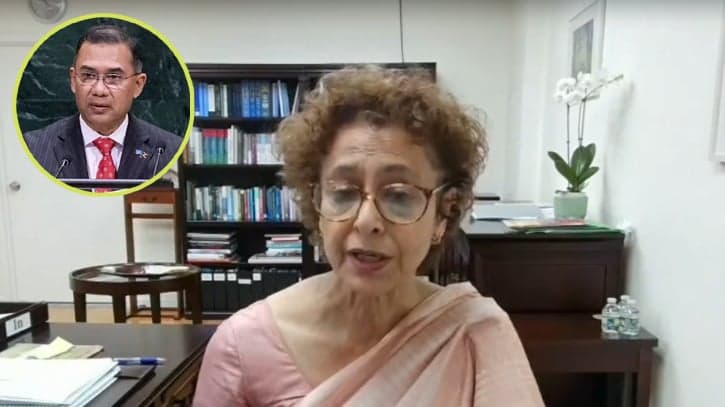

Bangladesh's Permanent Representative to the United Nations and Ambassador, Irene Khan, has reiterated Prime Minister Tarique Rahman's call for stronger action by the international community to resolve the Rohingya crisis and to take back more than 1.2 million forcibly displaced people safely to Myanmar.
In his first speech at the United Nations General Assembly (UNGA), the Prime Minister called for political action to end the protracted Rohingya crisis.
At the same time, he proposed a roadmap for the voluntary and safe repatriation of the Rohingyas to Myanmar and more humanitarian assistance for the displaced population.
In an interview with BBC World Service from New York, Irene Khan said, "Actually, what is failing is, first, the international commitment to assist these 1.2 million Rohingyas; second, to support the Bangladesh government during a very difficult time for the country; and third, to find a durable solution for this population."
In response to a question on whether the international community's actions are failing the Rohingyas due to declining funding and the world's attention shifting elsewhere, Irene Khan said the main reason is a lack of international commitment in assisting the refugees, supporting Bangladesh and finding a solution to the crisis.
Irene Khan, referring to the Rohingyas in Bangladesh as currently the world's largest displaced population, said they are living in crowded camps in a densely populated country.
She said, "Assistance is greatly needed, but its amount is decreasing. Humanitarian assistance is also declining at present."
Irene Khan said the Rohingyas have been living in the camps for nine years. Children are growing up there, and nearly 30,000 children are born in the camps every year.
She further said, "Where will they go? Staying in a camp for nine years is a very long time."
The ambassador said this is why Prime Minister Tarique Rahman has called on the international community, the United Nations and relevant parties both within and outside the region to come forward to ensure a solution to this crisis.
She said, "The source of the Rohingya problem is in Myanmar, and we believe its solution also lies there."
Noting that the Rohingyas are interested in returning to their own country, she said they want to return "with safety and dignity".
In response to a question on what kind of specific commitment Bangladesh expects, Irene Khan called on the United Nations and the international community to bring all stakeholders to the discussion table.
She mentioned Bangladesh, Myanmar, other countries in the region affected by the crisis, and countries that can influence Myanmar or supply necessary resources.
She said, "We want a political process where the Myanmar government is reminded of its responsibilities, of its legal obligations, so that they take back their people. At the same time, assistance is needed inside Myanmar to create a safe environment for people to return."
In response to a question on the UN's capacity to tackle major crises, Irene Khan said member states must take on more responsibility, especially the veto-wielding countries of the UN Security Council.
She said, "We really need these governments to work together more effectively."
She also noted that Bangladesh, along with a large number of countries in the world, believes in the multilateral system and in resolving global problems through diplomacy and dialogue.
On the sidelines of the UN General Assembly session, Prime Minister Tarique Rahman proposed five urgent steps to resolve the Rohingya crisis on September 23. He called on global stakeholders to formulate a clear and credible roadmap for the rapid, safe, dignified and sustainable repatriation of the Rohingyas. At that time, he said the time has come to move away from managing displacement and towards ending it.
Speaking at a high-level side event titled 'The Rohingya Crisis: A Renewed Call for a Durable Solution from Protracted Displacement, with Justice and Accountability' at the UN headquarters, he said, "The time has come to move from compassion to addressing the root causes and their solution, from promises to action, and from managing displacement to ending it."
The Prime Minister's five proposals include formulating a clear and credible roadmap for the rapid, safe, voluntary, dignified and sustainable repatriation of the Rohingyas to Myanmar; stopping violence against Rohingyas and civilians and ensuring their fundamental rights and security; ensuring adequate and predictable humanitarian assistance for the Rohingyas and host communities; strengthening justice and accountability; and strengthening regional and international cooperation to tackle the drug-driven economy, human trafficking, digital fraud, illegal arms and other cross-border crimes.
Leave A Comment