

Is the United States the only independent state in present global system?
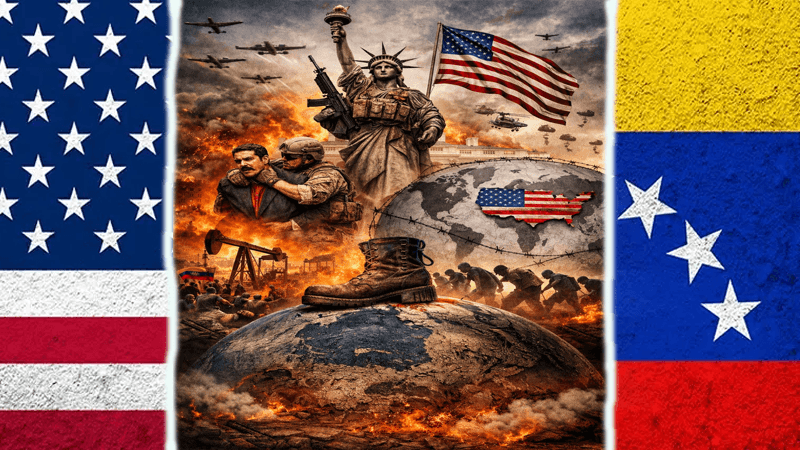
The world has accepted the US attack on Venezuela. The global community has been forced to accept it. At the same time, the current “civilised” world has also accepted that the United States has the right to attack any country at any time, kill military forces and civilians, remove the head of state or government, and seize resources. Therefore, it is also clearly proven that the United States is the only independent country in the current global system, and all other countries in the world are its colonies.
You may say Russia and China have protested the US action. Many countries, including the United Nations and the European Union, have also reacted. Bangladesh and India are also on the list of those responding. So how did the world accept the US attack on Venezuela? Let us analyse the language of protest and reaction. The strongest reaction came from China: “We never believe that any country can act as the world’s policeman, or that any country will claim to be the world’s judge—we will not accept that either.” Look at how cautious that reaction is. The United States attacked Venezuela, and casualties occurred there. But China’s response avoided the issue of the US attack on Venezuela. Instead, China only said that it would not accept any country acting as the “world’s judge”. Through this response, China has actually expressed its implicit support for the US attack.
Russia has more clearly supported the US attack on Caracas. In response, Russia “expressed restraint to both sides and called for resolving the problem through dialogue.” How ridiculous. Did Russia remember the words “restraint” and “dialogue” when attacking Ukraine?
The US Delta Force attacked Caracas like a group of bandits in the dark of night. Venezuela did not attack. So how are there two sides here? Referring to two sides means that Russia has effectively supported the US attack on Venezuela.
After such protests or reactions from China and Russia, there is little left to analyse regarding the responses of other countries. The most interesting development is that Ukraine, which was attacked by Russia, has unconditionally supported the US attack on Venezuela. So far, it has been proven that Russia’s attack on Ukraine was actually the first stage of US preparation for an attack on Venezuela. Zelensky is, in reality, a clown on the stage of both the United States and Russia.
Now it is Iran’s turn. What has started in Iran is quite understandable, and the possibility of this mass protest ending with the fall of the Khomeini regime is high. Many believed that Khomeini’s revolutionary government in Tehran was strongly opposed to the United States. In reality, it was not. Although Reza Shah Pahlavi was considered a close US ally, Iran’s strong economic foundation under his leadership in the sixties, seventies, and eighties became a cause of serious concern for the United States. The US never wanted to see a developed and liberal country next to its Middle Eastern garrison and military laboratory, Israel. That is why Iran, Iraq, and Syria were targeted. These three countries were advancing rapidly in higher education and technological research. On the other hand, luxury monarchies such as Saudi Arabia, the United Arab Emirates, Kuwait, and Qatar, though economically prosperous, posed no concern for the United States because they remained backward in science and education. During the attack on Iraq, the wealthy monarchs of Saudi Arabia and Kuwait effectively played the role of obedient colonial administrators under US control.
Therefore, religious fundamentalism and inter-religious conflict have been the primary weapons used to weaken countries moving towards strong economies. This is exactly what happened in Iran, Iraq, and Syria. The United States essentially uses two major tools to maintain its hegemony. One is drugs, and the other is radical religious ideology through militant production and training programmes. Since spreading militancy in Latin America is difficult, drugs serve as the primary weapon there.
Conversely, religious fundamentalism is deeply rooted in Central and South Asia. As a result, militant production and training programmes are the main tools used to maintain US dominance in this region. In the current information technology system, 80 percent of telecommunications and internet networks, 99 percent of operating software, 90 percent of security software, 95 percent of applications, and 99 percent of social media platforms are run by US companies. Therefore, nothing exists outside US control. Nothing functions independently. Thinking that the spread of drugs or terrorism occurs outside US control is simply foolish.
In fact, the Khamenei government in Iran came to power with US assistance, though its character was different. The religious fundamentalist ideology carefully planted as opposition to the United States turned into a full-scale takeover in 1979 after the fall of the Pahlavi government.
The US objective was to ensure that Iran would gradually fall behind in knowledge and development under religious fundamentalism, ultimately becoming an economically weak state. That objective was achieved. The Khomeini government poured massive resources into military procurement and nuclear research while reducing funding for education and development year after year.
As a result, Iran’s developing economy steadily weakened. That economic decline is the primary cause of today’s protests. However, the United States failed to maintain full control over Iran’s military capabilities acquired during the Khomeini era.
For instance, the United States could not retain full control over its former loyalists, Muammar Gaddafi of Libya and Hosni Mubarak of Egypt. Khamenei now faces the same fate. It would be surprising if the Khomeini regime survives.
Looking back, the United States emerges as the world’s largest genocidal power from the 1990s to the present. Under fabricated pretexts, the United States killed approximately 200,000 civilians in Iraq in two phases. The objective was to cripple Iraq, which it successfully achieved. Claims about Saddam Hussein’s chemical weapons and the killing of children in Kuwaiti hospitals were later proven false by US investigations. Only the United States can admit with a smile that it killed hundreds of thousands based on false allegations—because it is the only country beyond accountability.
After the attack on Venezuela, just as during the Iraq invasion, the roles of Russia and China were identical—or even weaker. Since the era of Mikhail Gorbachev, and in China since Sun Ching Li and Dong Bi-wu, neither country has meaningfully opposed US decisions. Both have consistently responded from convenient positions that ultimately support US actions. European countries, prioritising their own comfort, have avoided confrontation with the United States.
Pro-US analysts repeat a familiar argument: since World War II, a US-led world order has maintained global stability. If that order collapses, chaos will ensue. They claim that fear of the United States prevents authoritarianism worldwide. Without US hegemony, they argue, the world would collapse.
Yet they never question US invasions, oil seizures, genocides, or regime-change operations. Such actions are not authoritarian in their view. When innocent civilians are killed by US gunfire, they merely react with a hollow “wow”, echoing Zelensky.
We now live in a world where criticising the United States seems pointless. Every country, including Russia and China, bows to the US President, Senate, and Congress. In reality, all nations are US colonies. These colonies were not created overnight. Since World War II, US dominance—driven by information technology and internet-based military strategy—has left countries like Russia and China far behind.
The world has gradually become a colony of US information technology. Despite rapid economic growth, China still lags far behind the United States in technological dominance. Russia, meanwhile, remains a cautious predator, emerging from its heavy Siberian overcoat only when necessary—yet still grateful to the United States.
Author: Editor, Views Bangladesh
Leave A Comment
You need login first to leave a comment