
Is this the real face of NGO activities?
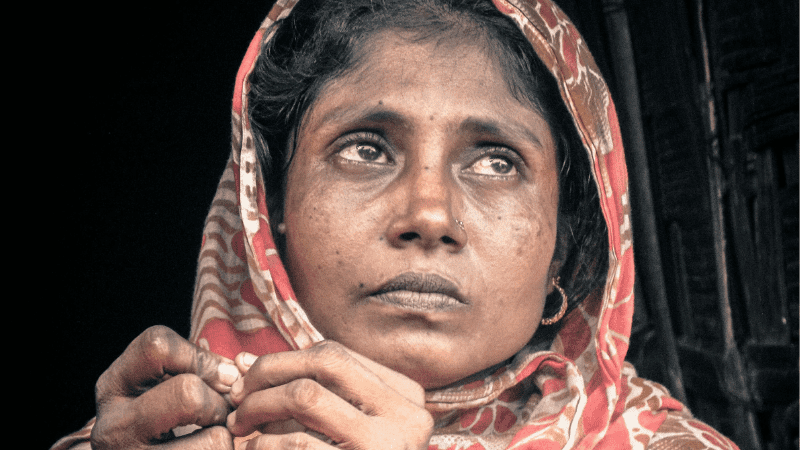

While high-ranking officials of NGOs, attired in pristine, white, pressed panjabis, vociferously advocate for governance, human rights, and sustainable development within the comfort of air-conditioned seminar rooms, a shocking instance of the grim reality endured by marginalized individuals laboring in the sweltering heat outside has surfaced in Tarash of Sirajganj.
For the 'offense' of not being able to pay a microcredit installment, a mother was incarcerated after her eighteen-month-old nursing child was forcibly taken from her. However, official documentation indicates that the actual sum in question was a mere Tk200.
Indeed, you read that correctly. Tk200 note—an amount that likely wouldn't even suffice for a single cup of coffee for the senior executives of that organization—yet they opted for retribution over such a trivial sum. The incarceration of a twenty-five-year-old mother named Jannati Khatun is not merely an isolated case; it resonates with the sorrow of countless 'Jannatis' throughout Bangladesh. They are perpetually oppressed under the weight of commercial entities that have emerged under the guise of poverty alleviation.
The cruelty of numbers and the criminalization of poverty
The details of this incident warrant a closer look. Jannati’s husband, Abdur Razzak, was an employee of that very NGO (TMSS). According to his employment terms, he had to deposit Tk24,800 as a security deposit. Later, a loan of Tk50,000 was taken in his wife’s name, half of which had already been repaid. The logical and standard procedure should have been to adjust the outstanding loan against that security deposit. Had that been done, the remaining debt would have been a mere Tk200.
This is where the extreme abuse of the law comes to light. TMSS filed this case using Section 138 of the Negotiable Instruments Act, 1881. This, despite the fact that a 2018 circular from the Microcredit Regulatory Authority (MRA) explicitly prohibits the taking of blank checks.
In this context, it is essential to mention the legal philosophy of Barrister Sara Hossain, a prominent human rights lawyer in the country. She has long been working for the judicial rights of marginalized people. From the essence of her legal battles, we know that transforming a civil-natured debt dispute into a criminal case like check dishonor (Section 138) is not just an abuse of the legal process; it is a well-planned tool to harass the poor and deprive them of justice.
On the other hand, criminologists view such institutional abuse of power through a different lens. In light of the research-based analysis by legal and crime researcher Md. Ariful Kabir, it can be said that when marginalized people are dragged into the dock by using institutional power through microcredit traps, it is termed as the 'Criminalization of Poverty'. This is not merely about debt recovery; rather, it is a terrifying form of institutional trauma.
The mirror of the developed world: where do we stand?
NGOs like TMSS primarily operate with funding from donor agencies in the developed world. Yet, the irony is that they do not apply the humanitarian standards of those donor countries here.
Consider the scenario in the developed world. According to CPS Guidelines in the UK or in Nordic countries (Norway, Sweden, Finland), a mother with an infant in her arms is generally not arrested, even for significant offenses. In those countries, sending someone to jail over a debt is unimaginable; rather, it is viewed strictly as a "civil dispute." In Germany, under the Mutterschutz law, the mother of a newborn receives special protection in judicial proceedings. In Canada, judges have a constitutional obligation to ensure the 'Best Interest of the Child.'
Why, then, is the picture so different in Bangladesh? The very NGOs that conduct seminars on child rights using foreign funds are the ones forcibly tearing infants away from their mothers' arms. Internationally, this is a clear crime. Articles 3 and 9 of the United Nations Convention on the Rights of the Child (CRC)—to which Bangladesh is a signatory—state that a child must not be separated from their parents under any circumstances. Furthermore, according to the United Nations Bangkok Rules (2010), imprisonment should be the last resort for mothers with dependent children. In Jannati's case, these global commitments have been flagrantly violated.
'Five-star' NGOs versus dying rivers
The NGOs that were born in the name of poverty alleviation now build five-star hotels in Bogura, run commercial medical colleges, and even operate luxury helicopter services. There are allegations that this aggressive policy of encroachment is behind the silent sighs of the dying Karatoya River in Bogura. When an NGO-owned entity possesses assets worth hundreds of billions, yet sends a woman to jail for a mere Tk200—what could be a bigger farce than this? Is it not urgent for the state to conduct an intensive investigation into the sources of such vast wealth for an organization that deprives an infant of its mother’s milk over Tk200 ?
The demand of conscience and responsibility of the state
Jannati Khatun has indeed been granted bail, but will the trauma inflicted be erased by bail alone? We must strike at the roots of this system:
Legal Amendment: Microcredit disputes must be completely exempted from Section 138 of the Negotiable Instruments Act. Abolishing the primitive practice of imprisonment for debt is now a demand of the times.
Banning the Security Deposit Trade: Taking 'security money' from employees by exploiting the unemployment crisis must be prohibited by law. What does not happen in any government or private corporate office cannot be allowed to continue in the NGO sector. This is a direct violation of International Labour Organization (ILO) principles.
Mission Audit: The NGO Affairs Bureau should strictly audit the sources of commercial investment and the proper utilization of foreign grants by these 'Five-Star' NGOs.
Child-Safe Arrest Protocol: A legal framework and police regulation must explicitly state that a child's primary caregiver cannot be arrested over minor financial disputes.
Final words:
The true measure of a civilization is reflected in its ability to safeguard its most vulnerable members. Although Jannati Khatun's child may not retain memories of this traumatic experience, should we—who profess to be aware and compassionate individuals—allow ourselves to forget? When progress is equated with hubris and exploitation, it becomes imperative to conduct a thorough examination of that so-called 'progress.'
If the government chooses to remain silent today, countless others like Jannati and their innocent offspring will inevitably be crushed beneath the weight of this 'NGO-cracy.' Let development serve the people—not be constructed upon their remains.
Md. Shamiul Alim Shawon
Writer and Development Worker (Best Youth Award Winner), Founder-President, Youth Action for Social Change (YASC), Rajshahi
Leave A Comment