

13th National Parliamentary Election
Jamaat-BNP focus on minority, AL–aligned, young voters
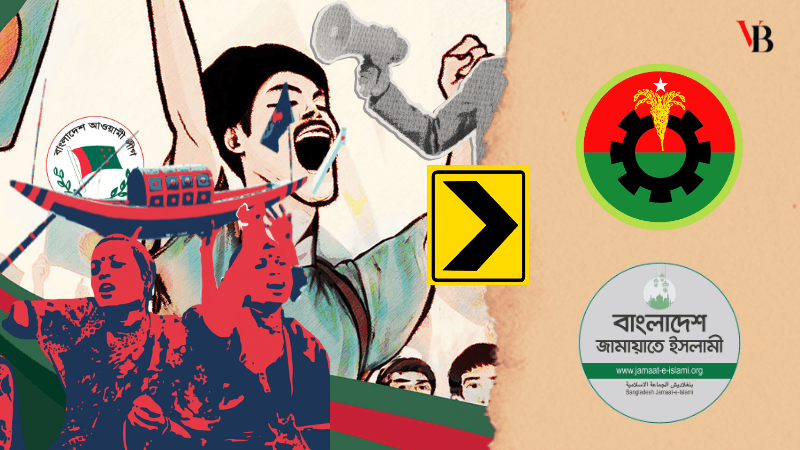

With the 13th National Parliamentary Election approaching, major political parties are now concentrating on three key voter blocs: minorities, Awami League–aligned voters, and young voters. Since the Awami League is not participating in this election, the political alignment of its support base has become a subject of fresh calculation. Issues such as the security and confidence of minority communities, attracting Awami League supporters to their own camps, and addressing employment and future prospects for young voters are shaping the strategies of the participating parties. Political analysts believe these voter groups could play a decisive role in determining the outcome of the election.
BNP and Jamaat Eye the Minority Vote Bank
As Bangladesh heads toward the 13th parliamentary election, various strategic calculations are becoming evident in opposition politics. However, both BNP and Jamaat-e-Islami appear particularly uneasy when it comes to one issue: the minority vote bank. Although minorities constitute a relatively small proportion of the electorate, their political significance is substantial.
In reality, both BNP and Jamaat continue to face a serious confidence deficit among minority voters.
Historically, minority communities—especially Hindus—have largely aligned with the Awami League. The party’s leadership during the Liberation War, its commitment to secular politics, and state-level recognition of cultural diversity have long made it appear a comparatively safer political force for minorities. In contrast, the political histories of BNP and Jamaat have contributed to distrust among minority communities.
Nevertheless, with the Awami League absent from the electoral race this time, both BNP and Jamaat are eager to draw minority votes into their own boxes.
There are around 20 parliamentary constituencies where the proportion of minority voters is comparatively high. These include Khulna-1 (Batiaghata–Dacope), where minorities make up about 47 percent of voters, and Khulna-5 (Dumuria–Phultala), with around 27 percent. Other constituencies include Khulna-6, Bagerhat-1, Bagerhat-4, Magura-1, Magura-2, Barishal-1, Barishal-5, Netrokona-4, Khagrachhari, Rangamati, Bandarban, Gaibandha-2, Gaibandha-5, Sunamganj-2, Moulvibazar-3, Dhaka-8, Dhaka-12, Chattogram-11, Sylhet-1, Lakshmipur-4, Gopalganj-3, Dinajpur-1, and Dinajpur-6.
In these constituencies, BNP is attempting to send positive signals to minority voters. Party leaders are emphasizing communal harmony, civil rights, and religious freedom in their speeches. Reports suggest that in some areas, BNP leaders have held meetings with minority representatives, exchanged greetings, and made various assurances.
Jamaat-e-Islami is also actively trying to expand its influence among minority voters. Through local leaders, the party is holding meetings, participating in religious and social events, exchanging greetings, and offering promises aimed at winning voter confidence. Jamaat has intensified its campaign particularly in constituencies with large minority populations such as Khulna, Bagerhat, Magura, Dinajpur, and Barishal. The party is highlighting themes of religious harmony and social welfare to attract support.
In a notable move, Jamaat has nominated a Hindu community leader, Tokrishna Nandi, as its candidate in Khulna-1 (Dacope–Batiaghata). He is the president of Jamaat’s Dumuria Upazila Hindu Committee. This is being viewed as a strategic step, as he is the first Hindu candidate fielded by Jamaat in a parliamentary election.
Despite these efforts, minority voters remain concerned about recent incidents of temple attacks, land grabbing, social insecurity, and allegations of impunity. Against this backdrop, both BNP and Jamaat are keeping the minority vote bank under close watch and pressure. They understand that without securing a significant share of these votes, victory in many constituencies will be difficult. Overall, the minority vote bank remains one of the toughest challenges for BNP and Jamaat in this election, as overcoming the crisis of trust, historical baggage, and political realities will not be easy.
BNP and Jamaat Compete for AL Supporters:
Awami League’s decision not to contest the 13th parliamentary election has created a distinct shift in the country’s political landscape. This change is particularly pronounced in traditionally Awami League–dominated regions such as Dhaka, Gopalganj, Madaripur, Shariatpur, Dinajpur, the Chittagong Hill Tracts, Habiganj, Patuakhali, and Khulna. In these areas, Awami League supporters have historically constituted a major vote bank. This time, however, it remains uncertain which party they will support.
Both BNP and Jamaat are increasing grassroots-level campaigning and outreach.
They are attempting to convey positive messages to Awami League supporters, focusing on civil rights, religious freedom, and local development. Party activists are holding meetings, exchanging greetings, and making promises to build voter confidence.
Political analysts said that all participating parties are well aware that Awami League supporters will act as a decisive factor in this election. The absence of the Awami League from the electoral field has created both challenges and opportunities for BNP and Jamaat, particularly in Awami League–stronghold areas.
BNP’s Strategy: Winning the Trust of Awami League Supporters
An analysis of BNP’s recent rhetoric suggests that the party is no longer solely focused on attacking the Awami League. Instead, it is attempting to distinguish between the party leadership and its general supporters. BNP leaders have also promised security for Awami League supporters.
Senior BNP figures frequently emphasize the message that “the problem is not the party, but the way the government has been run.” Through this narrative, BNP aims to show that it does not view Awami League supporters as enemies; rather, it portrays them as victims of the current system. By highlighting issues such as personal and collective security, economic hardship, rising prices, voting rights, and democracy, BNP is trying to attract Awami League–aligned voters—and, according to reports, with some success.
Jamaat’s Strategy: Targeting Religious Awami Voters
Although Jamaat-e-Islami has been relatively restrained in organizing large public rallies or overt political programs, its activities through social and religious networks remain significant. Jamaat is primarily focusing on Awami League supporters who are critical of the party from a religious perspective.
The party is promoting the idea that the Awami League has moved away from religious values and failed to reflect the sentiments of ordinary Muslim voters. Through such messaging, Jamaat is targeting Awami League supporters who are religiously sensitive but do not feel comfortable aligning directly with BNP politics. This approach appears particularly noticeable among young and middle-aged religious voters.
Intense Competition for the Youth Vote
Both BNP and Jamaat are making concerted efforts to win over young voters in this election. Approximately 30 percent of the country’s voters are between the ages of 18 and 35, making them a highly significant political force. To mobilize this segment, parties have intensified campaigns through social media, political programs, and student and youth gatherings.
BNP is emphasizing promises related to employment, education opportunities, entrepreneurship, and technological development to appeal to young voters. Jamaat, meanwhile, is engaging young voters through youth rallies, volunteer activities, and direct contact via local leaders. The party is paying particular attention to urban areas and regions centered around educational institutions.
Jamaat-e-Islami is also highlighting religious and moral values, social equality, volunteerism, and local development initiatives to attract young voters. Through youth gatherings, educational institutions, and community-based activities, the party is directly engaging with young people and incorporating themes of religious harmony and social responsibility into its electoral messaging—especially in urban and campus-centered areas.
Political analysts believe that young voters could be a major determinant of the election outcome. Given their strong presence on social media, rapid information consumption, and responsiveness to new political narratives, youth participation will not only increase voter turnout but also shape the fundamental dynamics of the election itself.
Leave A Comment
You need login first to leave a comment