

Last year's major activities in judiciary
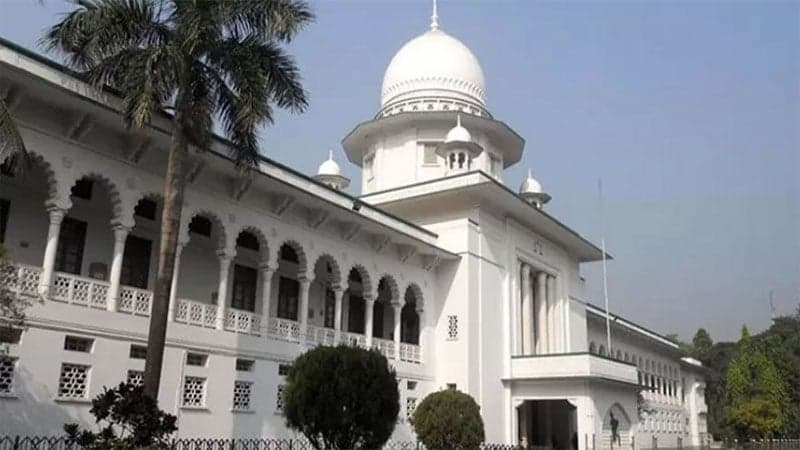
A new event happened in the judiciary in 2024. That year, for the first time in history, all the judges of the Appellate Division resigned simultaneously and High Court Justice Syed Refaat Ahmed was directly appointed as the Chief Justice. And in 2025, the historical events of the judiciary were the death sentence of former Prime Minister Sheikh Hasina in the International Crimes Tribunal, the inauguration of the Supreme Court Secretariat and the return of the caretaker government system. In addition, several important events and decisions were made in the Supreme Court.
Sheikh Hasina's death sentence
On November 17, 2025, the International Crimes Tribunal-1 sentenced ousted Prime Minister Sheikh Hasina and former Home Minister Asaduzzaman Khan to death for crimes against humanity committed during the July 17 uprising. The verdict was announced in the absence of Sheikh Hasina and Asaduzzaman Khan. They did not get the opportunity to appeal against the verdict as they were absconding. After that verdict, the interim government sent a letter to New Delhi to send back Sheikh Hasina, who was in India. However, India has not responded to it yet.
Legality of the oath of the interim government
The Appellate Division of the Supreme Court, the country's highest court, upheld the High Court's verdict that the formation and oath-taking of the current interim government led by Dr. Muhammad Yunus was legal. On December 4, a seven-member bench of the Appellate Division headed by Chief Justice Syed Refaat Ahmed unanimously rejected the leave to appeal filed against the High Court's verdict. Earlier, on January 13, the High Court directly dismissed the writ filed by lawyer Muhammad Mohsen Rashid challenging the legality of the formation and oath-taking of the interim government. He later appealed to the Appellate Division against the High Court's verdict.
The full order of the High Court observed that the interim government led by Dr. Yunus was supported by legal documents and was formed by the will of the people.
The High Court had stated that the formation and oath of this government were reasonable based on the opinion of the Supreme Court. Then on February 25, Muhsen Rashid filed a leave to appeal in the Appellate Division against the High Court order.
Supreme Court Secretariat Ordinance issued
The then Chief Justice Dr. Syed Refaat Ahmed inaugurated the separate secretariat of the judiciary on December 11. He inaugurated the secretariat building on the Supreme Court premises that day. At that time, Justice Dr. Syed Refaat Ahmed said, 'The support of the future government will be needed to maintain the independence of the judiciary. Not only that, but we will have to accept both the successes and failures of the independent judiciary.' He said, 'It was the collective efforts of everyone that made it possible to establish a separate secretariat.' Earlier, on November 20, the Advisory Council of the interim government gave final approval to the draft of the Supreme Court Secretariat Ordinance regarding the establishment of a separate secretariat for the Supreme Court.
Supreme Court Judge Appointment Act
The Supreme Court Judge Appointment Ordinance, 2025 has been recently promulgated to make the appointment process of the Chief Justice and other judges more transparent and independent. It provides a framework for the Chief Justice to advise the President, although there have been debates and writs on this ordinance, which have highlighted the need for a new law or policy on judicial appointments.
Supreme Judicial Appointment Council
Applications have been invited from interested persons for the appointment of additional judges in the High Court Division of the Supreme Court. This application has been invited for the purpose of appointment as additional judges as per Section 7(a) of the Supreme Court Judge Appointment Ordinance, 2025.
This public notice was published on the Supreme Court website on November 26. The Law Ministry issued the ‘Supreme Court Judge Appointment Ordinance-2025’ in the form of a gazette on January 21, to advise the President by selecting suitable persons for the purpose of appointing judges to the Appellate Division and High Court Division of the Supreme Court. According to Section 3 of the Ordinance, there shall be a permanent council to select and recommend suitable persons to assist the Chief Justice in the process of appointment or advice to the Supreme Court judges. And it shall be called the ‘Supreme Judicial Appointment Council’. The ‘Supreme Judicial Appointment Council’ has been constituted as per the provisions of the Ordinance.
Removal of Judges through the Supreme Judicial Council
Although the power to remove Supreme Court judges was vested in the Parliament through the Sixteenth Amendment to the Constitution, the High Court Division and the Appellate Division later declared this amendment invalid. However, the review petition filed in this regard remained pending for a long time. The Supreme Judicial Council was revived when the Appellate Division disposed of the review on October 20, 2024. Justice Khizir Hayat was removed on March 18 and Justice Khandaker Diliruzzaman on May 21 through this council. In addition, Justice Muhammad Khurshid Alam Sarkar of the High Court Division of the Supreme Court has been removed.
The President removed them in accordance with clause (6) of Article 96 of the Constitution, which was reinstated. A notification in this regard has been issued by the Ministry of Law, Justice and Parliamentary Affairs.
Caretaker government system restored
The Appellate Division of the Supreme Court has ruled to reinstate the non-partisan caretaker government system during elections in the Constitution. However, the ruling states that this system will be effective from the next National Parliament election, not the upcoming 13th National Parliament election. On November 20, the day the verdict was announced, the then Chief Justice Syed Refaat Ahmed's seven-member full and regular bench of the Appellate Division, announced the verdict. The caretaker system, which was abolished 14 years ago, has been automatically reinstated in the constitution through the Appellate Division's verdict, the then Attorney General Md. Asaduzzaman told reporters.
Supreme Court orders EC to register Jamaat
The Appellate Division of the Supreme Court has ruled to quash the High Court's verdict declaring the registration of Bangladesh Jamaat-e-Islami as a political party illegal. At the same time, it has directed the Election Commission (EC) to dispose of the party's appeal regarding the cancelled registration and other issues.
The top court also said that the Election Commission (EC) will take necessary steps regarding Jamaat-e-Islami's 'pending registration' and other issues. On the other hand, the top court granted Jamaat's application to withdraw its application regarding the party symbol without any observation. The Appellate Division gave this verdict on June 1, allowing the appeal filed on behalf of the party.
Khaleda Zia's acquittal upheld on appeal
The Appellate Division of the Supreme Court has upheld the High Court's acquittal of BNP Chairperson Khaleda Zia from a seven-year prison sentence and a fine of Tk 10 lakh in the Zia Charitable Trust case.
The three-member Appellate Division bench headed by Senior Justice Md. Ashfaqul Islam of the Supreme Court issued the order on March 3, dismissing three separate leave to appeals (applications seeking permission to appeal) filed by the state and the Anti-Corruption Commission (ACC) against the High Court's verdict.
ATM Azhar acquitted from death sentence
The International Crimes Tribunal formed during the then Awami League government had sentenced Jamaat-e-Islami leader ATM Azharul Islam to death in a case filed on charges of crimes against humanity.
The Appellate Division of the Supreme Court announced the verdict acquitting him from the death sentence. The full and regular bench of the Appellate Division announced the verdict on May 27, granting Azharul's appeal.
21 August granade attack case
The Supreme Court's Appellate Division has upheld the High Court's verdict acquitting all the accused, including BNP Acting Chairman Tarique Rahman, who was sentenced to life imprisonment, and former State Minister for Home Affairs Lutfuzzaman Babar, who was sentenced to death, in the 2004 August 21 grenade attack case. The Appellate Division gave this verdict on September 4 after hearing the state's appeal against the High Court's verdict. In addition, the Appellate Division acquitted BNP Acting Chairman Tarique Rahman from a 10-year sentence in the Zia Orphanage Trust case. The verdict was given on January 15 by a five-member Appellate Division bench headed by the then Chief Justice Dr. Syed Refaat Ahmed.
Access to Supreme Court courtrooms limited
Due to security reasons, the Supreme Court administration has restricted the access of trial seekers or any unexpected person except lawyers to the courtrooms of both divisions of the Supreme Court since December 15. Such information was given in a notification signed by the Registrar General of the Supreme Court Muhammad Habibur Rahman Siddiqui on the order of the Chief Justice. Which is a rare event in the Supreme Court.
Appointment of new Chief Justice
Zubair Rahman Chowdhury took oath as the 26th Chief Justice of Bangladesh on December 28. President Md. Shahabuddin administered the oath to him at Bangabhaban on that day.
The country's 25th Chief Justice Dr. Syed Refaat Ahmed retired on December 27 as he reached the retirement age of 67 according to the constitution.
Farewell of Attorney General Asaduzzaman
At the end of 2025, the country's 17th Attorney General Md. Asaduzzaman resigned from his post, citing personal reasons. On December 27, he submitted his resignation to the President. On the same day, he submitted his resignation letter to the Attorney General's Office. Asaduzzaman said that he took this decision with the aim of contesting the upcoming 13th National Parliament elections.
Md. Asaduzzaman collected nomination papers as a BNP candidate from Jhenaidah-1 (Shailkupa) constituency.
Leave A Comment
You need login first to leave a comment