
Lens witness to liberation: Raghu Rai and Bangladesh’s 1971 war
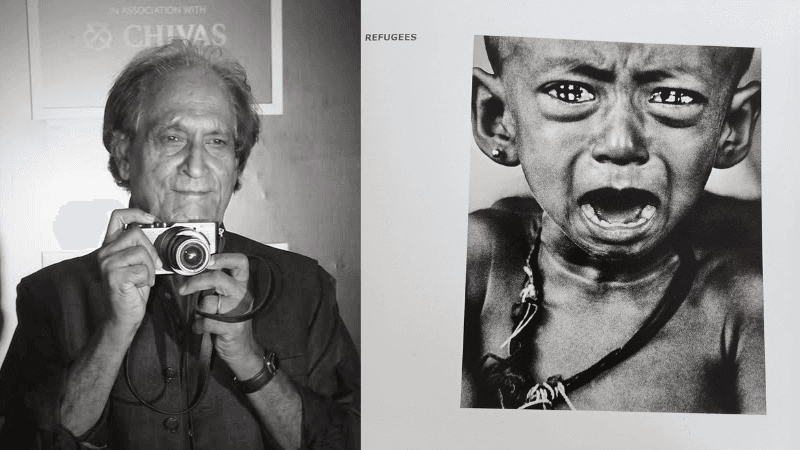
History is often written with words—but sometimes, a single photograph speaks louder than any chronicle. Few understood this better than legendary Indian photojournalist Raghu Rai, whose camera framed not just events, but the emotional and human epic of Bangladesh’s Liberation War in 1971.
Rai, born on 18 December 1942 in Jhung, then British India, initially trained as a civil engineer and worked in government service before turning to photography—a decision that would define his life and legacy. By 1965, he had joined 'The Statesman' in Delhi as chief photographer, a role that placed him at the heart of one of South Asia’s most defining historical moments.
During the Liberation War, he travelled across refugee camps in India and documented, through his lens, the unimaginable hardship and suffering endured by Bangladeshi refugees.
Risking his own life, he also entered then-East Pakistan during the conflict, capturing frontline scenes of freedom fighters in battle, their victory march after liberation, the emotional return home, and the historic surrender of the Pakistani forces.
These photographs stand today as an invaluable visual archive of Bangladesh’s Liberation War, while also earning him international recognition and establishing his reputation as a photographer of global distinction.
Capturing a Nation in Flames
From August to December 1971, Rai documented the unfolding war across border regions of India and then-East Pakistan. His images captured a nation in motion—millions fleeing violence, villages burning, skies filled with destruction, and families walking toward uncertainty in search of survival.
Yet his work was not limited to suffering alone. Rai’s lens also found resilience—young freedom fighters standing firm against a heavily armed adversary, their expressions carrying determination that would eventually shape a new nation. He also documented the historic moment of surrender at the Ramna Racecourse in Dhaka on 16 December 1971, a turning point in world history.
Each frame he produced went beyond reportage. It became testimony—of pain, courage, displacement, and ultimately, victory.
From Newsprint to Global Recognition
Rai’s 1971 work transformed war photography into something deeper—human narrative. While initially published as news images in 'The Statesman', they soon transcended journalism and entered the realm of visual storytelling.
His work caught the attention of legendary French photographer Henri Cartier-Bresson, who was deeply moved by Rai’s exhibition in 1971. Cartier-Bresson later nominated him to Magnum Photos, one of the world’s most prestigious photography collectives—placing him among the global elite of photojournalism.
Loss, Recovery, and Legacy
Much of Rai’s original negatives from 1971 were later lost after administrative changes at his newspaper archive. However, efforts by the Liberation War Museum and later exhibitions in Dhaka helped recover and preserve parts of this visual history, ensuring that his work continued to speak to future generations.
Over his career, Rai received numerous honours, including India’s Padma Shri (1972), the French government’s Officier des Arts et des Lettres (2009), and recognition as Photographer of the Year (1992) in the United States.
Final Frame
Raghu Rai passed away on April 26, 2026 in New Delhi at the age of 83, marking the end of a remarkable era in documentary photography.
But his images remain—silent yet powerful witnesses to history. His photographs of 1971 are not merely records of war; they are enduring portraits of human endurance, national birth, and collective memory. From refugee columns to battlefield resolve and the jubilant return of a nation’s founding leadership, Rai preserved Bangladesh’s liberation in light and shadow.
The camera may now fall silent. But what it captured will continue to speak—long after history itself fades into time.
Leave A Comment