
Let children's education not be interrupted by floods
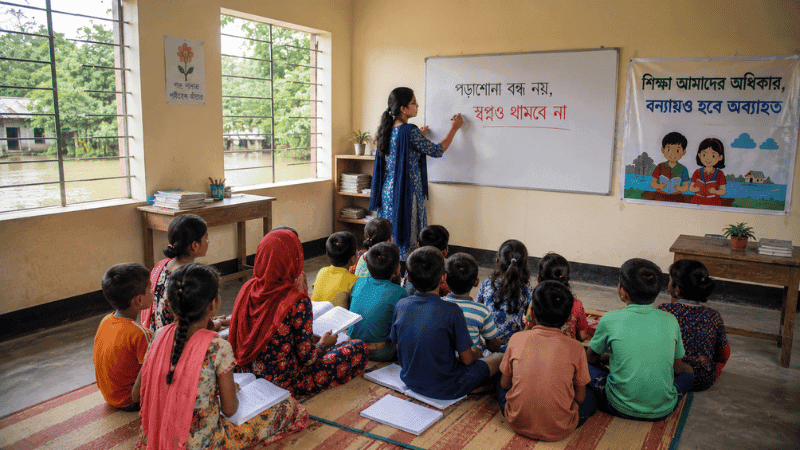

The people of Bangladesh are no strangers to floods. Every monsoon, rivers swell, sandbars disappear beneath rising waters, roads are cut off, and thousands of families seek refuge in emergency shelters. Yet behind this familiar scene unfolds another silent crisis every year—one that receives far less attention. It is the disruption of children's education. When schools remain closed for weeks or even months, the damage extends far beyond missed lessons. It undermines an entire generation's ability to learn, erodes their confidence, and jeopardizes their future.
Over the past several decades, Bangladesh has made remarkable progress in disaster management. Early warning systems for cyclones, the construction of cyclone shelters, and improvements in disaster response have all earned international recognition. However, the country still faces significant shortcomings in making its education system resilient to disasters. When floods strike, schools are often forced to close. Many school buildings are converted into emergency shelters, communication between teachers and students is disrupted, and classroom instruction is suspended indefinitely. Even after schools reopen, effective measures to compensate for lost learning are rarely implemented.
This challenge is no longer an isolated problem. It is becoming increasingly severe as climate change intensifies. According to UNICEF's latest analysis, climate-related disasters disrupted the education of approximately 33 million children in Bangladesh in 2024 alone. Bangladesh ranks among the world's most severely affected countries. In some areas, schools remained closed for a few days; in others, for several weeks; and in certain regions, regular classroom teaching was suspended for up to eight weeks. Climate disasters are no longer destroying only homes—they are also taking away children's classrooms.
Data from various United Nations agencies indicate that more than half of Bangladesh's children live in areas vulnerable to river flooding. Every monsoon, millions of children reside in places where reaching school becomes nearly impossible. Beyond damage to school buildings, textbooks and learning materials are destroyed, educational supplies are lost, and many families are displaced. Under such circumstances, securing food, safety, and livelihoods naturally takes precedence over education. Consequently, many children never return to school.
Bangladesh has long struggled with high dropout rates at both primary and secondary levels. Floods further aggravate this challenge. Children who remain out of school for extended periods often become involved in child labour to support their families. Others begin working permanently, while adolescent girls face heightened risks of child marriage. Thus, a natural disaster gradually evolves into a broader crisis encompassing education, livelihoods, health, and social protection.
During the devastating floods of 2024, more than two million children in eastern Bangladesh were directly affected. Hundreds of thousands of students in Sylhet and the northeastern regions were unable to attend school for prolonged periods. Many schools served as emergency shelters, making the suspension of classes unavoidable. Although this decision was necessary from a disaster management perspective, the absence of alternative learning arrangements meant that children paid the highest price.
Globally, there is now widespread recognition that education is not a luxury—it is a fundamental right, even during emergencies. Consequently, UNICEF, UNESCO, and other international humanitarian organizations are placing increasing emphasis on the concept of Education in Emergencies. This approach seeks to ensure that children's learning does not come to a complete halt during disasters. Prolonged absence from school significantly reduces the likelihood that children will regain their previous learning trajectory.
Against this backdrop, Bangladesh's educational planning requires a fundamental transformation. The central question is no longer simply how long schools should remain closed during floods, but rather how children's learning can continue even when school buildings are inaccessible. In the era of climate change, this will become one of the defining challenges for education policy.
Yet the most profound consequences of floods are often invisible. Statistics can measure how many schools were inundated, how many days classes were suspended, or how many students were affected. What they cannot easily quantify is the hidden learning loss that accumulates over time. Weeks or months outside the classroom not only create gaps in the curriculum but also weaken children's learning pace, confidence, cognitive development, and long-term educational prospects.
Educational experts have consistently argued that once learning continuity is broken, restoring it is extremely difficult. Research by the World Bank, UNESCO, and UNICEF shows that prolonged school closures caused by disasters reduce children's literacy and numeracy skills, diminish their motivation to learn, and significantly increase the likelihood of dropping out. Children from poor households, river islands, wetlands, coastal regions, and erosion-prone communities suffer the greatest consequences. When families lose their livelihoods, they are often compelled to send children to work instead of back to school. Adolescent girls face increased risks of early marriage. As a result, natural disasters deepen educational inequality, poverty, and social disparities.
This reality has transformed educational planning worldwide. Previously, repairing damaged schools and resuming classes after disasters were considered sufficient. Today, the focus has shifted toward building climate-resilient education systems—systems capable of maintaining educational continuity despite floods, cyclones, or other emergencies. UNESCO has advised climate-vulnerable countries, including Bangladesh, to integrate climate risk considerations into every level of educational planning.
Experiences from other countries offer valuable lessons. Flood-prone regions in the Philippines, Vietnam, and India have established temporary learning centres, community-based teaching initiatives, emergency education kits, and rapid education recovery programmes. Even when schools are closed, lessons continue in community centres, places of worship, or other safe buildings. Emergency education kits containing textbooks, notebooks, and essential learning materials are prepared in advance. The common objective is to ensure that children do not remain disconnected from learning environments for extended periods.
Bangladesh is not starting from scratch. For years, the country's floating schools have attracted international recognition. By transforming boats into classrooms, these initiatives have demonstrated that geographical barriers need not prevent children from learning. However, such programmes remain limited in scale. Their successful experience should now be institutionalized and expanded across flood-prone districts as an integral component of national education planning.
Alternative approaches to learning must also become more practical. Relying exclusively on online education is unrealistic because electricity and internet connectivity often remain unavailable for extended periods in remote regions. Therefore, offline digital content, educational programmes delivered through radio and television, mobile learning centres, small community learning groups led by local teachers and volunteers, and the pre-positioning of educational materials should all form part of disaster preparedness. Educational continuity cannot be improvised after a disaster—it must be planned beforehand.
Another critical issue deserves equal attention. Reopening schools after floodwaters recede does not automatically restore learning. Many students return having fallen behind academically, lost motivation, or experienced fear, anxiety, and psychological trauma. Consequently, Learning Recovery and Psychosocial Support have become internationally recognized pillars of post-disaster educational recovery. Without remedial classes, flexible assessment methods, mental health support, and targeted programmes to address learning gaps, educational losses cannot be fully repaired.
For Bangladesh, these are no longer future aspirations but immediate necessities. Scientists overwhelmingly agree that climate change will make floods more frequent and more severe. Protecting children's education, therefore, is no longer solely the responsibility of the Ministry of Education. It has become a central component of national disaster management, climate adaptation, and human capital development.
The country's first priority should be to stop viewing floods merely as seasonal disasters and instead incorporate them into mainstream educational planning. Just as early warning systems, shelters, and rescue operations are now integral to Bangladesh's disaster management framework, a comprehensive Education in Emergencies strategy must become a permanent part of the education sector. Such a framework should encompass preparedness before disasters, continuity of learning during emergencies, and rapid learning recovery once conditions improve.
Achieving this will require effective coordination among the Ministry of Education, the Ministry of Primary and Mass Education, the Ministry of Disaster Management and Relief, local government institutions, and district and sub-district administrations. Every flood-prone school should have its own risk assessment, contingency teaching plan, system for safeguarding educational materials, and roadmap for reopening as quickly as possible. Teacher training programmes should also include disaster-responsive teaching methods, psychosocial support for students, and techniques for assessing learning loss.
School infrastructure also demands renewed attention. Constructing buildings alone is insufficient in areas that experience annual flooding. Schools must gradually be transformed into climate-resilient facilities capable of serving as safe learning spaces during emergencies. Depending on local conditions, this may involve raising building foundations, constructing multi-purpose structures, or expanding floating schools and boat classrooms. An effective education policy must recognize and adapt to a country's geographical realities.
Responsibility for protecting children's education does not rest solely with the government. Families, local communities, elected representatives, volunteer organizations, development partners, and the media all have essential roles to play. Society must recognize that education is as vital during disasters as food, clean water, and healthcare. Although educational disruption may not appear catastrophic in the short term, its consequences become painfully evident years later in the nation's development.
Bangladesh has set an ambitious goal of becoming a developed, knowledge-based nation by 2041. Today's children are the country's greatest asset in achieving that vision. However, if millions of children continue to experience repeated educational disruption due to annual flooding, realizing that aspiration will become increasingly difficult. Climate adaptation is not limited to building embankments, dredging rivers, or expanding shelters; safeguarding children's right to learn is an equally essential part of the struggle.
Bangladesh has successfully overcome numerous challenges in the past. Significant achievements in primary school enrolment, girls' education, free textbook distribution, and disaster management demonstrate the country's capacity for progress. Building on these successes, Bangladesh must now develop an education system capable of withstanding the impacts of climate change. Schools may close temporarily, but a child's learning should never come to a standstill.
Floodwaters eventually recede, and damaged homes can be rebuilt. However, the learning opportunities lost by a child who spends months outside the classroom can never be fully recovered. Therefore, alongside food security, shelter, healthcare, and emergency relief, ensuring continuity of education must become a top national priority in disaster preparedness. Protecting a child's education today means protecting Bangladesh's future tomorrow.
Leave A Comment