
Marriage and divorce records to become accessible with a single click
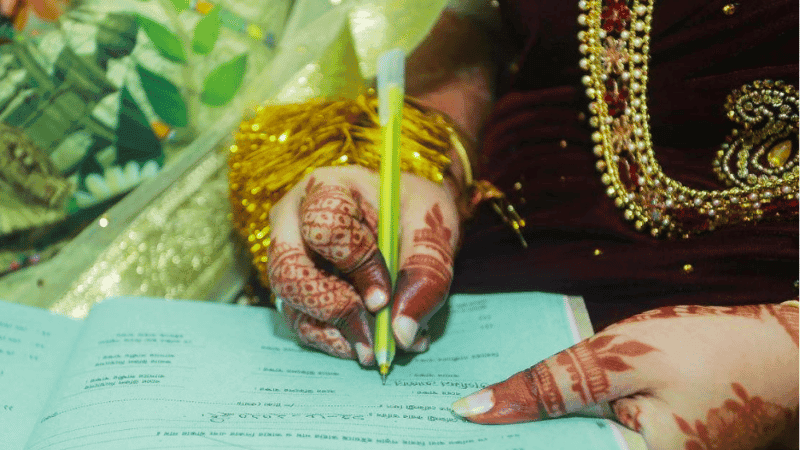

Marriage marks the beginning of a new chapter in life. Divorce, on the other hand, can bring that chapter to an abrupt end. Both are deeply significant events in a person's life. Yet for years, official records of such events have largely remained confined to paper registers and handwritten documents.
That has created scope for complications involving concealed information, forged certificates, manipulation of age records and multiple marriages. Now, the traditional system is set to undergo a major transformation as marriage and divorce registration moves into the digital realm. An online registration system is being introduced to help prevent child marriage, polygamy, forged marriage certificates and other forms of fraud related to marriage.
According to sources at the Ministry of Law, the first phase of the digital marriage and divorce registration system will be launched in October.
Initially, online registration will begin in 102 unions across 10 upazilas in 10 districts. From January 2027, marriage and divorce records will gradually be brought under a nationwide digital system and made available online.
The new system will allow people to verify marriage and divorce records more quickly and obtain digital certificates.
A source at the Law and Justice Division's Judicial Branch-7 told Views Bangladesh that the process of bringing all records related to Nikah (marriage) and divorce registrars across Bangladesh under digitalisation is nearing completion.
The system will also cover matters related to determining the fees and commissions of Nikah and divorce registrars, as well as resolving disputes that may arise in connection with their activities. Work to publish the laws and regulations governing Muslim marriage and divorce registration online is also nearing completion.
The 10 upazilas selected for the pilot project are Kaliganj in Gazipur, Tungipara in Gopalganj, Jhenaigati in Sherpur, Kurigram Sadar, Sundarganj in Gaibandha, Narail Sadar, Kasba in Brahmanbaria, Sylhet Sadar, Chakaria in Cox's Bazar and Kishoreganj Sadar.
After assessing the experience gained and technical capacity in these areas, all districts, upazilas and unions will gradually be brought under the same system.
The initiative is being implemented under the Law and Justice Division of the Ministry of Law through a project titled “Civil Registration and Vital Statistics: Development of ICT Infrastructure for Marriage and Divorce Registration.”
Law Minister Md Asaduzzaman told Views Bangladesh that incidents of polygamy, child marriage and forged marriage certificates, among other forms of fraud, continue to occur.
“To prevent such incidents from happening, the government is introducing a digital system for marriage and divorce registration. The first phase will be implemented in October,” he said.
Criticising previous governments, he said, “We have been told that digital systems have been introduced in every sector of the country. So why has such an important matter as marriage and divorce remained neglected? Why did nobody notice this until now?”
He said the government wanted to move forward by embracing innovative ideas that could serve the public interest.
“We want to move ahead. Whenever an innovative idea comes before us, we want to embrace it and move towards public welfare. That is our goal,” he said.
The minister said the government had also begun working at the grassroots level to prevent child marriage and protect women's rights.
“As part of this initiative, age and identity will be verified through interconnection with the National Identity Card and birth and death registration databases. This will make it easier not only to prevent child marriage but also to identify and prevent secret marriages, polygamy and various forms of fraud,” he said.
The system will also allow marriage and divorce information to be stored in real time and provide digital certificates more quickly.
A joint secretary of Judicial Branch-7 of the Law and Justice Division told Views Bangladesh that around 97 percent of the development work on the online marriage registration software had been completed.
A cloud server has been allocated from the National Data Centre, while API connections have been established with the birth and death registration and NID databases. Sonali Bank's payment gateway and biometric devices have also been connected on a trial basis.
He said approximately Tk 110 million was being spent on implementing the pilot project in the 10 upazilas.
Creating a database of marriage and divorce records accumulated so far across the country and bringing all previous and future records under the digital system could cost around Tk 5 billion, he added.
The digital system will not merely make it easier to obtain certificates. It will also expand the ability to verify an individual's marital status. This could make it easier to detect complications such as secretly entering into a second marriage, using a false identity or concealing a previous divorce before marrying again.
Those involved in the initiative believe the system could play an important role, particularly in protecting women's rights and ensuring legal safeguards.
From the dusty pages of paper registers to the digital screens of cloud servers, the transformation of marriage and divorce registration is therefore more than a technological upgrade. It is closely connected with family security, women's rights, child protection and the rule of law.
The question now is how effectively this digital vision, outlined on paper, can become a system that is truly transparent, fast and accurate in practice.
Leave A Comment