

Measles disaster in Rajshahi: Bureaucratic stagnation or structural violence
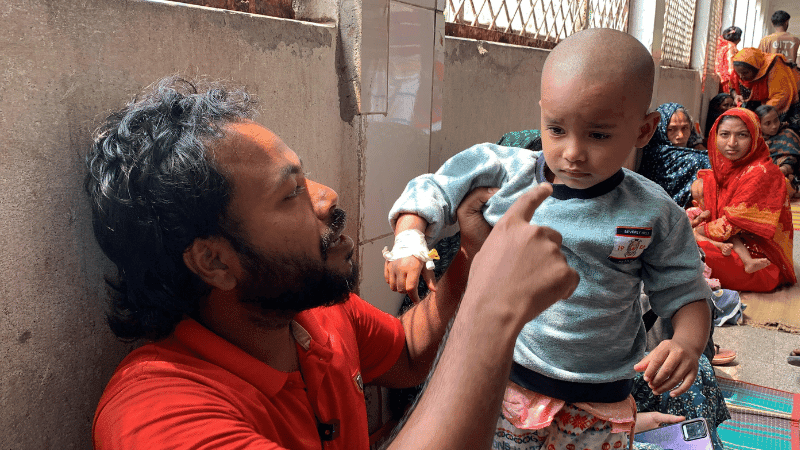

Measles — medically defined, it is a highly contagious virus that is entirely preventable. However, in the current context of Rajshahi, this term has transcended its clinical meaning — it has evolved into a testament to systematic administrative failure. Over the past month and a half, more than 53 children have succumbed to complications from the disease at Rajshahi Medical College (RMC) Hospital. Reports from the state-run news agency BSS and major media outlets indicate that 44 lives have been lost to measles within a mere two weeks. Furthermore, in the 48 hours leading up to the completion of this article, three more innocent children have tragically passed away while waiting in lengthy ICU queues. Rajshahi on the verge of an epidemic A laboratory investigation by the World Health Organization reveals that the measles positivity rate in this area currently stands at 29.4 percent. According to epidemiological standards, a measles detection rate exceeding 5 percent is classified as an 'epidemic threshold' or an emergency. A detection rate nearing 30 percent indicates that our public health system is inadequately prepared to confront this virus. The international medical research journal The Lancet characterizes a measles outbreak as the ‘litmus test’ for any nation’s public health infrastructure. The situation in Rajshahi starkly illustrates our failure to achieve 95 percent mass vaccination coverage, resulting in a significant generation of unvaccinated children who lack immunity to the disease. In response to this crisis, discussions are underway regarding the importation of emergency vaccines valued at Tk 661 crore. However, the core principle of public health policy dictates that preventive measures should be implemented before any lives are lost. Recent data indicates that this substantial vaccination gap has arisen due to prolonged stagnation in vaccination initiatives at the grassroots level and frequent alterations in operational strategies. Announcing a budget amidst a backdrop of deceased individuals is merely a belated response.
Another killer beside the virus — bureaucratic stagnation
In conjunction with the virus, another lethal factor has emerged in Rajshahi — our indecisive bureaucratic system. While young children struggle for oxygen on the damp floor of the children's ward at Rajshahi Medical College Hospital, merely a few kilometers away on the Berhampur City Bypass stands a fully equipped specialized children's hospital constructed at a cost of Tk36 crore. Yet, a substantial lock hangs at its entrance. What is the reason for this? The hospital's manpower structure file remains ensnared in the bureaucratic maze of the Ministry of Finance and Public Administration. However, the measles virus does not wait for any official sanction. Sections 14 and 16 of the 'Communicable Diseases (Prevention, Control and Eradication) Act, 2018' empower the state to utilize any infrastructure during an emergency. Yet, without exercising that authority, children afflicted with measles are being housed alongside healthy children in the general ward of RMCH — this is accelerating the spread of the disease and creating a dire infection trap. This situation is not merely mismanagement; it constitutes a blatant violation of the child's right to health protection as enshrined in Article 18(1) of our Constitution and Article 24 of the UN Convention on the Rights of the Child. Where the Health Minister himself has expressed his outrage at the hospital director over the death of a child due to a lack of ventilators, the failure to utilize the locked hospital next door represents an inexcusable administrative failure. Is death truly 'natural'? The death certificates of the three children who perished in the last 48 hours due to the absence of ICU facilities may have recorded 'measles' or 'complicated pneumonia'. However, from a sociological and modern human rights perspective, this is fundamentally a form of 'structural violence'. Political scientist Johann Galtung stated that when a life is lost due to the indecisiveness of the system, despite the availability of adequate infrastructure and resources to save that life, it cannot be classified as a 'natural death'. This is a loss of life due to state negligence - which is identified as 'state negligence' in the international arena.
This crisis in Rajshahi serves as a stark illustration of our reactive governance. The local administration only takes action when the media highlights the death toll. We have established a system where the tendency to evade responsibility post-crisis is more pronounced than the efforts for prevention and treatment, which are overshadowed by the reluctance to accept accountability. The allure of grand infrastructure projects and impressive growth figures cannot mask the tragic loss of a child's life. When the state constructs a specialized hospital yet allows children to perish on the floor by locking its doors, it reveals a system that is not only ineffective but also morally bankrupt. Immediate actions required There is no way to obscure the outcry from Rajshahi through statistical manipulation or the superficial appeal of buildings. The state must confront the moral dilemma of whether a bureaucratic file holds more weight than the lives of 53 children. The lock on Baharampur Hospital must be removed without delay. It is imperative to establish at least one specialized measles isolation and ICU unit through urgent ad-hoc appointments. We must acknowledge that each child's death signifies a failure in our public health system. This heartbreaking situation in Rajshahi should provoke a moral reckoning among our policymakers. Just as we must not be consumed by a culture of impunity, we must also resist the temptation to ignore this crisis. Today, we make this singular request to the state: if indecision today results in the loss of many more lives tomorrow, this generation will be held accountable in the annals of history.
Author: Shamiul Alim, rights activist and writer; President, Youth Action for Social Change (YASC)
Leave A Comment
You need login first to leave a comment