
Messi’s fairytale ends in New Jersey as 'La Roja' lifts World Cup
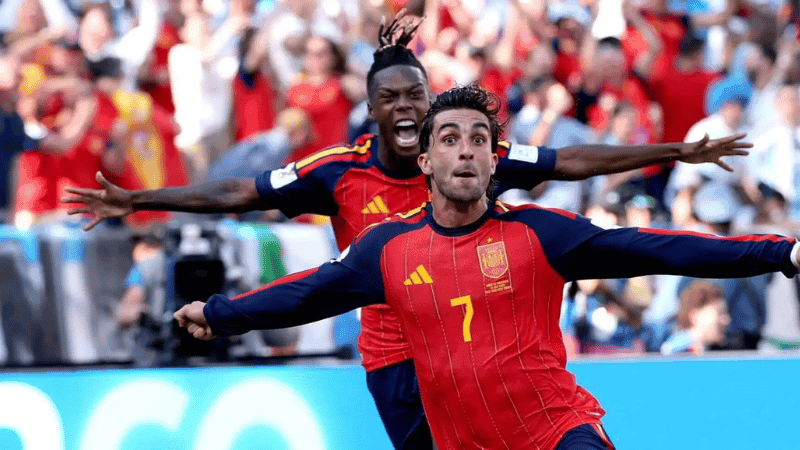

Spain captured their second World Cup title, defeating Argentina in extra time at MetLife Stadium in a match that mirrored their historic 2010 breakthrough on Sunday. Substitute Ferran Torres secured the championship for the Spaniards, netting the game's only goal in the 106th minute to deny Lionel Messi and Argentina a consecutive world title.
Spain controlled the tempo throughout the contest, stifling an Argentinian offense that failed to register a single shot in the first half. The 39-year-old Messi was largely neutralized by the Spanish defense, managing only one touch during the opening 15 minutes of play, which came directly from the initial kick-off. Spain's dominant performance was momentarily paused by a lengthy, 27-minute halftime entertainment show featuring performances by Madonna, BTS, Justin Bieber, and Shakira.
Argentina's difficulties compounded late in regulation when midfielder Enzo Fernandez was sent off after receiving a second yellow card for a challenge that sent Spanish defender Pau Cubarsi airborne. Down to ten men heading into the 30-minute extra-time period, Argentina succumbed to intense Spanish pressure.
While Spain had an initial extra-time goal disallowed due to a foul called against Argentina's Nicolas Otamendi, Torres ultimately capitalized on the man advantage. The forward beat goalkeeper Emiliano Martinez to finish a well-executed team move, sealing the victory and crowning Spain as world champions once again.
The moment Spain won it
Spain's relentless offensive pressure finally broke through a resilient Argentinian defense in the 106th minute of extra time, securing their second World Cup title after unleashing 20 shots over the course of the match. The Spanish side maintained one-way traffic throughout the contest, an advantage that only intensified after Argentina was reduced to 10 men. Despite Argentina's persistent attempts to disrupt the tempo through fouls and stalling tactics, Spain avoided a penalty shootout with a late tactical breakthrough.
The decisive moment mirrored Spain's previous tournament victories against Belgium and France, with Pedro Porro once again delivering a pivotal contribution. Porro sent a deep cross to the back post, where Nico Williams directed a precise header back across the area. Substitute Ferran Torres met the ball cleanly, driving his shot past a diving Emiliano Martinez to seal the championship.
The victory capped a tournament progression where Spain consistently improved as a collective unit, highlighted by an earlier elimination of tournament favorites France. Relying on a balanced team system rather than individual dependence on star player Lamine Yamal, the newly crowned champions finished the campaign boasting the tournament's top defensive record, having conceded only a single goal throughout the competition. The triumph closely mirrors Spain's inaugural 2010 World Cup title, where they similarly overcame an aggressive opponent to score the decisive goal in extra time.
A bleak ending to Messi’s World Cup career?
Lionel Messi's pursuit of a fairytale international finale ended in frustration at MetLife Stadium, as the Argentine captain was thoroughly neutralized by a disciplined Spanish defense during Sunday's World Cup final. A decade after briefly retiring from international duty at the same venue following the 2016 Copa América final, Messi was unable to alter the course of the match, leaving Argentina without a secondary offensive solution.
The 39-year-old forward spent the vast majority of the 90 minutes isolated upfront while Spain controlled possession. His most notable contribution in regulation occurred shortly after Enzo Fernández’s red card, when he unsuccessfully appealed to the referee regarding an exchange with Spain's Marc Cucurella.
Despite delivering several standout performances earlier in the tournament, Messi failed to significantly impact the final. His singular notable scoring opportunity arrived deep into extra time, but the attempt was blocked before reaching Spanish goalkeeper Unai Simón. The quiet outing marks a stark contrast to Messi's historic second act with the national team, which previously secured a World Cup and two Copa América titles.
How much did Fernandez’s red card cost Argentina?
A rapid sequence of disciplinary errors by midfielder Enzo Fernández severely compromised Argentina's World Cup defense, culminating in a critical red card that forced his team into a desperate defensive formation before their extra-time defeat. The Chelsea midfielder received two yellow cards in just over ten minutes, reshaping the tactical landscape of the final.

Fernández received his first caution for dissent after losing possession to Spanish midfielder Rodri in the center circle. Following an unsuccessful appeal for a foul, Fernández reacted aggressively toward referee Slavko Vinčić, who promptly issued a yellow card.
The definitive blow came during stoppage time at the end of regulation when Fernández committed a reckless challenge on Spain defender Pau Cubarsi. Despite Cubarsi being the favorite to reach a loose ball, Fernández failed to withdraw from the challenge, sending the Spanish defender airborne and earning a second yellow card.
The dismissal forced Argentina manager Lionel Scaloni to drastically alter his tactical setup. Forward Julián Álvarez initially dropped deeper into midfield before Scaloni introduced an extra defender during extra time, leaving an isolated Lionel Messi alone upfront. The tactical shift left Argentina playing for a penalty shootout, a strategy that ultimately collapsed when Ferran Torres scored the game-winning goal for Spain.
How did it take until the 41st minute for the referee to show a yellow card?
The officiating of the World Cup final, led by referee Slavko Vinčić, faced scrutiny following a match defined by a controversial early leniency that gave way to a pivotal second-half dismissal. Vinčić initially adopted a restrained approach, but his decision-making regarding Argentina’s disciplinary issues became a focal point of the contest.

Early in the first half, Argentina midfielder Alexis Mac Allister escaped a booking after a reckless, two-footed challenge on Spain's Dani Olmo in the 15th minute. Despite the severity of the tackle, which arguably warranted a yellow card, Vinčić opted not to intervene, a choice that risked undermining his authority early on. Shortly after, Argentina’s Nicolas Tagliafico also avoided a caution despite executing a clumsy, deliberate foul on Lamine Yamal, escaping only because of the nearby positioning of Lisandro Martinez.

The first yellow card of the match was finally issued in the 41st minute, when Martinez was cautioned for a clear tactical foul to stop a Spanish counter-attack.
Managing a major final requires a delicate balance between maintaining control and allowing the game to proceed, yet the match inevitably reached a turning point regarding player conduct. Enzo Fernández, already on a yellow card for earlier dissent, was forced off the pitch after a high-speed challenge on Spain’s Pau Cubarsi. While the force of the collision sent the Spanish defender airborne, Vinčić correctly identified the challenge as a second yellow card offense rather than a straight red, as the point of contact remained low and Fernández's studs were directed downward. The dismissal underscored the referee’s struggle to maintain discipline in a match where initial leniency potentially emboldened reckless play.NEW YORK — The officiating of the World Cup final, led by referee Slavko Vinčić, faced scrutiny following a match defined by a controversial early leniency that gave way to a pivotal second-half dismissal. Vinčić initially adopted a restrained approach, but his decision-making regarding Argentina’s disciplinary issues became a focal point of the contest.
Early in the first half, Argentina midfielder Alexis Mac Allister escaped a booking after a reckless, two-footed challenge on Spain's Dani Olmo in the 15th minute. Despite the severity of the tackle, which arguably warranted a yellow card, Vinčić opted not to intervene, a choice that risked undermining his authority early on. Shortly after, Argentina’s Nicolas Tagliafico also avoided a caution despite executing a clumsy, deliberate foul on Lamine Yamal, escaping only because of the nearby positioning of Lisandro Martinez.
The first yellow card of the match was finally issued in the 41st minute, when Martinez was cautioned for a clear tactical foul to stop a Spanish counter-attack.
Managing a major final requires a delicate balance between maintaining control and allowing the game to proceed, yet the match inevitably reached a turning point regarding player conduct. Enzo Fernández, already on a yellow card for earlier dissent, was forced off the pitch after a high-speed challenge on Spain’s Pau Cubarsi. While the force of the collision sent the Spanish defender airborne, Vinčić correctly identified the challenge as a second yellow card offense rather than a straight red, as the point of contact remained low and Fernández's studs were directed downward. The dismissal underscored the referee’s struggle to maintain discipline in a match where initial leniency potentially emboldened reckless play.
How did Spain stop Messi — and Argentina?
Spain successfully neutralised Argentina's attacking threat by implementing an aggressive defensive strategy that effectively starved Lionel Messi of the ball throughout the World Cup final. The tactical masterclass marked the first time any opponent managed to completely isolate the tournament's standout player, which subsequently crippled the rest of the Argentine offense.
Messi was limited to just 15 touches in the first half, registering his lowest involvement in a single half across the last three World Cups. His pass from the opening kick-off served as his singular contribution during the first fifteen minutes of play.
Spain executed a high defensive line to condense the pitch, taking advantage of the 39-year-old forward's diminished pace. This proactive positioning was demonstrated early in the match when Spanish goalkeeper Unai Simón sprinted to the center circle to intercept a potential through-ball intended for Messi.
By maintaining dominant possession and applying immediate pressure upon losing the ball, Spain disrupted Argentina’s ability to find their captain in dangerous pockets of space. When Messi did manage to receive the ball on the turn in midfield prior to the first-half hydration break, Spanish midfielder Rodri immediately intercepted him to concede a tactical foul.
Spain also successfully anticipated Messi's signature tactical shift to the right flank—a maneuver he had previously used to turn games against England and Egypt—by consistently deploying two defenders to crowd him out. The performance underscored a collective defensive triumph for Spain, who nullified the Argentine captain by suffocating his supply line rather than merely containing his individual movements.
Was Rodri the most influential player at the World Cup?
Spain midfielder Rodri delivered a commanding performance to anchor his side's World Cup final victory over Argentina, solidifying his status as the tournament's most influential tactical and technical performer. The 30-year-old Manchester City midfielder controlled the tempo from the center of the pitch, effectively neutralizing Lionel Messi and orchestrating a dominant Spanish offense that held Argentina to zero shots on goal late into regulation.

The 2024 Ballon d’Or winner consistently disrupted Argentina’s play throughout the match, executing a crucial tactical interception near the halfway line and utilizing a strategic shirt-tug to halt a potential breakaway by Messi. In possession, Rodri served as a constant outlet for his teammates, initiating a fluid first-half passing sequence alongside Dani Olmo and Fabián Ruiz that resulted in a scoring opportunity for Mikel Oyarzabal.
Argentina attempted to break Rodri's grip on the match through physical play, which escalated in the second half when Leandro Paredes was cautioned for a cynical elbow to the Spanish midfielder's back. Despite the physical pressure, Rodri quickly recovered to sustain a relentless, one-way offensive assault toward the Argentinian goal. The performance capped a tournament campaign where Rodri's passing and pressing—which previously proved decisive in a semifinal victory over France—outmatched the impact of the tournament's headline-grabbing forwards.
Was a 27-minute half-time show really needed?
FIFA broke tournament tradition during Sunday's final by extending the halftime interval to a record-breaking 27 minutes and 23 seconds to accommodate a massive, Super Bowl-style musical production. Sponsored by Topps, the unprecedented entertainment showcase marked the first time in World Cup history that a halftime intermission exceeded the standard 15-minute duration.

The performance featured an array of international stars, highlighted by former Brazilian international icons Ronaldo Nazário and Ronaldinho, who drove a buggy into the stadium carrying pop star Madonna as she performed. The extensive lineup also included South Korean group BTS, Shakira, Burna Boy, Justin Bieber, the cast of Ted Lasso, The Muppets, the New York Philharmonic Orchestra, and Venezuela's Simón Bolívar Symphony Orchestra. British band Coldplay concluded the extended performance.
While the highly choreographed production was generally well-received—despite a prolonged acoustic solo from Bieber—the event offered very minimal connection to the sporting tournament itself. The football-related segments were restricted to a brief demonstration of the Norwegian row celebration and an orchestral rendition of White Stripes' "Seven Nation Army," completely omitting mentions of Spain's tournament run or Kylian Mbappé's goalscoring record. The unprecedented delay drew immediate criticism for interrupting the flow of the game, sparking calls for future tournament entertainment to be restricted to pre- or post-match slots.
Leave A Comment