

Microfinance Bank: Elegance should never override functionality
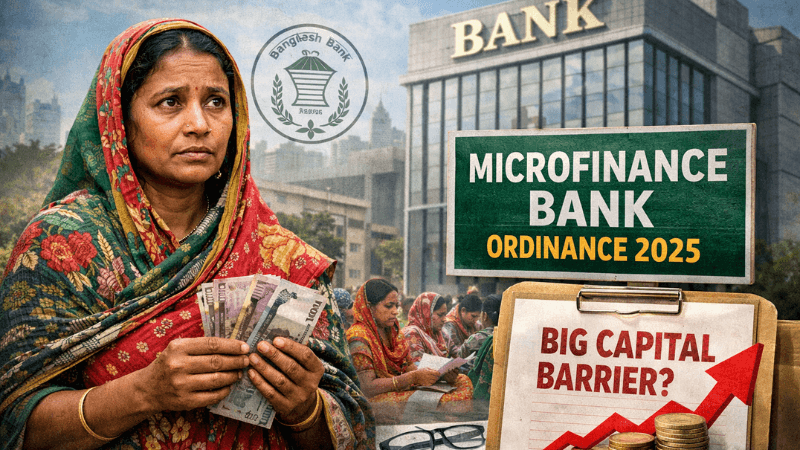

Is microfinance going to face significant constraints? This has become the primary topic dominating discussions across the global and regional microfinance sectors!
In addition to conventional banks in the country, initiatives have been taken to establish microfinance or microcredit banks for the first time in history. The draft of the 'Microfinance Bank Ordinance, 2025' has been finalized. It will be licensed by Bangladesh Bank and the bank will be run as a 'social business enterprise' - so it is said.
This idea seems to be better on papers. But the question is—will this initiative really strengthen the core philosophy of microfinance, or will it slowly erode it?
Microcredit is not a new concept in Bangladesh. For decades, NGO-run microcredit programmes have brought real changes in the lives of marginalized people in rural Bangladesh. Undoubtedly, the positive change in the lives of rural people has come about through microcredit run by the NGOs. At present there are about 3.23crore microfinance borrowers in the country, of which about 91 percent are women. Debt status is around Tk156,000 crores. This massive undertaking is not an experimental initiative; This is a field-proven reality. All of this is due to the NGOs that have worked tirelessly with the poor people in the fields, at the markets and at the ports.
Standing next to this current reality, the question must be asked now - is it really necessary to create a bank to manage microcredit?
The proposed microcredit bank has an authorized capital of Tk500 crore and a paid up capital of Tk200 crore. Shares cannot be traded, but it is said that 60 percent will come from borrower-shareholders. Even though this is said, is it possible for the marginalized or ordinary people to collect this amount in reality?
The 17 top microfinance institution, including BRAC, Asha, Bureau Bangladesh, TMSS, clearly said in a joint statement that the ordinance is not microfinance-friendly. Rather, it risks pushing out many firms by creating large capital barriers.
So the question is - who is this bank for? For ordinary people, or big entrepreneurs? Or to add new feathers to the success of the debtor culture?
According to this ordinance, the license and control of Microcredit Bank will be in the hands of Bangladesh Bank. Some trem this as positive. Economist Mustafa K. Muzeri also said that the performance can be seen with a limited number of licenses initially.
But in reality, the defaulting culture, misuse of rescheduling, financial irregularities have not stopped in the banks controlled by Bangladesh Bank. So will microfinance really be different if it comes under the same regulator?
Where microcredit is based on trust, social responsibility and regular field level monitoring - will the bank company law framework keep it free, or will it gradually be chained using paper works?
According to the ordinance, microcredit banks will be social business institutions. Shares cannot be traded, cannot be listed on the stock market—these are positive aspects for sure.
But social business is not just about giving a name. The heart of social business is purpose and management philosophy. The question is - when the bank's board of directors, entrepreneurs, regulators, management - all are used to the banking culture - then can the poor women in the field really influence the decisions? Even if there are four borrower directors, the balance of power will be on paper, not in reality—experience is not unknown to us.
According to the government statement, there will be microcredit banks along with the microcredit activities run by the NGOs. But in reality, if the two structures are side by side, where will the competition be? In the field? Among the customers? Policy making?
This is where the fear lies. If it is gradually said - there are banks, why NGOs?; Banks have license, why MRA?; There are banking structures, why social organizations?; Then the basic philosophy of microcredit will be at risk.
Development does not mean new banks, development does not mean new ordinances. Development means strengthening existing effective systems.
There is more praise than criticism for the NGO-run microfinance system, which has spread across the globe. Why an initiative in the same line as well as such a popular system? There is no denying that there can be problems with the NGO-run microfinance system. But the solution to that problem is opening a new bank? Or was it necessary to strengthen the MRA; Reconciling policy issues, if any; enhancing transparency and accountability; Regulation of excess interest charges; Strengthen customer protection? Without taking this path, suddenly entering the banking structure means putting the successful system at risk, isn't it?
Microcredit is not a banking product, rather a development philosophy based on faith. If we inject this philosophy into the culture of big capital, bank company laws and defaulters, microfinance will not survive—only the name will remain. So the question remains - small loans will not be shackled?
Author: AKM Jasim Uddin, Development Worker
Leave A Comment
You need login first to leave a comment