
Morshed Shafiul Hasan remembers Akhter Hussain
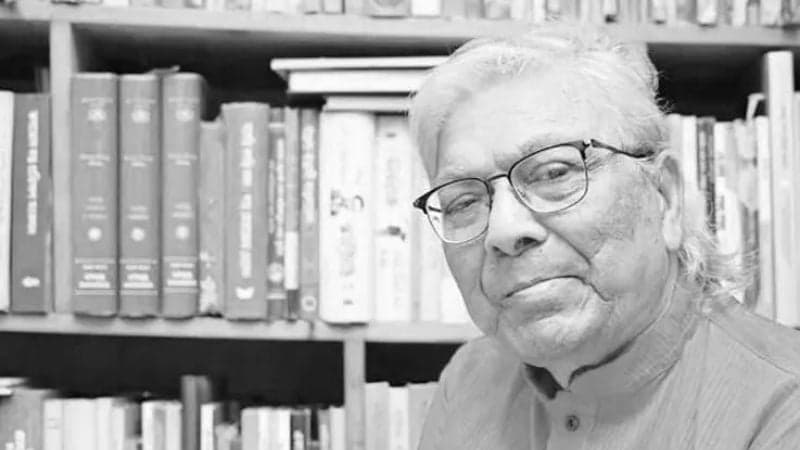

For nearly six decades, Akhter Hussain created a world of joy for children through playful rhymes, enchanting stories and inspiring songs. With his simple, lively and natural language, he coloured the childhoods of generations. His writings did not remain confined to the pages of books; they found their way into textbooks, songs and the country’s cultural movements, becoming part of people’s lives.
Alongside journalism and publishing, he was associated with progressive cultural organisations such as the Chhatra Union, Khelaghar and Udichi. During the Liberation War, his pen became an instrument of protest. His song “Swadhin Swadhin Dike Dike Jagchhe Bangalira” (“Freedom, freedom—the Bengalis are awakening everywhere”) has also made him a memorable figure in the cultural history of the Liberation War.
The creator of more than a hundred books, Akhter Hussain received numerous honours, including the Bangla Academy Award.
He had been undergoing treatment in hospital for various health complications, including a brain haemorrhage. He had also been suffering from heart disease and uncontrolled diabetes for a long time. He died at 12:45pm on Thursday (September 24) at Bangladesh Medical University in the capital, at the age of 81.
Essayist, critic, researcher and poet Morshed Shafiul Hasan has written a deeply personal remembrance of the accomplished poet, rhymester, children’s author and cultural organiser. His tribute is reproduced below in full:
Whenever someone died and their body was taken to the Shaheed Minar, Akhter Bhai would rush there. He would say, “Let me see the face one last time.” I do not remember him ever making an exception. When we were colleagues at the same workplace, he would insist that I accompany him. I never did.
I have never looked at the faces of my father, sisters or brothers after their deaths because I want to preserve the faces of the living in my memory. (I was away when my mother died.) Nor have I looked at the faces of friends or other people I knew after their deaths. Even when relatives or others pushed me forward to have a “last look”—apparently there is some religious provision concerning this, with different rules for men and women—I would, in most cases, turn my face away when I got close.
I also generally avoid using words such as “the dead” or “corpse.” Even when I attend the Shaheed Minar or a funeral prayer, I do not look at the face of the lifeless person.
But Akhter Bhai, even when he was physically unwell, would take a bus or rickshaw and hurry to the Shaheed Minar. I heard that he would spend a little more time looking at the face of someone he knew. Then, after returning, while describing the person and recalling memories, he would break down in tears. Many times, I saw him sitting alone at a table, resting his head on it and crying.
But no—I do not want to remember that tearful face of his. I want to remember the smiling face marked by the innocence of a child. That is why I could not—or perhaps did not want to—go to the Shaheed Minar today to see him one last time.
Forgive me, Akhter Bhai!
Although I cannot forgive you.
So many conversations between us remain unfinished. So much of your work remains undone.
I often urged you to break your habit of buying books. Though I was younger than you, I even scolded you quite seriously about it.
I would tell you, “What will happen to all these books when you are no longer here? You do not even have your own home; you live in a rented house.”
One of your wishes—which you often told me about—may finally be fulfilled: today, your final resting place is being prepared beside your beloved wife.
But what will happen to the vast collection of old, rare and expensive books and journals you so carefully gathered? I never had the good fortune to see the collection myself. You often spoke to me—and surely to many others as well—about your dream of building a library in the area where your own home would be.
What will become of that dream now?
Will someone come forward?
Will your heirs, or perhaps one of your admirers, followers or well-wishers, take up the responsibility?
Leave A Comment