

NASA’s Artemis II: Why humans are returning to the Moon after 53 years
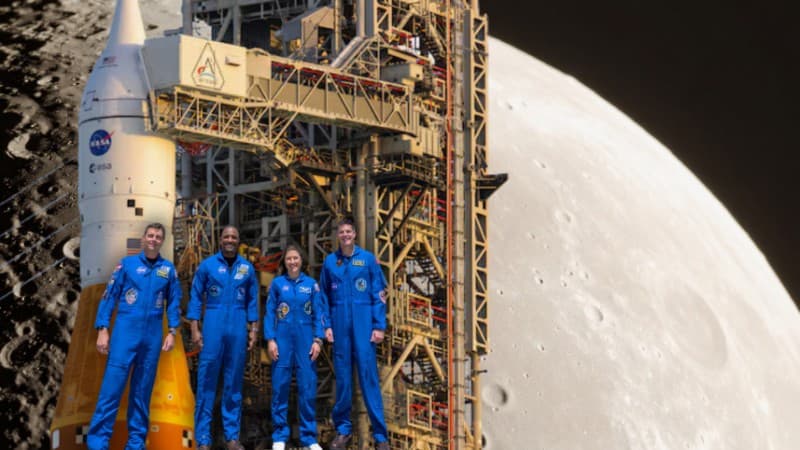

After more than five decades, NASA has launched its Artemis II mission, sending humans back towards the Moon. The four‑astronaut crew lifted off aboard the Orion spacecraft, beginning a 10‑day journey that will take them around the lunar far side and back to Earth.
The mission breaks a long silence. The last time humans flew beyond low Earth orbit was Apollo 17 in 1972. For most people alive today, this is the first time they are witnessing a crewed lunar voyage in real time.
Why go back now?
NASA has framed Artemis II as far more than a nostalgic trip. The mission is a critical test flight for new technology. The agency says it will demonstrate life‑support systems, propulsion, power and navigation aboard Orion under real space conditions. Nothing like this has been tried with a crew for over half a century.
The astronauts will pilot the capsule in Earth orbit, rehearse rendezvous procedures, and then travel about 46,000 miles beyond Earth before swinging around the Moon. The data they collect will shape future missions – starting with Artemis III, which aims to land near the Moon’s south pole in 2027, and Artemis IV, targeted for 2028.
A more diverse crew
The make‑up of the team also marks a shift. The crew includes Christina Koch and Victor Glover from NASA, alongside Jeremy Hansen from the Canadian Space Agency. Their selection reflects an effort to make deep‑space exploration more inclusive than it was during the Apollo era.
The most powerful rocket ever built
The spacecraft is being pushed by the Space Launch System (SLS), currently the most powerful rocket in operation. At launch it produces 8.8 million pounds of thrust – roughly equivalent to 160,000 Corvette engines firing at once. That raw power is what makes it possible to send humans beyond Earth’s orbit again.
4K view of the lunar surface
One noticeable upgrade from the 1960s and 1970s is the imaging technology. Artemis II carries advanced cameras capable of beaming back ultra‑high‑definition video. Instead of grainy, black‑and‑white footage, the world will see the Moon in 4K quality or better – as if viewers are sitting in the cockpit.
Stepping stone for Mars
Beyond the Moon, NASA has a larger goal. The agency views Artemis II as a vital test drive for technologies that will eventually carry humans to Mars. Every system pushed to its limit during this 10‑day flight will help prepare for an even longer journey to the Red Planet, which NASA hopes to attempt in the 2030s.
The silent race
Geopolitics is also part of the story. NASA officials have acknowledged credible competition from China, which has already landed multiple uncrewed missions on the Moon and plans to send its own astronauts there before the end of the decade. For the United States, returning to the Moon is about maintaining leadership in space as much as it is about science.
Water and a future base
There is also a practical reason to go back. Recent research has overturned old assumptions that the Moon is completely dry. Orbital missions have found ice trapped in permanently shadowed craters – water that could be used for drinking, or broken down into oxygen and hydrogen for fuel. Those resources could make it possible to build a sustained human presence on the lunar surface.
Scientists also see the Moon as a time capsule. With no atmosphere or plate tectonics to disturb its surface, it has preserved billions of years of impact history. Studying it could unlock secrets about the early solar system.
For now, Artemis II is the first step. If all goes well, what follows will be landings, a planned lunar base by the end of the decade, and eventually, a push toward Mars.
Leave A Comment
You need login first to leave a comment