

NATO'S strategic activities in East Asia
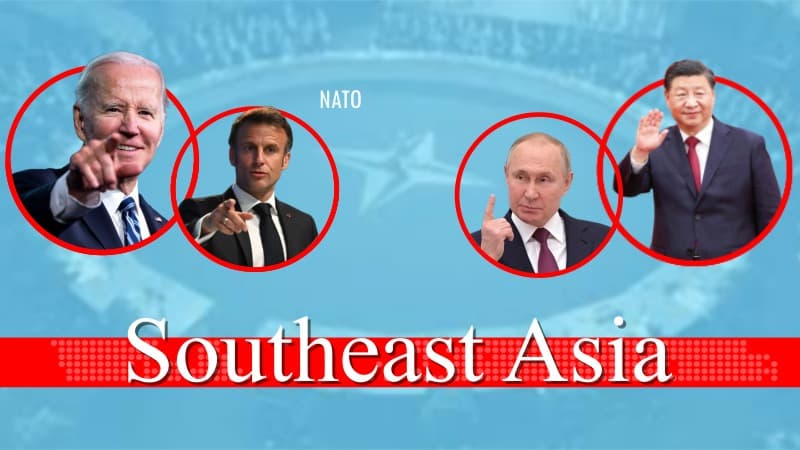

The gradual collapse of the US-led World order has been visible for decades. China's accession to the world trade organization in 2021 challenged the United States monopoly. China isn't the only country in recent years; several other countries are trying to show strength. Under Putin's revisionist leadership, Russia is also trying to return as a world power.
Putin has a close relationship with China. Tensions have reached such a high level that the G7, a coalition of wealthy countries led by the United States, recently changed the purpose of relations with China. The reality is that using trade policy as a weapon in the name of national security does not reduce geostrategic tensions, but destroys the possibility that both sides will benefit from economic relations.
In 2010, China stopped exporting two of its minerals to Japan over a territorial dispute. In 2020, China banned import from Australia after it called for an independent investigation into the origins of the Covid pandemic. Such retaliatory measures are ineffective in the ultimate sense.
Similarly, the United States has banned the export of microchips of its advanced technology to China. It's a form of economic coercion. There is no guarantee that Americans will continue to dominate the technology sector for a long time by stopping China. Nato is taking the wrong steps in East Asia to counter china's influence. Such a move could pose a major strategic threat to the European member states of the military alliance. Tensions between China and NATO are bound to escalate. At the same time, there is a risk of developing a close relationship between China and Russia.
The strategy of capturing China will bring no real benefit to Europe's security. It will inevitably serve US interests. Nato doesn't have new members from East Asia, but is pushing for strategic partnerships with 'like-minded' countries in the region. Japan, South Korea, Australia and New Zealand are in the process of entering a new level of relations from NATO'S global partners.
What NATO has named, the Individually Tailored Partnership Program (ITPP). Japan's strategic ties with NATO began to grow as Russia began to invade Ukraine. At a NATO summit in Lithuania in July, Jens Stoltenberg, the head of the western military alliance, thanked Japanese Prime Minister Fumio Kishida, saying, 'No partner is a close as Japan'. In a move to establish stronger military ties, NATO decided to open a liaison office in Tokyo, a first in Asia. But NATO is trying to hide the plan for now.
French President Emmanuel Macron warned that such a move would be a 'big mistake'. But officially expanding NATO in East Asia aims to expand cooperation on maritime security, new technologies, cyber and climate change. But in reality, the purpose of this expansion is to stop China. NATO is now openly saying that our interests, security and values are challenged.
In this meeting with Kishida, Stoltenberg expressed concern about china's massive military buildup and the modernization and expansion of nuclear power. Stoltenberg's concern will surely sound like a mantra to Kishida's cars. But it is difficult to see how Europe's security will benefit if NATO expands its military role in East Asia. On the other hand, it would specifically make Beijing hostile. China has reacted strongly to NATO's words and actions.
China fears that US allies under the same umbrella with NATO will have a more anti-China character. NATO opposed Beijing's position, saying Nato's military presence in the region was not intended for harm and was self-defense. Nato's demands do not reassure Beijing. All experts in international relations agree that it is impossible to properly understand the intentions of other states.
NATO members often accuse China of trying to change the status quo. But they do not understand or understand that NATO's actions are changing the status quo in East Asia. And this is a move that Beijing is bound to respond to.
Experts in international relations specifically point to a lack of common sense for creating such tensions. They call it a security checkpoint. If China's leaders continue to see NATO's strained relationship in East Asia as threat, they will increase military power as a precautionary measure. It will form a new alliance. In retaliation, if China now becomes closer to Russia, it will have an impact on Europe's security.
But after Russia's invasion of Ukraine, the security protocol theory can no longer be trusted. If we accept the theory of security deception, we must accept the excuse that Russian President Vladimir Putin invaded Ukraine in retaliation for NATO's expansion efforts.
Russia considered NATO expansion a threat. Europe doesn't understand the danger of expansion across a wider geography, even after the war in Ukraine. NATO'S security is directly inked to Eastern Europe, but there is no reason for its deep military involvement in East Asia. This will only increase their hostility to China.
Earlier this year, French President Emmanuel Macron rightly said that such a move would be nothing but a trap for Europe. In order to successfully eliminate geostrategic competition, national security must move away from a 'either win or lose' approach.
If we want to establish geostrategic dominance over the other side, tensions will only increase in bilateral relations and the arms race will continue. Inevitably, the result is a defeat on both sides. Self-reliance is necessary to create maximum wealth Adam Smith's strategy doesn't give a country less security.
Countries must go straight to an agreement to stop the coercive activities against other countries. They need to reach security agreements, including arms control agreements, the establishment of neutral zones. Economic coercion is ultimately an ineffective weapon.
The negative effects of industrial policy are further fueled by the divisive competition in the technology sector. Every country has an industrial policy. Take, for example, the Recent Inflation Reduction Act or the Chips and Science Act enacted by the United States. But the reality is that very few countries can finally successfully implement their industrial policies.
Most industrial policies ultimately fail to produce the desired results. The problem with industrial policy is that it is not confined to the borders of the country. When the industrial policy of a small country. The new 'unfair industrial policies and unfair trade practices' that the WTO has reached an agreement could be a way to mitigate the major risks posed by the industrial policies of large countries. To reach an agreement on arms control and industrial policy, the United States and China must first restore their broken trust relationship.
Today's Russia-Ukraine conflict is the result of the US's actions ignoring the policy obstacles of the EU's leading and industrialized countries. Other European countries could get involved, leaving the US on the other side of the Atlantic intact. That's why instead of NATO, they considered building their own European defence system.
Long after the collapse of the Soviet Union in 1991, Russian leader Putin also expressed a desire to join the European Union. Although there is no Longer a Marxist or socialist government in the Soviet system or that camp, the United States has positioned Russia or China as a model as adversaries because of its imperialist interests. Sometimes they are being used as a strategy to maintain an upcoming presidential election, military might or dominance.
Europe and the world are suffering. According to experts, countries in Europe, Asia and Africa are now in the grip of a recession overall in terms of trade and economic. The people of these regions are upset due to inflation. NATO, a Western military alliance in Europe, may one day collapse because of the imperialist or hegemonic policies of the United States. Doesn't French President Emmanuel Macron's plan to join BRICS or the prospect of breaking the monopoly of power and the dollar monopoly bear that hint?
Writer: Researcher and columnist
Leave A Comment
You need login first to leave a comment