

Stakeholders label the process as suicidal
NBR seeks to re-impose VAT exemption on metro rail
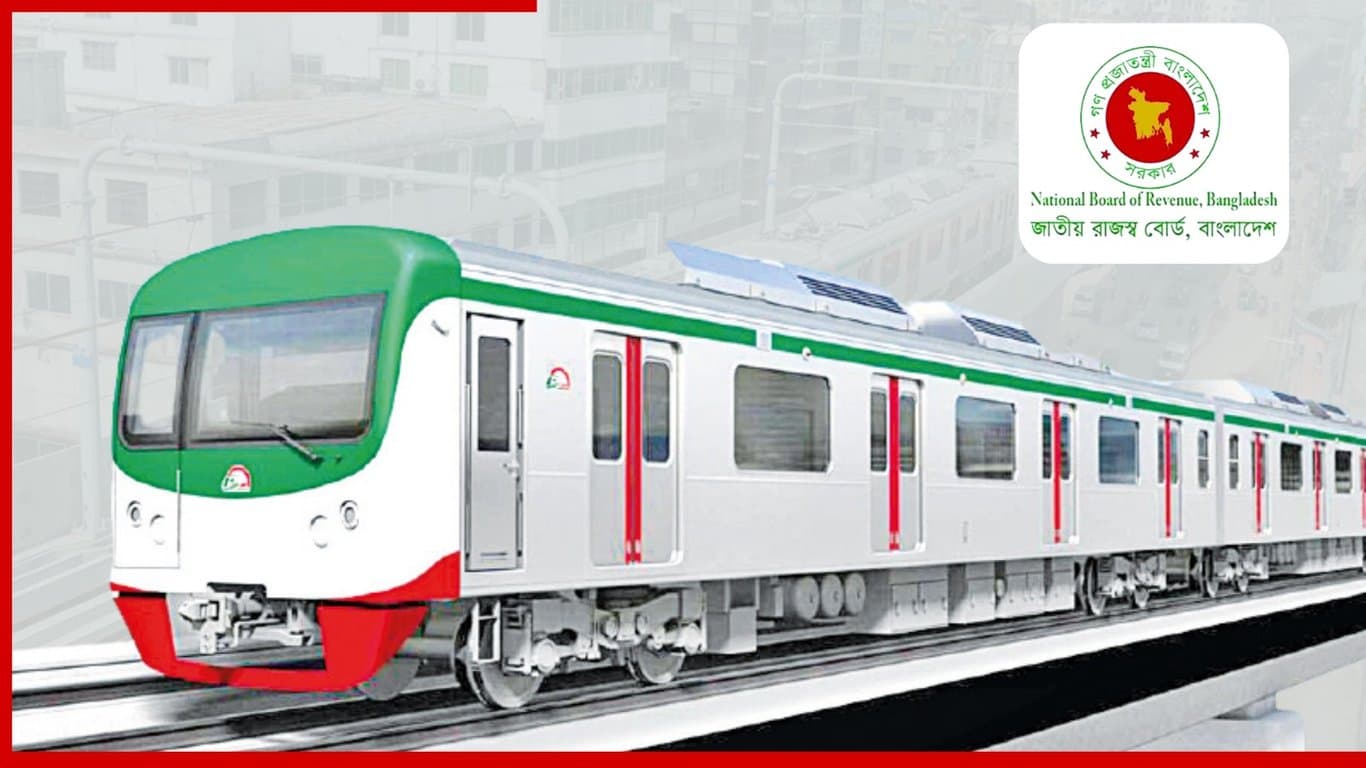

In the fiscal year 2023-24, the National Board of Revenue (NBR) exempted the Metro Rail passenger service from Value Added Tax (VAT). However, in the upcoming fiscal year 2024-25, NBR intends to lift this exemption. As a result, the ticket prices for the Metro Rail will increase, which will burden regular commuters. Those involved in this sector consider the implementation of this decision as self-destructive. However, economists have suggested policy adoption to ensure that the removal of VAT exemption does not become discriminatory.
Dhaka Mass Transit Company Limited (DMTCL) initially operated the metro rail line-6 from Uttara North Station to Agargaon, although currently it is running from Uttara North station to Motijheel station. DMTCL hopes to start operations up to Kamalapur Station by 2025.
According to DMTCL's fare schedule, the fare from Uttara North Station to Motijheel station is 100 taka. Additionally, for any distance traveled, the minimum fare is 20 taka. However, when adding 15% VAT to this fare, the 20 Taka fare will increase to 23 taka. Furthermore, if one travels from the starting station to the last station, instead of paying 100 taka, they will incur a cost of 115 taka.
Mozammel Haque Chowdhury, secretary general of Jatri Kallayan samity, a private organization, thinks that imposing VAT on Metro Rail services will create additional pressure on passengers and considers the plan to impose VAT on Metro Rail services as suicidal.
He told Views Bangladesh that, "The revenue generated from the Metro Rail is also government revenue. Now, if VAT is imposed to increase revenue further, passenger fares will increase. This is a suicidal decision. As a result, the fare for our Metro Rail is the highest among South Asian countries. Not only is it the highest, but it is also several times higher, creating a lot of pressure on ordinary people."
He further stated that Metro Rail is being funded solely by taxpayers. If the quality of public transportation improves and roads remain congestion-free, it would have been difficult for passengers to use the Metro Rail at this fare. The government needs to consider these issues seriously.
According to DMTCL sources, currently, an average of about 260,000 passengers travel on the Metro Rail daily. So far, the maximum number of passengers in one day is 275,000. Despite contacting multiple officials of the organization, information regarding daily earnings from passenger fares could not be obtained. However, if 260,000 passengers spend 50 Taka each, the total amount stands at 1.30 crore Taka.
If an additional 15% VAT is imposed, NBR will be able to collect an extra Tk 19 lakh 50 thousand in revenue daily. As a result, an additional revenue of Tk 71 crore will be added to the revenue account annually.
Dr. Khandakar Golam Moazzem, research director of Centre for Policy Dialogue (CPD), said imposing VAT only on the metro rail would be discriminatory.
He said, "There is a tendency in the government to grant VAT exemptions in various sectors. VAT exemptions are given in many areas, often for specific companies or projects. I think NBR should consider whether it is maintaining VAT exemptions in certain areas while imposing VAT elsewhere. It should not be discriminatory. NBR needs to make policy decisions on this matter."
Dr. Khandakar Golam Moazzem said that VAT should be imposed on every taxable service. He stated, "As a matter of policy, VAT should be levied on every eligible service sector." However, he also emphasized that this should not be one-sided, such as imposing VAT exemption on the Metro Rail while continuing VAT exemption on the import of equipment for the Rooppur Nuclear Power Plant.
He said that if the policy is uniform for everyone, although it might be inconvenient for some, passengers would be more inclined. He stated, "The government's goal is to increase revenue and promote competition among services. It should be applicable across all sectors, not just on the Metro Rail. The burden of the Metro Rail fare is challenging for passengers, but they will be willing to bear it when they see it working fairly under the exemption policy. It's not increasing for some and decreasing for others."
Earlier in a notification last year, NBR had exempted VAT on metro rail passenger services till June 30, 2024. The Customs, Excise and VAT Commissionerate Dhaka had written to Dhaka Mass Transit Company Limited to inform it of 15 percent Musak rate against metro rail passenger services before the notification was issued.
In response to the letter, Dhaka Mass Transit informed that in various countries, metro rail operates through government subsidies. It's not feasible to operate the metro rail service profitably solely on fare revenue. The company stated that since there is no classification of metro rail services or passengers, no surcharge is applicable to metro rail passenger services.
However, according to NBR laws, a Value Added Tax (VAT) at a rate of 15 percent is applicable to both AC and non-AC railway services. VAT and supplementary duty laws under Section 26 of the Value Added Tax and Supplementary Duty Act, 2012, do not provide exemptions for passenger transport services in the areas of temperature-controlled (AC) and first-class non-AC railway services. As the metro rail is fully temperature-controlled, a 15 percent surcharge is currently applicable to temperature-controlled railway services despite the exemption from VAT on metro rail passenger services.
Later, the government decided to exempt VAT on metro rail. Behind the desire to bring it back, NBR officials cite the increased capacity and revenue collection of the metro rail as reasons. On condition of anonymity, an NBR official told Views Bangladesh that when partial routes of the metro were operational, the number of passengers was low, resulting in reduced revenue. Currently, with the expansion of routes, the number of passengers has increased significantly. Since they have achieved capability, it is not deemed necessary to maintain VAT exemption. Discussions with them are expected soon.
Regarding whether the increase in fares for passengers is being considered to address their issues, the official said that working people primarily keep the metro running by paying higher fares. If they are not stakeholders in the government's development, the country's entire development will become dependent on loans.
Notably, in the first six months of the current fiscal year (July-December), although revenue collection increased, NBR is far from the desired target. According to the institution's data, the target for revenue collection from income tax, value-added tax (VAT), and customs duties was Tk. 1,88,856 crore. However, only Tk. 1,65,629 crore has been collected, resulting in a shortfall of Tk. 23,227 crore. Although revenue collection has increased by 13.89 percent compared to the same period last fiscal year, it has not been enough to offset the significant shortfall.
Leave A Comment
You need login first to leave a comment