
Nepal demands flood ‘compensation’ from China, India, US
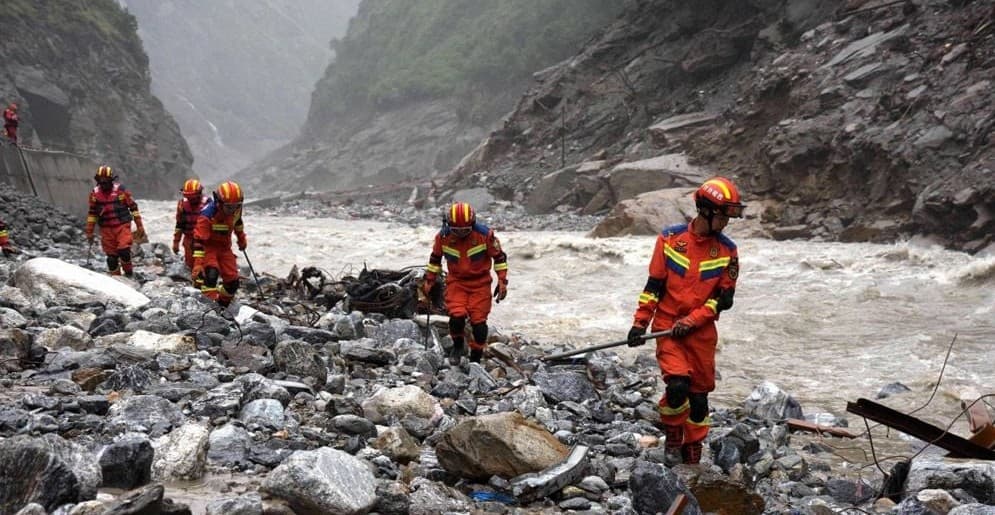

Nepal has demanded climate compensation after massive loss of lives and damage in the devastating floods. The country is strongly raising this demand on the international stage after more than one thousand people were killed and many went missing in the devastating disaster of the last week.
Mentioning the names of China, India and the United States, which are among the world’s largest greenhouse gas emitters, Nepal has said that the countries affected due to climate change have the right to get compensation. Kathmandu has also claimed that the large emitter countries have responsibility in this field.
It has been mentioned in the report that at least 1,127 people have been killed and about 3,900 people are missing in the flood of Bhote Koshi river that caused extensive damage in several districts of Bagmati Province. It is initially assumed that the flood started due to rock and ice avalanche near the Nepal-China border.
Nepal is planning to send Prime Minister Balendra ‘Balen’ Shah to the 81st session of the United Nations General Assembly to raise the demand for compensation at the international level. The Kathmandu Post has informed that the proposal of Shah’s New York visit is currently under discussion.
Foreign Minister of Nepal Shishir Khanal said Nepal is not responsible for this disaster. Yet the vulnerable countries like Nepal have to suffer the impact of global warming the most. His claim is that Nepal’s greenhouse gas emission is extremely low. Still glaciers are melting rapidly and the risk of mountain disasters is increasing due to climate change. Therefore the large emitter countries have the responsibility to give compensation to Nepal.
In an interview given to Kantipur TV, Khanal said, “We are changing our diplomatic framework from assistance towards justice and compensation.”
‘Flood compensation is not donation, it is justice’
Khanal said this disaster of Rasuwa should not be seen only as a humanitarian crisis for which donation or assistance is needed. He is viewing giving compensation for the damage that countries like Nepal are facing due to greenhouse gas emission of the large industrialised economies as a responsibility.
He said, “This is not a matter of charity; this is a matter of legal and moral obligation.”
Mentioning China, the United States and India as the three largest greenhouse gas emitter countries of the world, Khanal claimed that they have the responsibility to give compensation to countries like Nepal.
However, it has been said in the report of India Today that although India is one of the largest emitter countries of the world in terms of total emission amount, the country’s position is much lower compared to the developed countries in terms of per capita and historical carbon emission. According to the 2024 EDGAR calculation of the European Commission, China, the United States and India are the three largest greenhouse gas emitter countries of the world in terms of total emission. India’s carbon dioxide equivalent emission is about 3 tonnes per capita, China’s about 11 tonnes and the United States’ more than 17 tonnes.
India has long been saying that historical emission, per capita emission, the necessity of development and the greater responsibility of the countries that earlier benefited through industrialisation should be considered in determining the responsibility of climate change.
Devastating flood struck the basin of Bhote Koshi river on August 26. Various areas of Rasuwa, Nuwakot and Dhading districts of Nepal were extensively damaged in this. Alongside houses, roads, bridges and hydropower projects being damaged, thousands of people have been displaced.
Nepal has termed this disaster as ‘Himalayan Tsunami’. According to the information given by Nepal Police, the death of more than 1,100 people has been confirmed until September 1 and thousands of people are missing.
The authorities and experts assume that the flood started from the high mountainous region near the Nepal-China border. However, further scientific research is needed to confirm its specific cause and how much its relation is with climate change.
In the preliminary assessment, rock and ice avalanche, unstable glaciers and changes in the Himalayan ecosystem are being considered as possible causes of the flood.
Experts’ concern has also increased regarding the safety of the infrastructure projects built by China in the fragile Himalayan region due to the flood incident in this earthquake-prone and high-risk area.
Finance Minister of Nepal Swarnim Wagle told the news agency Reuters last week that Nepal may need 4 to 5 billion dollars to rebuild the infrastructure destroyed in the flood. This amount is equal to about 10 percent of the country’s total economy.
Nepal has also formally applied to the United Nations-backed ‘Fund for Responding to Loss and Damage’ for emergency financial assistance.
Leave A Comment