
Nepal-Tibet floods leave 1,500 missing including foreign tourists
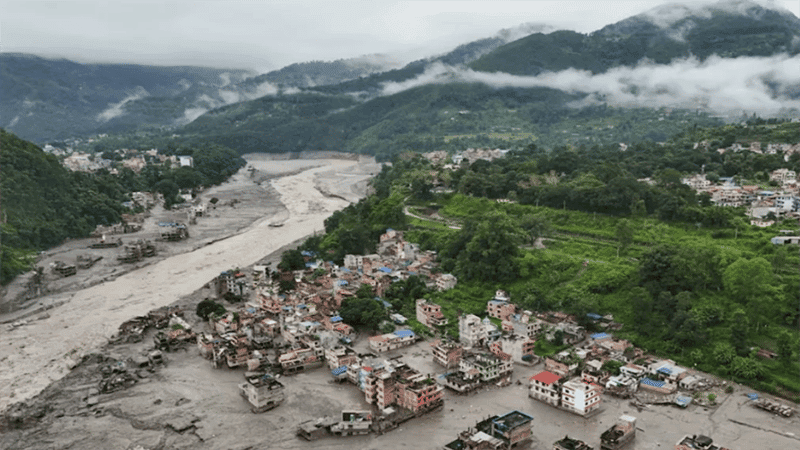

Around 1,500 remain missing after a devastating flash flood swept through areas along the Nepal-China border and Tibet, sending torrents of mud, rocks and debris through settlements and key transport routes, reports Reuters.
The disaster struck on Wednesday after ice and massive rocks reportedly collapsed from the Himalayas, blocking a river and creating a huge natural dam. The accumulated water later burst through the obstruction, unleashing a sudden surge downstream.
The scale of the disaster has raised particular concern for foreign nationals. Nepalese police and tourism officials said at least 165 people have died and 826 people are missing in Nepal, including nearly 600 foreign tourists. Among them are 177 Indians, 63 Americans, 34 Australians, 33 Britons and 25 Canadians.
Chinese authorities separately reported 588 people missing in Tibet’s Gyirong County, including around 250 foreign nationals.
The affected region includes a major mountain route linking Kathmandu with Lhasa. At the time of the disaster, the area was crowded with hikers, trekkers and pilgrims travelling towards Mount Kailash and Lake Manasarovar.
Verified footage shared on social media showed a massive wall of mud and debris sweeping through a border crossing, carrying away people and vehicles. Buildings, bridges, roads and a power facility in Gyirong were also badly damaged.
Among the survivors is 68-year-old Keshav Prasad Baral, who is receiving treatment in hospital. He said he tried to hold on to his wife as the mudflow rushed towards their home, but she was swept away before he could reach safety. A helicopter rescued him about four hours later.
Another survivor said he clung to a mango tree as floodwaters swept through the area, watching helplessly as his workplace disappeared beneath mud and debris.
Initial reports linked the disaster to an earthquake after seismic activity was detected in the region. However, data from the US Geological Survey indicated a magnitude-4.4 tremor that may have been caused by the collapse of ice and rocks from the mountains rather than a major earthquake.
The prevailing assessment is that falling ice and rocks blocked a river, allowing water to build up before the natural barrier gave way. The resulting wall of water, mud and debris then rushed downstream, triggering the flash flood.
More than 5,000 Nepal Army and police personnel have been deployed for rescue and relief operations. Helicopters are being used to deliver food, tents and emergency medicines to isolated areas while search teams continue looking for survivors and missing people.
The United States has announced $500,000 in emergency assistance to Nepal and plans to send specialists. The United Nations and India have also begun providing emergency support. Canadian Prime Minister Mark Carney and Australian Prime Minister Anthony Albanese have expressed concern over the disaster.
Rescue teams are also facing the threat of another flood. Chinese authorities have warned that a large volume of water has accumulated upstream in Tibet, forming a temporary lake. A breach could trigger another major surge, adding urgency to the ongoing search for those still missing.
Leave A Comment