

New attacks across Iran and Gulf, war widens
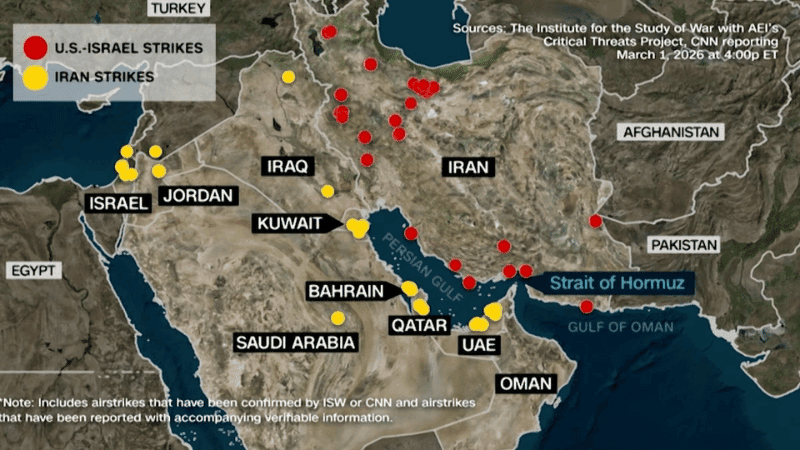

Israel launched new attacks on Iran on Thursday. At the same time, Iran has intensified attacks on Gulf countries such as Qatar and Bahrain. This is rapidly spreading the war in the Middle East throughout the region.
AFP reported from Tehran that the agency's journalists heard loud explosions in Tehran and Doha.
Thick black smoke was seen rising in the sky over the Qatari capital.
The conflict, which began after the US-Israeli attack that killed Iran's supreme leader Ayatollah Ali Khamenei, has rapidly intensified on Saturday. It has not only involved the entire region, but also drawn global powers and caused major instability in maritime trade and energy markets.
The impact of the war has reached the coast of Sri Lanka, where a US submarine torpedoed an Iranian warship. Azerbaijan has also threatened revenge after a drone attack damaged an airport.
Azerbaijan said it would "respond" to the attack and take necessary retaliatory measures, raising fears that another country could be drawn into the war.
AFPTV footage showed buildings in the capital Beirut in ruins and plumes of black smoke rising after an Israeli strike on the Iranian-backed group Hezbollah in Lebanon.
Tehran, on the other hand, said it had attacked Kurdish groups based in Iraq. The US has accused Iranian Kurdish groups of trying to infiltrate Iran by supplying weapons.
Australia has deployed two military aircraft to the region. Canadian Prime Minister Mark Carney said Canada's armed forces could also take part in the fighting if necessary.
The impact of the war has reached NATO member Turkey. The alliance's air defenses have shot down an Iranian missile that was heading towards Turkish airspace. Turkey later summoned the Iranian ambassador over the incident.
‘I am not afraid’
AFPTV footage showed burnt-out cars and damaged buildings after the attacks in Tehran on Thursday.
Smoke was still rising from some areas.
“We are going through a very important moment in history and I am not afraid. The only thing we have now is hope,” a 30-year-old Tehran resident told AFP.
Iran’s state news agency said 1,045 military personnel and civilians had been killed since the start of the war. AFP could not independently verify this figure.
Iranian media reported that the US and Israeli strikes in Tehran damaged a sports complex, a football stadium, municipal buildings and many shops.
According to monitoring group Netblocks, the internet in Iran has effectively been reduced to around one percent of capacity, leaving the country virtually cut off from the rest of the world.
Israeli military spokesman Brigadier General Effie Defrin said their goal was to “seriously damage the Iranian terrorist regime until they eliminate the existential threat.”
Israeli Defense Minister Israel Katz said US Defense Secretary Pete Hegseth had assured Washington of strong support for their joint military operation and encouraged it to continue “until the end.”
“We will not surrender”
Explosions were heard in Jerusalem after an Iranian missile warning was issued, although residents were later allowed to leave shelters.
In Lebanon, Israel said it had struck several Hezbollah command centers in southern Beirut.
Lebanon’s state news agency reported that a drone strike early in the morning killed senior Hamas official Wasim Atallah al-Ali and his wife in the Beddawi refugee camp near Tripoli.
Lebanese authorities said at least 72 people had been killed, 437 wounded and nearly 83,000 displaced since Monday.
Gulf states also hit
The war has also affected wealthy Gulf monarchies, which are usually considered a relative safe haven in volatile regions.
At least 13 people have been killed in the Gulf since the war began, including an 11-year-old girl in Kuwait.
Qatar said it had intercepted a missile attack amid a powerful explosion in Doha. Earlier, an attack targeting Hamad International Airport had also been repelled.
Meanwhile, six people were injured when debris from a downed drone fell on the United Arab Emirates capital, Abu Dhabi.
Impact on the global economy
The head of the International Monetary Fund, Kristalina Georgieva, warned that the war could create a period of prolonged instability for the global economy.
Iran's Revolutionary Guards claimed to have taken control of the Strait of Hormuz. About a fifth of the world's crude oil is transported through this route. According to market analyst firm Klepler, oil tanker traffic has fallen by about 90 percent.
The British Maritime Safety Agency said a major explosion occurred on an oil tanker off the coast of Kuwait, causing an oil spill.
Meanwhile, South Korea announced the activation of a $68 billion market stabilization fund amid fears of an energy shortage. China is reported to have asked oil refineries to stop exporting diesel and gasoline.
The tourism sector is also taking a big hit as flights are grounded and tourists are stranded.
"My last group of tourists left three days ago," said Nazih Rawashdeh, a tour guide in the northern Jordanian city of Irbid.
Leave A Comment
You need login first to leave a comment