

Nirmalendu Goon and Selina Hossain commemorate March 7
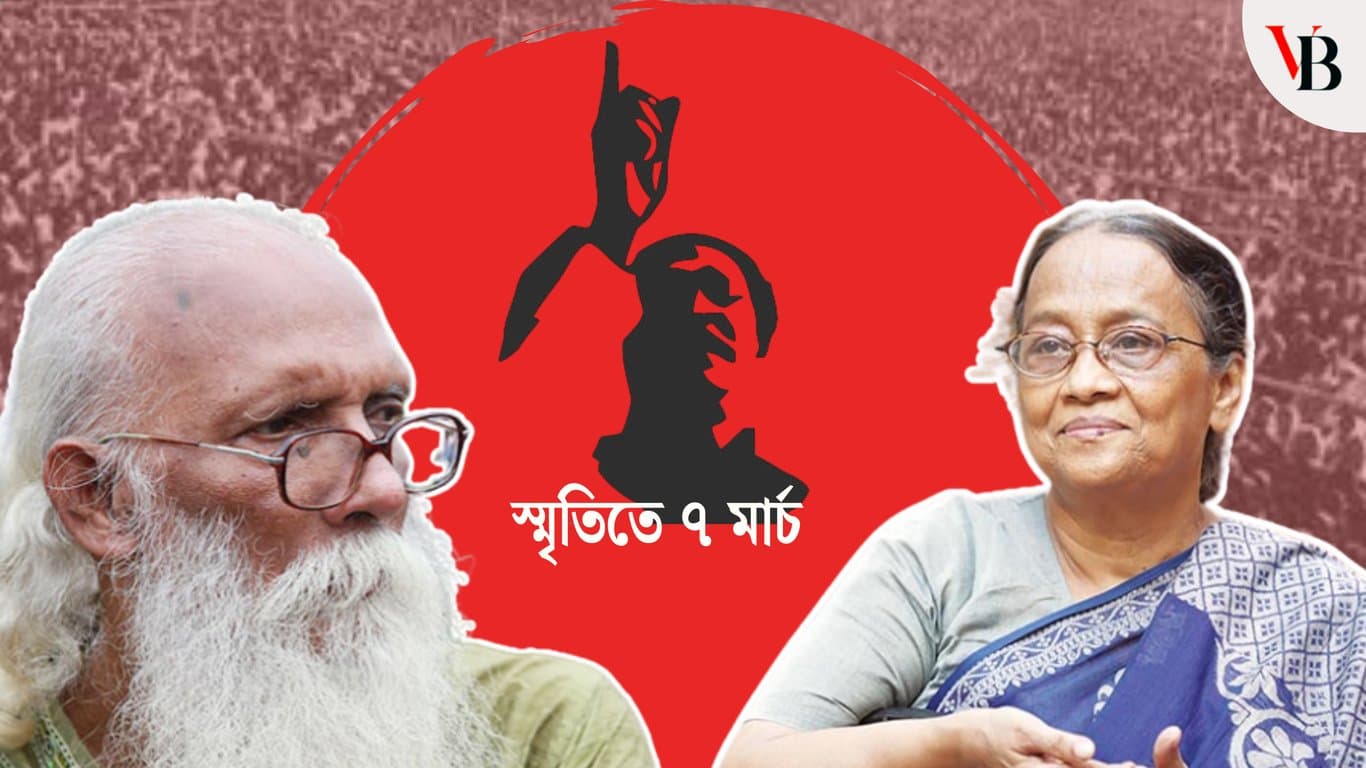

On March 7, 1971, at the then Racecourse Maidan, Bangabandhu Sheikh Mujibur Rahman delivered a momentous speech that served as an indirect declaration of independence. UNESCO has acknowledged the March 7 speech as a "Global Authentic Heritage." Millions of Bengalis assembled at the event that day to listen to Bangabandhu's voice. He stepped onto the stage, raised his finger, and proclaimed, "The struggle of this time is our struggle for freedom..."
Poet Nirmalendu Goon and literary figure Selina Hossain reminisced about their experiences from that historic day.
Nirmalendu Goon
On March 7, 1971, the Father of the Nation and the visionary leader of the liberation struggle, Bangabandhu Sheikh Mujibur Rahman, delivered a momentous speech at Dhaka's Suhrawardy Udyan, previously known as Racecourse Maidan. I had the honor of being seated very close to the podium, on a bench designated for journalists, witnessing that historic address before a massive crowd exceeding one million people.
At that time, I was employed by the English daily "The People," which was edited by the industrialist and lyricist Abidur Rahman. A Bengali weekly publication named 'Ganabangla' was also produced from the People Newspaper Building. I contributed to both Ganabangla and The People.
On March 7, I resolved to attend Suhrawardy Udyan to hear Bangabandhu's speech. Little did anyone know that the address delivered that day would be regarded as one of the greatest speeches in world history, acknowledged by humanity as unmatched evidence. Nevertheless, the significance of Bangabandhu's speech that day resonated among the populace and echoed throughout Dhaka.
The expansive field of the Racecourse was filled to capacity. As I occupied the reserved seats near the stage for journalists, I felt incredibly fortunate. There was a slight delay in Bangabandhu's arrival at the rally site. During this interval, Jahid bhai conversed with A S M Abdur Rob, one of the leaders of the Chhatra Sangram Parishad. The dialogue went something like this: "Will your leader declare independence today?" In that moment, rolling up his sleeves, student leader A S M Rob replied, "If he does not, then we will declare independence today." Jahid bhai then jestingly responded to Rob, "We shall see. Once the leader arrives, all of you will turn into cats."
I cannot recall Rob's response. Because, at that instant, amidst the thunderous cheers of the assembled masses, Bangabandhu's arrival felt like a powerful wave crashing upon the shores of a vast sea. He approached the Racecourse Ground from Ramna Park in a white car.
Welcoming the leader, the field echoed with the voices of hundreds of thousands:
Sheikh Mujiber poth dhoro
Bangladesh Shadhin koro
Tomar neta, Amar Neta Sheikh Mujib Sheikh Mujib
Tomar Amar Tthikana, Padma, Meghna, Jamuna
Joy Bangla, Joy Bangabandhu.
(Follow the path of Sheikh Mujib, liberate Bangladesh, Your leader, my leader, Sheikh Mujib, Sheikh Mujib,
Your and my address, Padma, Meghna, Jamuna,
Victory to Bengal, victory to Bangabandhu.)
He had no prior experience of addressing such a massive crowd. Why am I only mentioning his name? Has any leader in the world been fortunate enough to address such a large gathering? I could never imagine what he would say to address this massive audience. He looked stunned at the sea of people. Then, raising both hands in a gesture of humility, he signaled the crowd to calm down. Instantly, the roar of the crowd subsided.
Facing the microphones set up in front of the rostrum, he leaned slightly and began his historic speech. He said, “Bhayera Amar”… (“My brothers”….).
I listened to Bangabandhu's thunderous speech with admiration, captivated by his lofty voice. Reporters around me were jotting down his words on paper. It seemed appropriate for me to do the same, but I found myself getting lost in Bangabandhu's speech. Eventually, his speech came to an end. Amidst the chants of "Joy Bangla" and "Joy Bangabandhu" echoing from the multitude, he stepped down from the stage and set foot on the ground of the park.
We quickly left the venue to return to the People's Office. With pen and paper in hand, I try to write, but I cannot recall what Bangabandhu actually said in his speech. Only one sentence keeps rotating in my mind: "This time's struggle is our struggle for freedom, this time's struggle is the struggle for independence. Joy Bangla."
Selina Hossain
March 7, 1971. That afternoon, as I sat at the Race Course Maidan (now known as Suhrawardy Udyan) and listened to the remarkable speech delivered by the Father of the Nation, Bangabandhu Sheikh Mujibur Rahman, I never imagined that I would eventually write a novel on this historic event. On that momentous March 7, my friend Namita Sanyal accompanied me. We all sensed that there was no turning back. With his speech resonating in my mind, I remained in the field for an extended period. I intended to leave once the crowd dispersed. There was a designated area for girls, enclosed by bamboo, near the stage. Poet Sufia Kamal was present, and I was positioned close to her. After conversing with her, I exited a little later. On my way out, I purchased nuts from a vendor. The nut seller handed me the nuts and remarked, 'Erased, East Pakistan erased'. I gazed at him in astonishment! I am aware that Bangabandhu never referred to East Pakistan in his address. He spoke of Bengali, East Bangla, and Bangladesh. He declared, ‘Today the people of Bengal desire freedom, the people of Bengal wish to live, the people of Bengal demand their rights.’ In that remarkable address on the historic March 7, he raised his index finger and emphatically stated, ‘R dabaya rakhte parbana (You won't be able to suppress [us] anymore)’.
This statement warrants reflection. He did not employ standard Bengali. By integrating regional verbs with local expressions, he instantaneously unlocked the vast emotional reservoir of the Bengali nation, revealing all the defining traits of the Bengali spirit. In his speech on March 7, he followed that statement with, ‘This time, the struggle for our emancipation [and] the struggle for our independence’. It is significant that he articulated this sentence in standard Bengali. How astonishingly he has transitioned from a national context to an international platform; the struggle for liberation and the quest for freedom are universal principles applicable to every nation. The fight for liberation and the pursuit of freedom cannot be undertaken in isolation; it necessitates international support and assistance.
'R dabaya rakhte parbana na' - how might we visualize the essence of this phrase? It can be inferred that a group of individuals lying prostrate seeks to press the feet of their oppressor against their neck, the very core of their existence; yet, how long can they maintain this position? Gradually, they begin to lift their heads. In rejecting those feet, the head aspires to ascend. As it elevates, it gazes upward towards the heavens. With both hands, it seizes the feet of the ruler and rends them apart. One can envision that the rebellious poet Kazi Nazrul Islam's 'Bolo Bir Chiro Unnoto Momo Shir' was inspired by the image of countless heads rising high - what a remarkable fusion! This illustrates how politics intertwines with the art of poetry. The poet and the politician confront each other directly. On that day, March 7, women were also armed with bamboo sticks during that assembly. This address illuminated the path to independence for the Bengalis throughout the nine months of the Liberation War. The tale of how this speech transcended national borders is recounted by an eyewitness. He recounted an encounter with a Kashmiri guerrilla fighter abroad. While discussing various subjects, he posed the question, can you attain your independence by relying on other nations in this manner? The guerrilla fighter promptly responded, Are you from Bangladesh?
This illustrates how the liberation struggle of Bangladesh has resonated with the citizens of smaller nations in the developing world. This resonance is not merely a coincidence. It is rooted in the experiences of a millennia-old individual, who carries a history that spans a thousand years within himself. On October 30, 2017, Director-General Irina Bokova proclaimed at the UNESCO headquarters in Paris that the historic address delivered by the Father of the Nation, Bangabandhu Sheikh Mujibur Rahman, on March 7 has been designated as a ‘world heritage’ in the ‘Memory of the World International Register’. UNESCO, the United Nations Educational, Scientific and Cultural Organization, has bestowed this recognition, providing an opportunity for this speech to resonate with people globally throughout history.
Leave A Comment
You need login first to leave a comment