
Nobel prize pays tribute to historic 114-year-old Tagore-Russel correspondence
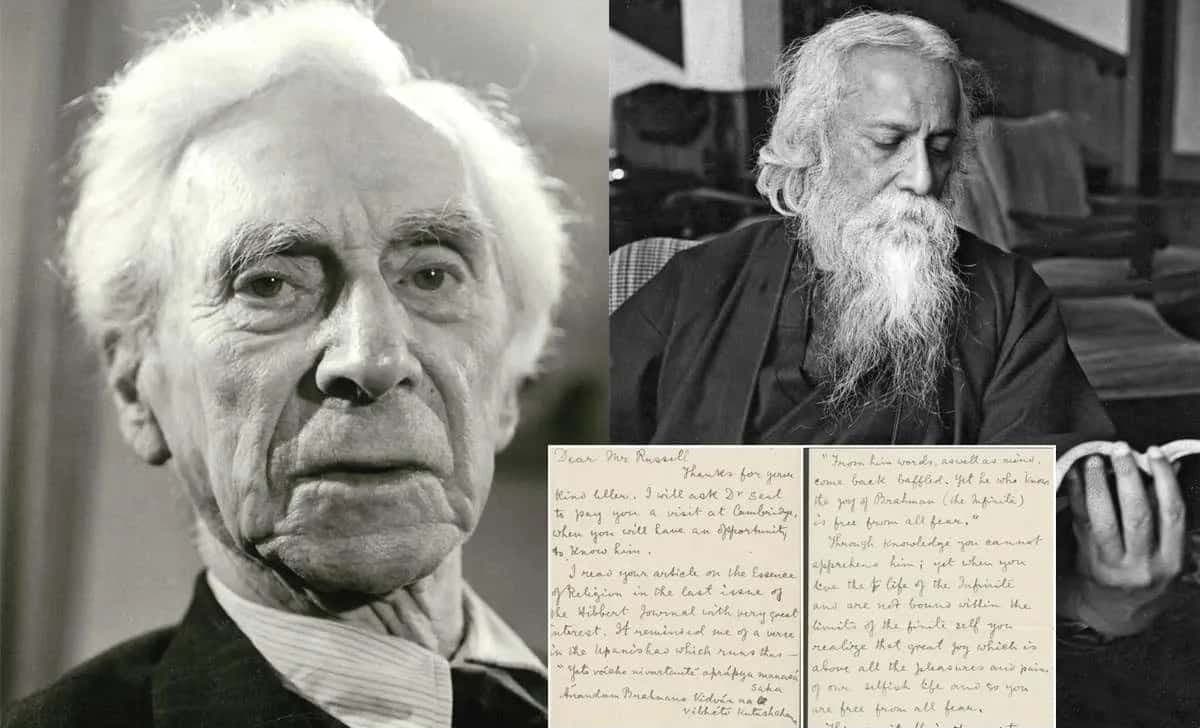

The official social media platforms of the Nobel Prize have shared a rare, 114-year-old handwritten letter exchanged between literature laureates Rabindranath Tagore and Bertrand Russell, highlighting a historic intersection of Eastern philosophy and Western thought.
The Nobel Prize showcased the artifact with the caption, "Take a look at this 114-year-old correspondence between literature laureates Bertrand Russell and Rabindranath Tagore," drawing immense global attention to the rare document preserved in the Bertrand Russell Archives at McMaster University Library in Canada.
The correspondence, penned by Tagore on October 13, 1912, reveals that the legendary Indian poet had just finished reading Russell's analytical article titled "The Essence of Religion," which was published in the Hibbert Journal.
Tagore wrote to the British philosopher that the piece deeply resonated with him, stating that the discourse reminded him of a sacred verse from the Upanishads—the ancient Sanskrit texts that form the core foundations for many Hindu traditions.
The two twentieth-century intellectual giants had met personally when Tagore visited England earlier that year in 1912, setting off a profound cross-cultural philosophical friendship.
In the letter, Tagore seamlessly bridges their shared concepts of ego-transcendence by transcribing the classical Sanskrit verse directly into the text, followed by a detailed English translation and commentary on how the "Infinite self" overcomes the limitations of the "finite self" to live a life free of fear.
This monumental exchange took place at a major turning point in global literary history. Almost a year after writing this letter, Rabindranath Tagore achieved the historic milestone of becoming the first non-European to receive the Nobel Prize in Literature in 1913 for his poetry. Bertrand Russell would later follow in his footsteps, receiving the same prestigious global honor 37 years later in 1950.
Cultural historians and literary archivists view the Nobel Committee's global feature of this epistle as a timely reminder of a golden era of philosophy, showing how ancient Vedic insights and modern Western rationale harmoniously converged to address the universal human condition.
Leave A Comment