

Origin of currency and banknote printing in Bangladesh

No animal needs money or currency to sustain life on Earth; it is only required by the human species. That's why humans desire not just food but also "money" for their livelihood. We often pray for sustenance, seeking the Creator's blessings, but not all prayers are answered.
Perhaps, the wealthy become even wealthier because some prayers are not accepted, while the poor become even poorer. Corrupt individuals and extortionists often cannot manage their own ill-gotten wealth; they rely on others to keep track of their money. Money can be used for various purposes, and it can even be used to obtain things that seem impossible, akin to the saying, "Money can even buy milk of a tiger."
The discovery of "money" has also facilitated smuggling in abroad. If the barter system were still in place, it would not have been possible for currency smugglers to thrive in Begumpara, Canada. However, nowadays, money or paper notes gradually find their way to oblivion as debit cards or credit cards are predominantly used.
With loans from banks or by depositing money into bank accounts, these two cards can be used to settle debts anywhere in the world, and paper currency is no longer carried around by people.
Another concept of transactions that is gaining limited adoption is through cryptocurrency. This currency is increasingly being used for gambling, and there have been instances of significant amounts of money being smuggled out of Bangladesh through online gambling. There is no existence of this currency in the world; some people believe that the existence of currency is not essential in today's world for transactions.
We almost all know that at one point in time, humans were entirely dependent on hunting for their livelihood, sharing and dividing what they obtained from hunting. The day when humans learned to sharpen stones, hunting became easier, and the discovery of fire changed their preference for food since then. Humans left caves and built houses, discovered the seeds of crops, made clothing from plant leaves, and underwent numerous other transformations.
Humans learned the art of production. They discovered the skill of exchange without depleting the excess of necessity. Although they acquired various skills essential for livelihood, at the initial stage of civilization, humans did not know the use of currency. During that time, humans engaged in barter, where they exchanged goods with other goods.
However, due to differences in the shape and value of the exchangeable items, various societies faced problems in trade. In some places, it was metal objects like beads, in others, shark teeth, salt, cows, goats, or hoes, that were accepted as a medium of exchange. Nevertheless, salt might have been the world's first currency, as in ancient Egyptian civilization, humans may have recognized salt as a form of currency. Before the invention of refrigeration, salt was extensively used for food preservation.
During that time, a person's wealth was often determined by the amount of salt they possessed. Subsequently, metals like copper, silver, and gold were introduced as forms of currency. In ancient times, the term "coin" referred to all these metal currencies. Around three thousand years ago, the Lydian civilization in Turkey is believed to have produced the world's first metal coins.
Meanwhile, in China, a different form of metal currency gained popularity. In India, the production of coins began around eight and a half thousand years ago. The use of paper notes for transactions, transportation, and storage of value began in China in the 7th century for the first time. Paper notes are also a form of currency, with each country having its own name for their currency. In some countries, it's called the dollar, in others, it's the pound, euro, rupee, and so on. While the names may vary from country to country, the function remains the same.
In Bangladesh, the currency is known as the 'Taka.' According to linguists, the word 'Taka' is derived from the Sanskrit word 'Tankha.' During the rule of Kublai Khan, the Venetian merchant and traveler Marco Polo journeyed to China and, upon returning to Europe, shared tales of paper currency.
However, his accounts were initially met with skepticism, leading many in Europe to label him as delusional. As a result, it took several centuries for the widespread adoption of paper currency in Europe. The use of paper notes in Europe didn't become prevalent until around the 17th century. Sweden is credited with introducing the first banknotes in 1652. Subsequently, in 1760, the United States printed its first dollar notes. In India, the concept of banknotes was established by a private bank founded by Governor General Warren Hastings between 1770 and 1780.
Government-backed banknote printing in India began in 1861. After Bangladesh gained independence in 1971, Pakistani currency notes continued to circulate in the country for a brief period. During this time, stamps with the word "Bangladesh" were used on these Pakistani notes.
The official currency of Bangladesh, known as the "Taka," was introduced on March 4, 1972, replacing the Pakistani currency. Initially, Bangladesh did not have the capability to print its currency, so it imported banknotes from countries such as India, Switzerland, England, South Korea, and Germany until it established its own currency printing facility.
Following a prudent policy of sourcing banknotes from other countries and considering the risks involved in establishing a domestic currency printing facility, Bangladesh felt the necessity of setting up its own currency printing press. In 1983, the decision to establish such a press was made, and it officially came into operation in 1989. Before its formal inauguration, the printing press had undergone trial runs in 1988 for the production of 1 Taka and 10 Taka banknotes. Initially, this institution operated as a project of the Bangladesh Bank. In 1992, with the approval of joint venture capital from a foreign company, it transformed into a public limited company.
Despite the existence of over two hundred independent countries globally, there are only around 65 currency printing presses, both government-owned and private, worldwide. Among them, Bangladesh's "Takshal" is one of them, playing a crucial role in currency printing. The country takes great pride in this institution, known as "The Security Printing Corporation (Bangladesh) Limited." In English, the term "mint" is equivalent to "Takshal" in Bengali, where metallic coins are produced. However, while the Security Printing Corporation prints banknotes, it does not produce coins.
Nevertheless, the general public commonly refers to this institution as the "Takshal" in Bengali. Low-denomination banknotes often undergo frequent wear and tear, rendering them unsuitable for use. Despite this, the complexity of exchanging these notes at banks deters many individuals. In this context, instead of introducing coins, Bangladesh continues to import metallic coins from abroad to replace these low-value paper notes.
However, our people have not fully embraced the use of coins, and the indispensability of coins in our country has yet to be established. In various countries around the world, when traveling by tram, bus, train, or using vending machines for road services, it is essential to have coins. In such cases, one needs to use coins instead of paper currency. In our country, there was a time when a one-fourth or twenty-five paise coin could be used to make phone calls from public telephone booths, but this practice no longer exists.
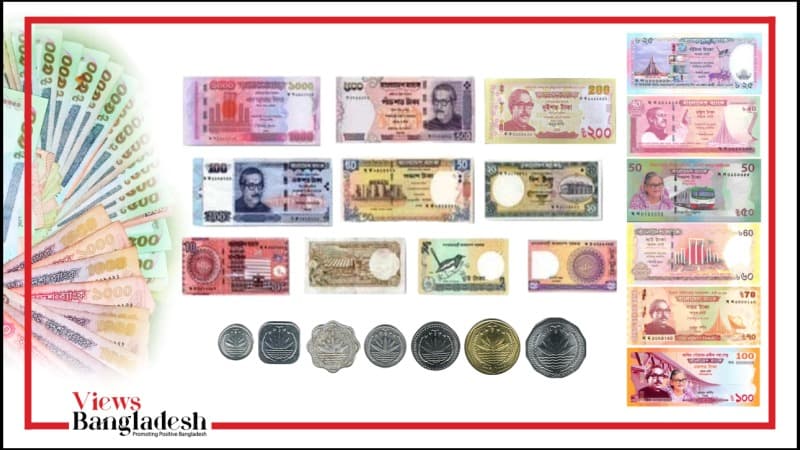
Some people do not carry coins in their pockets when leaving their homes. In Bangladesh, all the currently circulating banknotes are printed at the mint referred to as the "Takshal." Competing with banknotes from other countries, Bangladesh's 2-taka note featuring the image of a royal Bengal tiger has achieved the distinction of being the world's most beautiful banknote, as per an online entertainment outlet in Russia.
Commemorative notes are also printed at the Takshal to mark significant events in the country's history. In commemoration of Bangladesh's 40 years of independence, a commemorative note of 40 taka was printed in 2011. Similarly, to mark the 60th anniversary of the Language Movement, a 60-taka commemorative note was issued in 2012.
In 2013, to celebrate the 100th anniversary of the Bangladesh National Museum, a 100-taka commemorative note was printed. Additionally, in 2013, a 25-taka commemorative note was issued to mark the 25th anniversary of the Security Printing Corporation (Bangladesh) Limited, also known as the "Takshal."
More recently, to commemorate Mujib Year, a 200-taka note was printed, which can also be used for everyday transactions as valid currency. The interest and curiosity of the general public are significantly drawn towards the institution due to the printing of currency notes. This unique facility of producing currency within the confines of approximately 66 acres of land is surrounded by lush greenery and trees, which is why the premises of the Takshal(Security Printing Corporation) are always bustling with diverse birdlife and natural beauty. It's not just about its natural appeal; the uniqueness of the Takshal lies in its exclusive capability to print currency notes, setting it apart from other institutions in the country.
The author is former Managing Director of Bangladesh Bank and Former Managing Director of The Security Printing Corporation (Bangladesh) Limited, or Takshal
Leave A Comment
You need login first to leave a comment