
Pahela Baishakh: Dialectical formation of Bengali identity
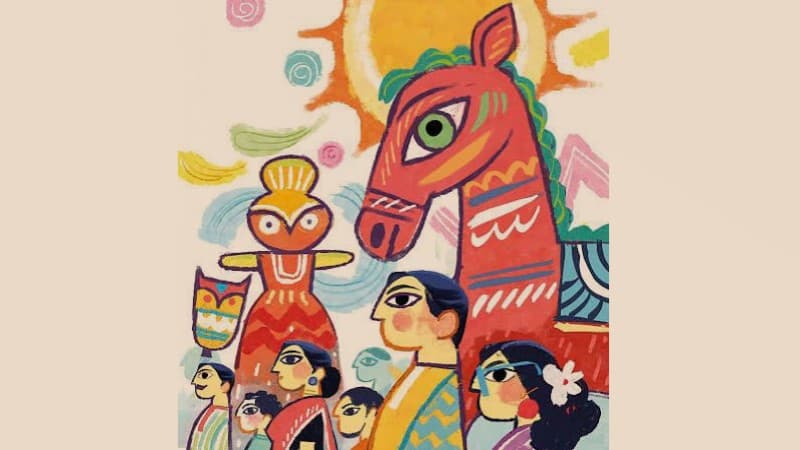

When individuals participate in a procession, carrying clay dolls or softly singing, "Eso, he boishakh, eso eso..." (inviting the summer), a pertinent question arises: is this celebration a festival of the Bengali people, or is it an imposition of Hindu culture upon the 'Muslims'? The latter assertion is quite significant.
This inquiry is fundamentally altered with the onset of Baishakh. Its core lies in the comprehension of identity, culture, religion, and history. Pahela Boishakh stands as the most prominent socio-cultural festival in Bangladesh. This festival, which is rooted in the illusion of capitalism, is now celebrated in every household of the proletariat within the freedom of society. It has been intertwined with the cultural elements generated by the social order of transformation.
This amalgamation is now irreversible. Even the philosophies of Marx or Hegel would falter in this context. Nevertheless, the discourse surrounding this festival persists. The crux of the debate: it is regarded as the timeless cultural manifestation of Bengalis, while conversely, it is viewed as a contemporary political construct, with a specific religious group rejecting and opposing it as an encroachment of foreign culture. It is impossible for all members of the nation to be entirely acquainted with one another.
However, despite our differences, our journey and struggles are unified. Just as we feel joy when a Bengali receives an accolade thousands of miles away, we also experience sorrow when a Bengali perishes in a conflict in the Middle East. What accounts for this phenomenon? We have cultivated certain humanly conceived entities within ourselves, which fosters our attraction to one another.
Festivals serve as entities that bring our imagined forms to life. Millions of Bengalis commemorate Baishakh on the same day, donning new saris, making domestic arrangements, and taking leisurely walks; it resembles a disciplined aesthetic celebration. This practice renders our souls eternal (Let the dirt be removed, let the rust be eliminated, let the fire be purified). The expanding route of the Mangal Shobhajatra from Halkhata has not ceased over the centuries, despite numerous constructions arising from protests against various social injustices and the might of the rulers.
The 'Fasli San,' introduced by administrative measures during the reign of the Muslim emperor Akbar, primarily aimed at revenue collection, was enforced upon the peasant community. Subsequently, this community gradually assimilated this tradition into their own life rhythm through various events (Halkhata, Nabanna, Baisakhi Mela). The second phase occurred in 1967 when Chhayanaut organized its inaugural New Year's Eve celebration at the foot of Ramna, during a time when the Pakistan government was aggressively targeting Bengali culture.
There were attempts to prohibit Rabindra Sangeet, alongside plans to undermine the Bengali language. In this context, the Batamul ceremony transcended being merely a cultural festival; it became a symbolic expression of resistance. It represented one of the cultural battles waged by Bengalis against the Pakistani authorities. Later, in 1989, amidst the height of the anti-Ershad dictatorship movement, the 'Mangal Shobhajatra' was initiated by fine arts students.
A specific fundamentalist movement in Bangladesh dismisses Pahela Baishakh as a 'Hindu festival'. Concurrently, it advocates for its reform, which essentially aims to maintain the festival in a state of deterioration. Their reasoning is varied: the owl, elephant, and mask featured in the Mangal Shobhajatra are representations of Hindu folk art; the term "Mangal" has Sanskrit roots; the celebration of sunrise is inspired by nature worship.
These objections must initially be comprehended in an objective manner. To begin with, this represents a categorical mistake. Cultural practices and religious beliefs are distinct entities. Wearing a cross around one's neck does not necessarily indicate that an individual is a Christian. Similarly, having a shaved head does not imply that one's father is destined for heaven. The subsequent discussion reveals that the distinction between "secular" and "religious" is, in fact, a contemporary political fabrication.
Fundamentalists exploit this division as a means to assert that culture is "corrupt". To distance themselves from its practice, various fatwas are issued at different times. Nevertheless, the true importance of the fundamentalist objection transcends the issue of historical accuracy. It fundamentally represents a struggle for identity.
The primary inquiry is: Is it possible for a Bangladeshi Muslim to simultaneously identify as both Muslim and Bengali? In this context, Amartya Sen illustrates that the effort to reduce identity to a singular form is a significant catalyst for violence. When an individual embodies multiple identities — such as being Muslim, Bengali, a farmer, and Bangladeshi — the insistence on confining this multifaceted identity to a single label leads to conflict.
From this perspective, fundamentalism's resistance to Pohela Baishakh is not truly directed against the festival itself, but rather against the complex Bengali identity it represents. The festival poses more of an identity question than a cultural one: Who am I, and who has the authority to delineate the parameters of my identity? The amalgamation of participation, joy, memory, and emotion that has been cultivated by millions over the last sixty years cannot be obliterated by any theoretical critique or press statement, nor will it be diminished.
Leave A Comment