
Political Confrontation and the EU Envoy's Message
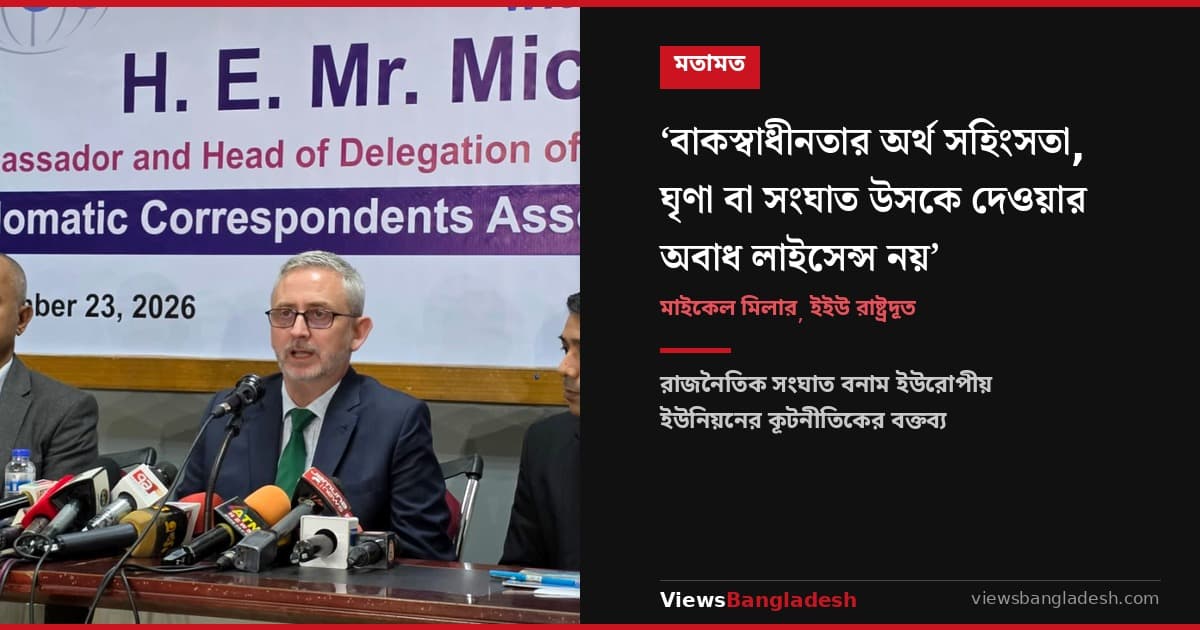

At a recent "DCAB Talk", hosted at the National Press Club by the Diplomatic Correspondents Association, Bangladesh (DCAB), the country's association of diplomatic journalists, European Union (EU) Ambassador Michael Miller made several remarks. Given Bangladesh's current political situation, his remarks matter a great deal and deserve serious thought.
The ambassador said plainly, "Freedom of expression and the right to peaceful assembly are essential elements of a democratic society. But that freedom is not an unrestricted licence to incite violence, hatred or conflict." His remarks make clear that political parties should be free to carry out their programmes as they see fit, but they must stay away from violence. The question is: is this principle being applied equally to every political party, opinion and organisation in Bangladesh? Was it ever fully applied in the past?
Miller also said that political transformation does not happen overnight. It requires long-term reform, political consensus, and restoring public trust in state institutions. He also stressed accountability and justice for past human rights violations. In other words, a change of political power alone is not proof of democratic change.
Most significantly, the ambassador said the EU has no institutional position on whether the Awami League's political activities should be banned or allowed. This is worth noting. Banning a political party, or denying it the right to political activity, cannot be left to the political judgement of those in power alone. It also involves the rule of law, constitutional rights and justice.
This leaves the government with a basic question. If zero tolerance for violence is a matter of principle, it must apply equally to all sides. Is that happening? If not, why not? Shielding anyone's crimes because of their political identity, or taking away anyone's right to peaceful politics, is not compatible with democracy. The government needs to understand that the state is not the private property of any political party. No government has the right to use state power to suppress dissent, intimidate political opponents, or use the administration for partisan ends. Yet this has gone on in Bangladesh for a long time, and it has become part of the political culture.
Against this backdrop, Prime Minister Tarique Rahman's speech at the closing session of the Jatiya Sangsad on November 18 stands out. He called the Awami League a "terrorist group" and said its head should be "crushed" before the party can stand up again. Whether this fits the responsible political language expected of a head of government deserves consideration. If any individual or group is accused of a crime, they will be tried in court. But does such vindictive language, aimed at a political party and its supporters, create an atmosphere of political tolerance, or does it fuel further conflict? When the Prime Minister says this standing in a place like the national parliament, it carries far more weight. Many people say many things in street politics. But parliament and the street are not the same place.
A request to Prime Minister Tarique Rahman: you are no longer only the chairperson of the BNP; you are the Prime Minister of Bangladesh. Your duty is therefore not to threaten to eliminate opponents, but to guarantee the rights and safety of every citizen of the state. Everyone should remember that running a state is different from running a party. The arrogance of power can suppress political opponents, but it cannot win public trust. That brings good results for no political party, as we saw with the Awami League in the recent past. However, the Awami League's political future should not be a matter of any individual's personal wish. It should be decided on the basis of the constitution, the law and the people's political rights. If the government truly believes in democracy, reform and the rule of law, it must guarantee the constitutional right of every political party, including the Awami League, to carry out peaceful political activities. Yet the parties that were allied with the Awami League during its rule are unable to hold any political programmes. The few that have tried have faced such a situation that they no longer dare to announce new ones. Everyone should remember that crimes must be tried on the basis of evidence, not political identity.
The core message of the EU ambassador's remarks is therefore clear. Democracy does not mean elections alone. Democracy means security for dissent, political tolerance, equal application of the law, and guaranteed dignity and rights for every citizen. The test of democracy lies not in the ability to suppress opponents, but in the political will to protect their rights and safety. Power is temporary, but the people's rights before the state are permanent.
Amitosh Paul, Special correspondent, Samakal
Leave A Comment