
Protests on streets, talks at table: Bangladesh under pressure from workers' unrest
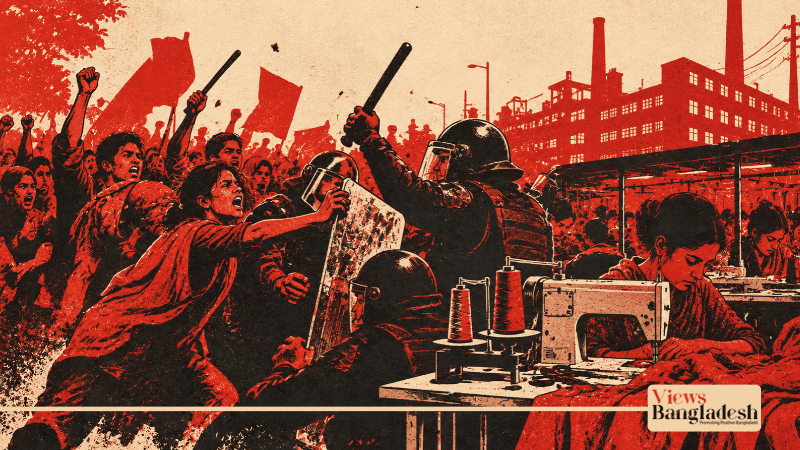

Bangladesh’s ready-made garment (RMG) industry is the backbone of its economy. The sweat of millions of workers in this sector generates the lion’s share of the country’s export earnings. The industry accounts for around 80 per cent of Bangladesh’s total exports, worth approximately $36 billion last year. Yet behind this success lies a long-standing crisis over wages, working conditions and job security. In recent months, unpaid wages, layoffs and factory closures have once again fuelled workers’ discontent.
The government has formed a Minimum Wage Board to determine a new minimum wage for garment workers. On 1 November, the Ministry of Labour and Employment issued two notifications announcing the move. Yet on the same day, workers blocked roads in Mirpur, Savar, Gazipur and Narayanganj, with repeated clashes between protesters and police. While the negotiating table is being prepared, tensions on the streets are escalating. The future of Bangladesh’s largest export industry over the final weeks of the year will be shaped by the tension between these two realities.
The nationwide movement for higher minimum wages in late 2023 was among the most intense episodes of labour unrest in a decade. Demanding that the minimum wage be raised nearly threefold to Tk 23,000, thousands of workers clashed with police, while numerous factories were vandalised. The protests also resulted in casualties. Eventually, the new wage structure set the entry-level monthly wage at Tk 12,500. Labour organisations rejected the figure at the time, arguing that it was insufficient to meet the rising cost of living.
Garment workers also played a significant role in the mass uprising of 2024. Yet questions remain over how much their lives have changed since the political transition. A leader of a labour rights organisation said workers were struggling even to maintain a minimum standard of living.
The picture this year is particularly troubling. According to a report published in July 2026, nearly 20,783 workers lost their jobs at 80 factories between January and June. From August 2024 to June 2026, a total of 457 garment and textile factories shut down, leaving more than 240,000 workers unemployed. The report was published by Justice Makers Bangladesh in France, a France-based human rights organisation. It also highlighted delayed or unpaid wages and shortcomings in workplace safety. Women workers, who make up the majority of the sector's workforce, have been particularly affected.
The consequences have been visible in a series of confrontations on the ground. In late February, workers at a factory in Rupganj staged protests over unpaid wages and layoffs. Repeated clashes with police left at least 20 people injured, including workers, police personnel, journalists and passers-by. In December last year, workers in Savar reportedly went on strike for several consecutive days. In August, members of Garment Workers' Solidarity held a rally in Dhaka demanding full implementation of the Bangladesh Labour Act 2026 and democratic labour regulations.
In April this year, parliament passed the Bangladesh Labour (Amendment) Act 2026, replacing the 2025 ordinance. The legislation has been presented as a major reform intended to bring the country's labour laws closer to International Labour Organization (ILO) standards. Some international labour organisations have welcomed the new provisions on trade union rights, workplace safety and dispute resolution.
But debate within Bangladesh continues. Labour leaders argue that key recommendations of the Labour Reform Commission have been omitted and that weak enforcement leaves the law tilted in favour of employers. One analysis has pointed out that the legislation does not establish a statutory National Minimum Wage Commission or a formal framework for setting minimum wages, despite longstanding demands for one. Meanwhile, the Bangladesh Knitwear Manufacturers and Exporters Association (BKMEA), a major employers' organisation, has called for a review of several provisions, including those concerning the definition of workers and collective bargaining representatives.
The weakness of organised labour is another major challenge. According to data from the Bangladesh Institute of Development Studies (BIDS), only 11.35 per cent of workers belong to trade unions. Registered trade unions exist in just 30 per cent of the country's approximately 4,000 garment factories. As a result, for many workers, the streets often remain the only available alternative to the negotiating table.
The problem, however, is not one-sided. Factory owners argue that low prices offered by international buyers make it difficult for many manufacturers to comply fully with minimum wage requirements. Representatives of employers have said that paying the mandated wages would not be a problem if buyers offered fair prices. At the same time, the sector is facing mounting external pressures. The president of the Bangladesh Garment Manufacturers and Exporters Association (BGMEA) has said that conflict in the Middle East is disrupting production. BKMEA has also warned of losses caused by severe load-shedding. In February, garment exports fell by 12 per cent to $3.49 billion. On the other hand, Bangladesh's share of the US apparel market rose to 10.53 per cent, pointing to opportunities as well as challenges.
The biggest question over the coming months is the revision of minimum wages. Previously, wages had to be reviewed every five years. The 2026 amendment to the labour law has shortened that interval to three years. Three years will have passed in December 2026 since the Tk 12,500 minimum wage was announced in December 2023. Labour organisations have already called for the formation of a new wage board. Unless the cost of living comes under control and a revised wage structure is announced swiftly and in a manner acceptable to workers, the risk of renewed unrest towards the end of the year will remain high.
Analysts have already warned that the new government could face major labour protests amid unfinished reforms and rising living costs. The future will depend on how effectively the law is implemented. Rights written on paper are not enough. Labour inspection must be strengthened, and effective measures must be taken swiftly when wages remain unpaid. Buyers, too, must play a role in determining prices if workers' wages are to rise. Otherwise, the burden will fall disproportionately on small and medium-sized factories, potentially leading to more closures and further layoffs.
Without regular tripartite dialogue among employers, workers and the government, the old cycle will return: protests, clashes, factory closures and, eventually, agreements that remain unimplemented. The days when Bangladesh could sustain its garment industry primarily through low wages are drawing to a close. Diversifying markets and products, alongside improving workers' skills, is essential. Moving into higher-value products would also create greater capacity to pay better wages.
Labour unrest is about more than wages. It is a question of dignity, security and a fair share of the wealth workers help create. If the people who keep the country's export engine running cannot even be certain of receiving their wages at the end of each month, no industry can remain stable in the long run. The new labour law and the impending wage review represent a test for the government, factory owners and international buyers alike. If they seize this opportunity, Bangladesh may finally break free from its cycle of unrest. If they fail, workers may once again take to the streets at year's end, and the cost will be borne by the entire economy.
Anjan Kar
Sub-editor, Views Bangladesh
Leave A Comment