
Question of teachers' dignity: from east to age of decolonization
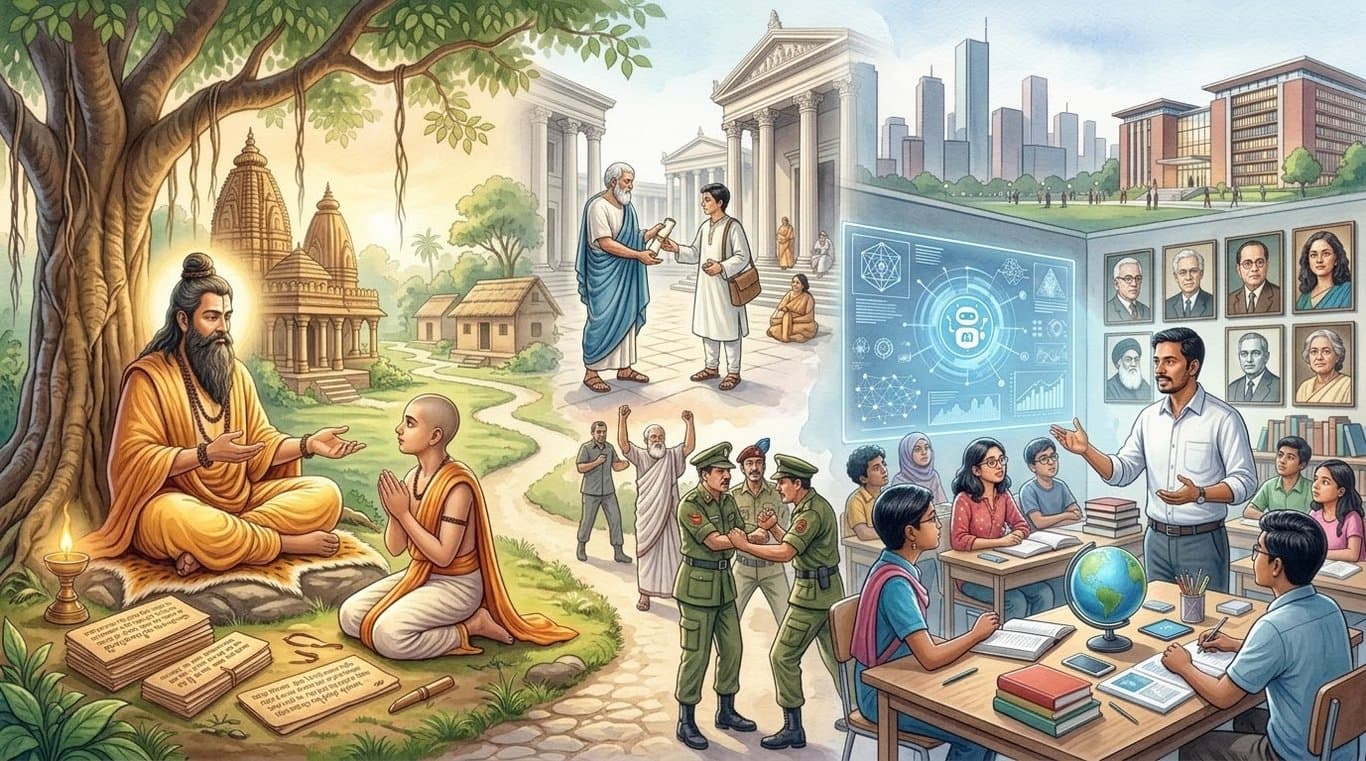

From the guru to artificial intelligence, education has travelled a remarkable distance. That journey has brought us to an uncomfortable question: what, exactly, is the relationship between a teacher and a student? Is education simply the free circulation of information, a matter of self-learning and acquiring useful knowledge? Or is the ability to memorise and reproduce information still regarded as the ultimate measure of intelligence?
In the Indian intellectual tradition, education was never merely an exchange of information. It was a continuous transmission of knowledge — a parampara, a living tradition passed from one generation to the next. In the Mundaka Upanishad, Shaunaka approaches the sage Angiras with a deceptively simple question: what is that knowledge by knowing which everything else becomes known? It is in such encounters that the deeper meaning of education begins to emerge.
The Taittiriya Upanishad offers another glimpse of this relationship. At the end of his studies, a teacher instructs his departing student: speak the truth, practise righteousness, honour your mother, your father and your teacher. Yet reverence here is not the same as blind obedience. The student retains the right to judge, while the teacher must acknowledge that he, too, is not infallible. Education is therefore not a one-way transfer of authority. It is a relationship of mutual responsibility.
The Western tradition followed a rather different path. In fifth-century Athens, the rise of democracy transformed the demands placed on citizens. People had to speak in assemblies and defend themselves in court. Rhetoric and argument became instruments of power and advancement. The Sophists arrived to meet that demand. Protagoras, Gorgias and Hippias travelled from city to city, attracting students and charging substantial fees for their instruction.
This can be seen as one of the earliest organised forms of the commercialisation of knowledge. Knowledge became a service: there was a buyer, a seller and, increasingly, a promise of victory in debate.
There is nothing inherently wrong with teachers being paid. Teachers deserve a dignified livelihood. The problem begins when the purpose of knowledge shifts from the pursuit of truth to the satisfaction of the customer, or to the logic of a market in which everything — including education — is valued primarily as a commodity.
Across both traditions, however, one principle is clear: education flourishes when the relationship between teacher and student is grounded in trust and respect. Teachers transmit what they have learned, helping societies free themselves from superstition and move towards knowledge, modernity and progress.
But history also shows how quickly that relationship can be corrupted when power enters the equation.
The conflict is no longer about the purity of knowledge, as in the legendary confrontation between Bhishma and Parashurama. It becomes a struggle over pride, greed, jealousy and desire.
The Mahabharata offers one of the most enduring examples. Dronacharya refused to accept Ekalavya, the son of a Nishada chief, as his student. Ekalavya nevertheless fashioned an image of Drona and taught himself archery from a distance, eventually becoming exceptionally skilled. When Drona discovered this, he demanded Ekalavya's right thumb as guru dakshina. Drona's stated purpose was to ensure that Arjuna remained the greatest archer of his age. But the episode reveals something darker: the teacher had become a guardian of a hierarchy of privilege, deciding who was entitled to knowledge and who was not.
When the conflict between power and pride moves beyond individuals and enters the machinery of the state, institutions themselves become vulnerable.
Modern Asia offers few more devastating examples than China's Cultural Revolution. Teachers, academics and intellectuals were branded counter-revolutionaries, publicly humiliated and sent to labour camps. Some were driven to suicide. Knowledge itself became suspect because independent thought was seen as a threat to political authority.
Bangladesh's history contains its own terrible chapter. In 1971, Pakistani forces killed teachers and students at Dhaka University, including in Jagannath Hall and other residential areas, while similar atrocities took place across the country. As the Liberation War approached its conclusion, intellectuals — including teachers, doctors and other professionals — were systematically abducted and murdered on 14 December. The objective was clear: to leave the emerging nation intellectually crippled.
More than five decades later, a different kind of assault began in the aftermath of 5 August 2024. Following the change of government, teachers at schools, colleges, madrasas and universities in different parts of Bangladesh faced pressure, threats, humiliation and harassment. Some were forced to resign. In some cases, the humiliation was followed by tragedy.
One such case was that of SM Ayub, vice-principal of Hazera-Taju Degree College in Chattogram. He was reportedly humiliated and forced to resign at his institution. He fell ill that day and, after spending several days on life support, died. Behind such incidents lay a mixture of politics, personal grievances and institutional disputes.
These are tragic developments. It is deeply disturbing when teachers themselves turn personal resentment against colleagues into political weapons. But the misconduct of a handful of teachers cannot justify the humiliation of an entire profession.
There is, at the same time, another uncomfortable truth: a state that fails to provide its teachers with adequate pay, security and social respect is failing in one of its most basic responsibilities.
What punishment should there be for humiliating teachers in schools and other educational institutions? The very fact that the state feels compelled to legislate against such behaviour should force us to ask a larger question: what happens to a society when respect for knowledge begins to collapse?
Education is ultimately a relationship of reciprocal obligations.
Society owes teachers security, fair pay and dignity, so that they can teach without being crushed by fear or poverty. Teachers owe society something in return: they must refuse to reduce knowledge to a commodity, place truth and humanity above convenience, and keep themselves at a distance from the temptation to flatter power. And students have their own responsibility — to ask questions with the humility of Shaunaka, rather than with the arrogance of someone who believes every answer is already theirs.
China's experience after the Cultural Revolution offers another lesson. Having endured the devastation of that period, China placed science and technology at the heart of its national development. In recent years, the state has also made efforts to popularise scientists, bringing their lives, photographs and ideas into the public sphere.
There is a lesson here in social psychology.
Children tend to imitate the people their society celebrates. If the billboards of a city are filled almost exclusively with advertisements for consumer goods and the faces of politicians, young people will naturally learn to associate success with consumption and power. One way of understanding a nation's values is to look at whose faces appear on its walls.
The role of the teacher, like education itself, has changed with time.
Today, artificial intelligence can answer a question in seconds. It can write an essay, solve a mathematical problem and summarise an entire book. So what, then, remains for the teacher to do?
Quite a lot.
A machine may provide an answer, but it cannot by itself determine which question is worth asking. It may produce information, but someone must still ask whether that information is credible, logical or true. And beyond facts lies a more difficult territory: how to confront uncertainty, how to distinguish truth from convenience, how to live with moral responsibility.
These forms of judgement are not simply downloaded. They are cultivated through human relationships.
That is why the ancient encounter between Shaunaka and Angiras still matters. The value of the question has not diminished in the age of artificial intelligence. If anything, it has increased.
For when machines can give us almost any answer, the most important educational task may once again be learning how to ask the right question — and having a teacher who is worthy of hearing it.
Leave A Comment