

Race of ‘Domm’ in breath-taking game
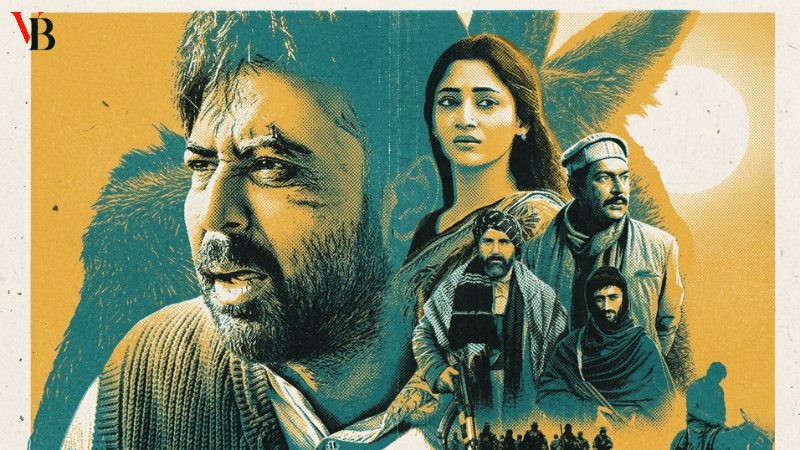

A delighted filmmaker and producer, a pleased audience. Because for the past few years, Eid-centered films have been able to spark general interest through their stories and production. Setting aside the minor political unrest of 2024, the trajectory of these films has been upward. This year too, Dhaka cinema has maintained that momentum. Since release, there has been noticeable enthusiasm among viewers for about three to four films. Among these, “Domm” directed by Redwan Rony stands out.
A survival thriller based on a true story—perhaps the first of its kind in Bangladesh. Whenever Afghanistan appears in the story—actually filmed in Kazakhstan—the wide-angle cinematography washed in sepia tones brings the harshness of the barren land and the hostility of the environment vividly to the viewers’ eyes. The suffocating atmosphere of Afghan society, overwhelmed by the dominance of the Taliban group, is also clearly portrayed through carefully measured scenes.
In the film, it is shown that the Taliban’s jihad is directed against the U.S. government. Therefore, they kidnap Shahjahan Islam Noor, an employee of a Bangladeshi private organization associated with the United States. In exchange, they demand the release of one of their leaders. When that attempt fails, they try to extract money instead.
Noor’s life flickers like a dying lamp, dependent on the whims of the Taliban members. Among them is a Taliban commander of Pakistani origin whose father served in the Pakistani army and fought in Bangladesh in 1971. He seeks revenge for his father’s death at the hands of the freedom fighters by killing Noor.
By bringing in the context of the Liberation War, the director has not limited the film solely to a story of kidnapping, ransom, and one man’s struggle for survival; he has also added a touch of nationalist sentiment. Elements of love and romance have been mixed in as well. To me, both of these seem like attempts to please the masses. The idea that a film will not do well commercially without adding such elements ultimately destroys all the potential of what could otherwise be a truly good film.
The way Domm begins gives the impression that it will be a tightly gripping thriller or action movie. However, after a while, when Noor’s wife appears in a flashback accompanied by the song 'Ei Mon Tomake Dilam,' the fabric that had been woven at the start of the film begins to unravel. As the film moves into a romantic mood, the musical arrangement or background score and the color palette have to change accordingly. As a result, the film becomes completely relaxed and shifts into a different atmosphere.
Even if one argues that this gives the audience’s nerves a moment of rest, it must be said that the brief glimpses Noor sees of his wife Rani in his delirious state during captivity would have been enough. There was no need to dive into wedding scenes, the wedding night, suggestive dialogues about 'capability,' and song-and-dance sequences typical of average Hindi and Bengali films.
When inconsistent scenes are added, the film’s core genre becomes damaged and it creates a jarring effect for the audience. In film genre theory, this discussion is referred to as verisimilitude—meaning that from a film’s poster and trailer to even the first two minutes of the movie, viewers usually understand which genre the film belongs to. Based on that understanding, audiences begin investing their expectations and predictions.
When those expectations do not slightly bend but instead move in the opposite direction, the entire presentation begins to feel discordant. Mixing different genres in a film is nothing new, but it needs to be balanced and coherent. If the elements become completely contradictory, the film loses the momentum it initially promised.
The shift from sepia tones to natural colors, and the sudden jump from the anxious soundscape of the desert to a modern Bengali love song—these two changes are the main reasons why Domm ultimately loses its breath.
The use of Kazi Nazrul Islam’s song 'Durgam Giri' in Domm is also not appropriate. As we know, in 1926, in protest against the riots in Kolkata and as a call to move toward a brighter future by rejecting the poisonous atmosphere of communal hatred and violence, Nazrul composed the song 'Kandari Hushiar.' The essence of the song is clearly expressed in two of its well-known lines: 'Hindu na ora Muslim? Oi jigyase kon jon? / Kandari! Bol dubiche manush, shontan mor ma’r!'
Over the past few decades, the people of Bangladesh have increasingly intertwined religion with social and political spheres, and this tendency is clearly advertised in Domm.
Later, the song has been used metaphorically during various national crises. However, in the film Domm, it seems the song was used merely because of the presence of mountains and desert landscapes, suggesting that the motive was more about pleasing the audience than conveying its deeper meaning.
Above all, the most important observation about this film is that it attempts to reflect the current social and religious situation in Bangladesh—and here too there is a strong element of populism. Over the past few decades, the people of Bangladesh have increasingly intertwined religion with social and political spheres, and this tendency is clearly advertised in Domm. Even before its release, the trailer promoted the line: 'I am Shahjahan Islam Noor, a Bangladeshi Muslim—remember that.' In other words, religious identity is given great importance alongside nationalism.
Within the film as well, the way Noor’s life is portrayed as being saved through miraculous intervention is no less pronounced than in any Hindu nationalist film from Bollywood. If the story had shown that Noor was released because of the Taliban’s beliefs or decisions, the element of the miraculous would not have been established in the same way. Instead, through parallel editing, the filmmaker brings together Noor’s family praying, Noor—helpless on the back of a donkey—remembering his Creator, and the Taliban’s own religious faith, merging them at a single point. This approach ultimately reaffirms and satisfies the beliefs of the ninety percent of Bangladeshis who hold such faith. Yet this moment could have been treated differently.
Of course, the film portrays very effectively how brutal the Taliban can be—beheading someone with a single strike; how superstitious they are—leaving a person’s life or death to the whims of a donkey; and how deeply misogynistic they are—keeping women confined to their homes, refusing to utter a wife’s name in public, and arranging marriages for young girls.
However, along with this, was there not also some attempt to portray a softer side of the Taliban? A young Taliban fighter educated in English is shown behaving in a friendly manner toward Noor. Although the film is based on a true story, it is still a work of fiction—and in fiction, the filmmaker’s framing is what matters most.
Whether the attempt to present the Taliban somewhat positively was influenced by the fact that the Taliban are currently in power in Afghanistan, and by the visit of a Bangladeshi religious leader to Afghanistan after the events of 2024, is unclear—perhaps it did, perhaps it did not.
Overall, watching Domm gives the impression that on such a large canvas, if the film had avoided the usual populist elements in its cinematic treatment and been a bit more careful in mixing genres, it could have set a benchmark as a survival thriller. The way the game of holding one’s breath at the beginning and end of the film, along with Bangladesh’s national sport 'ha-du-du', has been used is extremely appropriate and impressive.
Afran Nisho’s method acting in the role of Noor will likely take him much further in his career. Therefore, it can be said that despite its shortcomings in many areas, Domm will keep its breath alive in discussions about Bangladeshi cinema for a long time.
Author: Editor of 'Cut to Cinema' and Film Critic
Leave A Comment
You need login first to leave a comment