
Rioters loot stores in Frankfurt as Gen Z-led protests in Germany turn violent
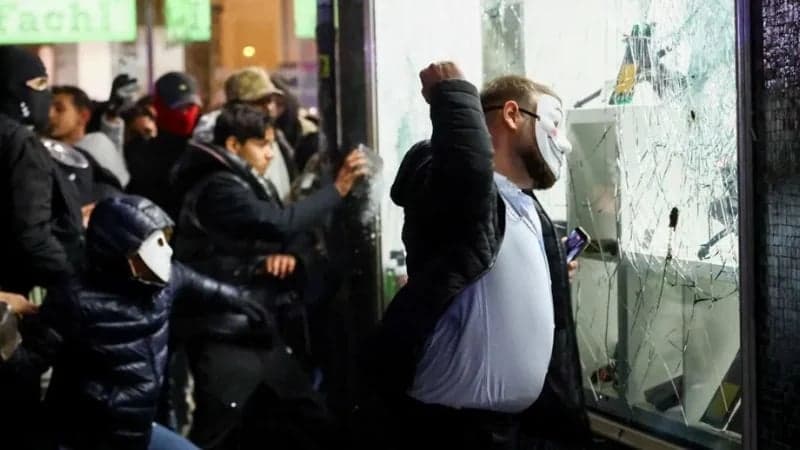

Violence erupted during youth-led protests across Germany over demands for increased funding for education and healthcare, lower living costs and an end to compulsory military recruitment.
On Saturday (October 31) night, masked individuals vandalised and looted several shops in Frankfurt. Petrol bombs were also thrown at emergency service workers. Police launched operations to bring the situation under control.
According to a Reuters report, the youth movement ‘Gen Z Regelt’ organised demonstrations in 34 German cities on Saturday. Thousands of people took part in rallies in Berlin, Frankfurt, Munich and other cities. Protesters called for increased government investment in education, social services, culture and healthcare, alongside measures to reduce the cost of living. They also opposed compulsory military recruitment.
The situation escalated at night in Frankfurt, one of Germany’s major commercial centres. At least two shops were looted, while several other businesses were vandalised. Frankfurt police said on social media platform X that the windows of several shops in the city centre had been smashed. Petrol bombs were also thrown at emergency service workers. Authorities urged residents to avoid the city centre.
There was a discrepancy between organisers' and police estimates of the number of protesters. According to police figures, around 18,000 people participated in demonstrations in Frankfurt, Munich and Berlin combined. However, the organisers' website put the figure for these cities at approximately 36,000. Earlier, the movement had expected at least 182,000 participants nationwide.
German authorities said most demonstrations remained peaceful during the day. However, officials had warned in advance that extremist groups might attempt to exploit the protests. In Hamburg, several roadblocks were also set on fire.
Speaking at the Berlin rally, Lina Friedrich, a spokesperson for ‘Gen Z Regelt’, said the protesters had taken to the streets to stand for peace and freedom rather than war and coercion. She also called for increased investment in healthcare and education and a fairer distribution of social responsibilities. She reiterated the movement's opposition to compulsory military recruitment.
Meanwhile, businesses in several German cities took precautionary measures ahead of the demonstrations amid fears of possible violence. In Berlin's upscale Kurfürstendamm shopping district, some shops covered their glass windows with wooden boards. Several businesses also decided to close early.
According to Germany's Federal Ministry of the Interior, some far-left groups and organisations linked to foreign extremist movements have attempted to expand their influence within the protest movement. Hesse Interior Minister Roman Poseck also expressed concern over the violence. He said Germany should learn lessons from recent protests in France, where looting, arson and attacks on police were reported.
At a rally in Munich, an 18-year-old protester criticised the government's austerity policies. He argued that instead of addressing young people's concerns, the government was placing additional burdens on ordinary citizens. He said they would continue protesting by exercising their constitutional rights until their demands were met.
Germany has faced mounting pressure in recent years to improve economic growth. At the same time, its ageing population and declining working-age population have raised concerns about the rising costs of pensions and public services.
However, questions have also emerged over whether the ‘Gen Z Regelt’ movement is entirely led by young people. The involvement of various political and civic organisations has prompted concerns about its organisational structure. Germany's national student organisation, BSK, has distanced itself from the initiative and is planning a separate demonstration on November 20.
Sean Becker, a student at the Technical University of Berlin, also expressed his support for the protests. Highlighting the deteriorating condition of university buildings and inadequate learning environments, he said students were being forced to study in facilities that resembled abandoned buildings.
Source: Reuters
Leave A Comment