
The Boy who was named after a president
Ronaldo's story from a Madeira hospital room to a Dallas pitch
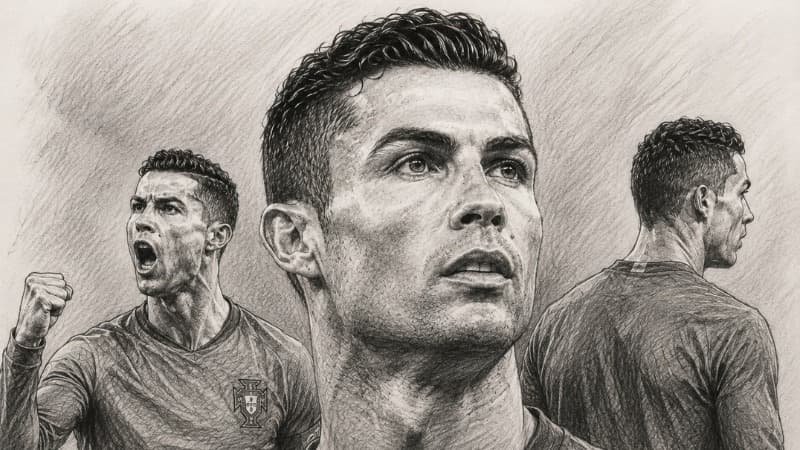

Funchal, Madeira, February 5, 1985. A fifth child is born into a family that doesn't have much — his father works as a gardener and kit man for a local club, his mother cooks and cleans in other people's houses. They name him Cristiano Ronaldo dos Santos Aveiro, the "Ronaldo" borrowed from Ronald Reagan, whom his father admired. Nobody in that room could have imagined the weight that name would carry one day.
He grows up poor, in a house on a steep hill, sharing a room with siblings, sometimes going without proper meals. Football is the one thing that's free. He plays barefoot, on concrete, obsessed — teachers remember a boy who couldn't sit still unless there was a ball at his feet. At twelve, he's diagnosed with a racing heart condition and undergoes a minor procedure to correct it, then goes right back to training like nothing happened.
Sporting CP spots him. He leaves home at fourteen, alone, homesick, crying himself to sleep some nights in Lisbon while his mother works two jobs back on the island just to visit him. This is the part people forget when they call him arrogant now — the loneliness that built the obsession.
Manchester, and the making of a machine
2003. Manchester United play a friendly against Sporting, and a teenage Ronaldo destroys them so completely that United's own players beg Sir Alex Ferguson to sign him before someone else does. He arrives as a flashy, stepover-happy winger everyone assumes will fade. Instead, under Ferguson's discipline, he rebuilds himself — extra shooting drills after training, obsessive gym work, a total reinvention of his body. By 2008 he's a Ballon d'Or winner and Champions League champion, the joy of Moscow's final still on his face.
Then Real Madrid, 2009 — a then-world-record transfer. What follows is almost unbelievable: he becomes Real Madrid's all-time top scorer, wins four Champions League titles in eight years, becomes the competition's all-time leading scorer, a record that may never be broken. Juventus. Then Manchester United again. Then Al-Nassr. Five Ballon d'Ors. A trophy case heavier than most clubs'.
For his country, he captains Portugal to their first-ever major title — Euro 2016 — limping off in tears in the final, only to return to the touchline as an assistant coach, screaming instructions from the sideline like his heart would break if they lost. It didn't. Portugal won.
The World Cup wound
But there's one thing missing from his cabinet, and it's the one that seems to matter to him most.
Six World Cups. A record no outfield player has matched. He's scored in each of the last six tournaments, becoming the first man in history to do so. And yet, twenty years on from Portugal's fourth-place finish in Germany 2006, they still haven't gone further than a quarterfinal.Now I have what I need.
July 6, 2026 — Arlington, Texas
Before the match, he had already said it himself: "This will be my last World Cup, but let's hope tomorrow isn't my last game." He talked about the tournament with something softer than his usual defiance — this was the World Cup he'd remember most, because of the passion of the people around him, calling it emotionally the best experience of his career.
Then the match itself: goalless, tense, both sides cautious, until the 91st minute, when Mikel Merino slid past the defense off a pass from Rodri and beat Diogo Costa to send Spain through. One goal. That was the difference between one more chapter and the end of the book.
Ronaldo was visibly emotional and in tears as it marked the end of this specific journey in his career. He exited the pitch at a FIFA World Cup for the final time. Twenty-three years, 232 caps, 146 goals for Portugal — and still, no World Cup trophy. He walked off a Texas field the same way he walked into a Lisbon academy at fourteen: alone with the weight of it, except this time, a whole stadium was watching him carry it.
The Rivalry that defined a generation
No story about Ronaldo is complete without the other name that shadows it — Messi. For nearly two decades, football split itself in two, and fans built entire identities around which of them was "the greatest." Ronaldo the physical marvel, built by will and repetition; Messi the natural, effortless genius. Both won everything there was to win, except the version of history where one simply retires the argument.
Here's where the story gets murkier — and more emotional for the fans who've stayed loyal through it. There's a narrative, popular among a section of Ronaldo's supporters, that his international teammates never served him the way Messi's did — that Argentina built its entire attacking structure around feeding Messi in his final tournaments, while Portugal never fully committed to doing the same for Ronaldo, whether out of ego, tactical stubbornness, or a quieter resentment of his stardom. You'll see it in comment sections after every Portugal exit: 'if only they passed to him more, respected him like Messi's teammates respect Messi.'
It's a real and deeply felt belief, but it's worth holding gently rather than as settled fact. The counter-argument, made by many pundits and even rival coaches, is less about sabotage and more about squad depth and system — Argentina in Messi's prime had De Paul, Di María, and a midfield built to funnel the ball to one man; Portugal, across Ronaldo's career, often had more individually gifted attackers (Figo, Nani, Bruno Fernandes, now Rafael Leão) competing for the same service, in teams that didn't always organize around a single focal point. Spain's own coach, ahead of this very match, spoke with open admiration rather than rivalry — calling himself a fan of players with ambition and character who are tireless and want to be better every day. That's not the language of a sport that disrespects him — it's the language of one that, even in his decline, still can't look away.
What's left
Ronaldo himself has addressed the scrutiny directly — saying people have tried to tear him down for 23 years, and that he's stopped paying it much mind. Whatever the truth of the teammate theories, whatever the final verdict in the Messi debate — and it will never be fully settled, because greatness like theirs doesn't resolve into a single number — the image that will likely outlast the arguments is the one from Monday: a 41-year-old man, exhausted, crying, walking off a World Cup pitch for the last time, having given it absolutely everything he had, and still coming up one goal short of the only trophy that ever eluded him.
Not a villain, not a saint. Just a boy from a hill in Madeira who turned obsession into history, and still wasn't done wanting more.
Leave A Comment