
Saudi, Turkey, Pakistan sign joint defence pact
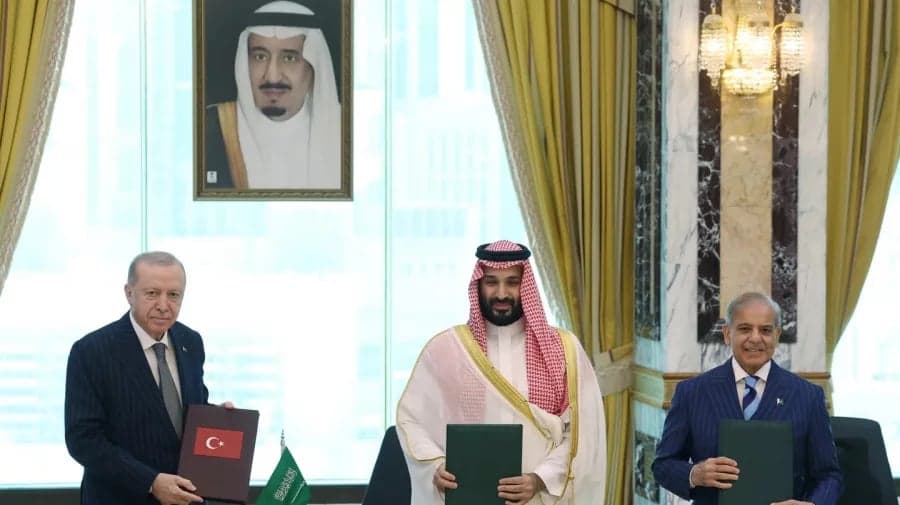

Saudi Arabia, Pakistan and Turkey have signed a joint defence pact in the holy city of Makkah amid the Iran war and escalating conflict in the Middle East. The three Sunni-majority nations, all allies of the United States, formalised their defence partnership through the Makkah Defence Pact on Friday, August 7.
Since the US and Israel launched a major offensive on Iran on February 28, Iran and its allies have been carrying out missile strikes on Saudi Arabia and other Gulf oil-exporting nations and blockading energy shipments.
A joint statement from the three countries stated that the primary objective of the pact is to build a collective defence against any aggression. Under the agreement, an armed attack on any one of the three countries will be considered an attack on all.
While the specific obligations of the pact were not made public, it was stated that the main goal is to strengthen collective security and ensure peace and stability in the region. A Turkish official said the pact is defensive in nature and not directed against any specific country. It is open to other regional nations and does not override any existing bilateral or multilateral agreements.
With the traditional US ally struggling to contain regional chaos, all three countries are deeply concerned about the aggressive military postures of Israel and Shia-ruled Iran.
Abdul Aziz Sager, chairman of the Saudi-based Gulf Research Centre, said the political symbolism of this summit is highly significant. Three of the most influential Muslim-majority nations are showing interest in closely coordinating security matters amid uncertainty.
Turkey has the second-largest military force in NATO, Saudi Arabia is the custodian of Islam's holiest sites and one of the world's top oil exporters, and Pakistan is the only Muslim-majority nation with nuclear weapons.
Ahead of the pact, Pakistan's Prime Minister Shehbaz Sharif and powerful army chief Asim Munir performed Umrah in Makkah and later met with Saudi Crown Prince Mohammed bin Salman in the presence of Turkish President Recep Tayyip Erdogan.
Since the war began on February 28, Saudi Arabia has repeatedly come under attack from Iran, Yemen's Houthis and Iraqi Shia militias. Shipping through the Strait of Hormuz, a route for nearly one-fifth of the world's energy supply, has come to a halt.
The pact is the result of nearly a year of negotiations. Following Hamas's attack on Israel on October 7, 2023, the conflict spread across the Middle East. Israel has waged war in Gaza, attacked southern Lebanon, seized territory in Syria and conducted two airstrikes on Iran. Iran, in turn, has struck US bases and civilian infrastructure in Saudi Arabia, Kuwait, Bahrain, Qatar, the UAE, Oman, Jordan and Israel.
With their own security and economies under threat, Turkey and Pakistan are eager to restore peace. For Saudi Arabia, the conflict has put its oil exports and domestic development plans at serious risk, also raising questions about dependence on the US security umbrella.
Mansoor Ahmed of the Strategic and Defence Studies Centre at the Australian National University said Pakistan and Turkey have strong defence industries, while Saudi Arabia can invest financially and technologically. However, he believes Pakistan's nuclear capability is unlikely to be part of the pact due to threats from India.
Pakistan has been providing training and technical assistance to Saudi forces for decades. In 2023, Riyadh signed a deal to purchase Turkish drones. Recently, Pakistan has also deployed about 8,000 troops, fighter jets, drones and an air defence system in Saudi Arabia.
Source: Times of Israel
Leave A Comment