
School feeding crisis: Addressing food insecurity and way out
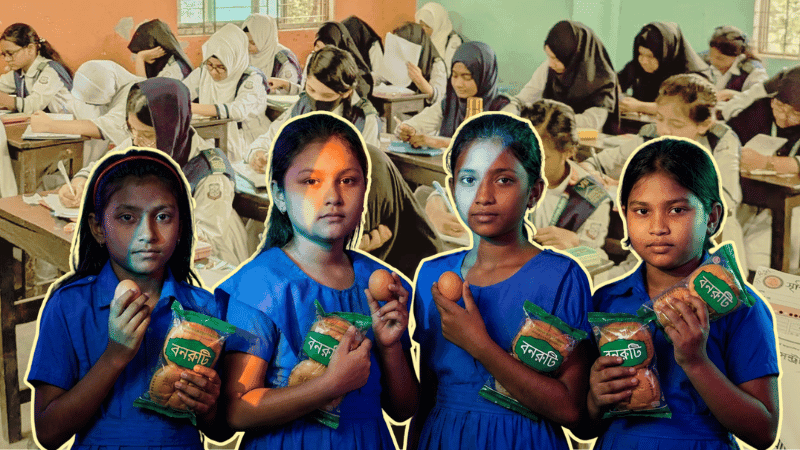

The incident involving 18 students who fell ill after consuming food from the school feeding program at Salim Dolpara Government Primary School in Chapainawabganj Sadar Upazila has once again brought to light a troubling question: why does a program intended to provide nutritional support for children repeatedly pose health risks to them?
According to government reports, 10 of the students who became ill required hospitalization. Initially, the causes cited included both substandard or unhealthy food and excessive heat. Food samples have been sent for laboratory analysis. An investigation will be carried out, a report will be generated, and accountability will be established. However, one must ask, is this the first occurrence of such an incident?
The answer is no.
In recent years, there have been numerous complaints regarding the food provided by the school feeding program across various districts and upazilas in the country. Some complaints have involved rotten or foul-smelling boiled eggs, others have reported raw or inferior quality bananas, expired biscuits, and subpar bread. In certain instances, students have fallen ill, while in others, they have been compelled to discard the food. These occurrences are not isolated but rather indicative of a broader systemic issue.
Currently, approximately 13.5 million students are enrolled in 65,566 government primary schools in Bangladesh. The government has plans to gradually implement a mid-day meal or school feeding program in all schools. Presently, eggs, milk, bananas, biscuits, and buns are provided to children on different days of the week, with an expenditure of about 40 to 50 taka per student each day.
In essence, this initiative is not merely a food distribution program; it represents one of the largest human resource development initiatives in the country.
Global research indicates that nutritious food programs in schools enhance children's attendance, decrease dropout rates, improve focus, and positively influence long-term educational achievements.
In Bangladesh, where malnutrition, anemia, and poverty continue to pose significant challenges to child development, the significance of the school feeding program is amplified. However, the most critical issue facing such an extensive program is the control of food quality.
Particular concern has been raised regarding the distribution of boiled eggs. Food safety experts warn that keeping boiled eggs at room temperature for extended periods poses a risk. Once boiled, the egg's natural protective barrier is compromised, increasing the likelihood of bacterial contamination.
If these eggs are transported and stored for several hours in the extreme heat of Bangladesh, it could pose a serious health threat.
In a similar vein, quality control is crucial for products such as milk, bananas, and bread. Many children experience lactose intolerance, while others may have allergic reactions to specific foods. However, there is currently no registered database in our schools that tracks the food sensitivities of children.
Consequently, identifying and managing health risks becomes a challenging task.
Conversely, there are ongoing complaints regarding the supply system. Although suppliers are chosen through tenders in accordance with government procurement policies, concerns about transparency persist in various sectors. Allegations of local political influence, syndicates, subcontracting, substandard food supplies, overbilling, and inadequate supervision are not new issues. Even when investigation reports are produced, their clear findings are seldom made accessible to the public. This lack of transparency hinders the development of a culture of accountability.
Indeed, the most significant crisis is that children are unable to voice their concerns. They do not have the status of voters, lack an influential demographic, and do not possess the social power to advocate for their rights.
Consequently, their struggles often become obscured within the broader context of statistics. A fundamental principle of political science asserts that the moral integrity of a state can be gauged by its commitment to protecting its most vulnerable citizens.
Thus, child food security transcends mere administrative concern; it fundamentally reflects the morality of the state.
There exists an alternative approach as well. A few years ago, a remarkable initiative rooted in local participation was implemented at the Tarbagan Guchchagram Government Primary School in Haripur Upazila of Thakurgaon. In this instance, regular hot meals were provided to children without government funding, thanks to the collaboration of villagers, teachers, and guardians. Mothers took turns preparing meals, and local rice and vegetables were sourced, resulting in a significant increase in student attendance.
This experience imparts a vital lesson: the involvement of the local community is essential, rather than relying solely on the central supply system.
The recent initiative by the Ministry of Primary and Mass Education to establish a five-member ‘Guardian Committee’ consisting of mothers at the school level is a commendable advancement. However, this committee should not merely exist as a theoretical framework. It is essential that they possess genuine supervisory authority, avenues for receiving complaints, and an efficient mechanism for redressal. Several essential reforms are now imperative.
Firstly, stringent quality control must be enforced at every phase of the food supply chain. Secondly, both regular and unannounced inspections at the local level should be intensified. Thirdly, provisions should be made to digitally store information and images of the food supplied on a daily basis. Fourthly, should any food-related discrepancies be substantiated, legal action must be initiated against the supplying entity. Lastly, a local source-based food procurement model should be developed, engaging local farmers, dairy producers, and women entrepreneurs.
It is crucial to recognize that irregularities in the food provided to children should not be dismissed as mere corruption. These are serious offenses against the health of children.
Bangladesh stands as a remarkable success story in terms of development, growth, and infrastructure. However, the true advancement of any nation is gauged by the quality of life afforded to its children. A child arriving at school with an empty stomach is not seeking charity from the state, but rather asserting their rights. Providing safe and nutritious food on their plate is not an act of kindness; it is the constitutional and moral obligation of the state.
The recent event in Chapainawabganj is not merely a report of a few students falling ill. It serves as a cautionary tale. If prompt and effective actions are not undertaken, this significant initiative, valued at thousands of crores of taka, risks being undermined by corruption, mismanagement, and a loss of public trust. Ultimately, it is the children, who embody the aspirations for Bangladesh's future, that will bear the greatest burden.
Dipu Mahmud
Writer, Journalist
Leave A Comment