
Sheikh Hasina's announcement to return home, death sentence, and judicial maze
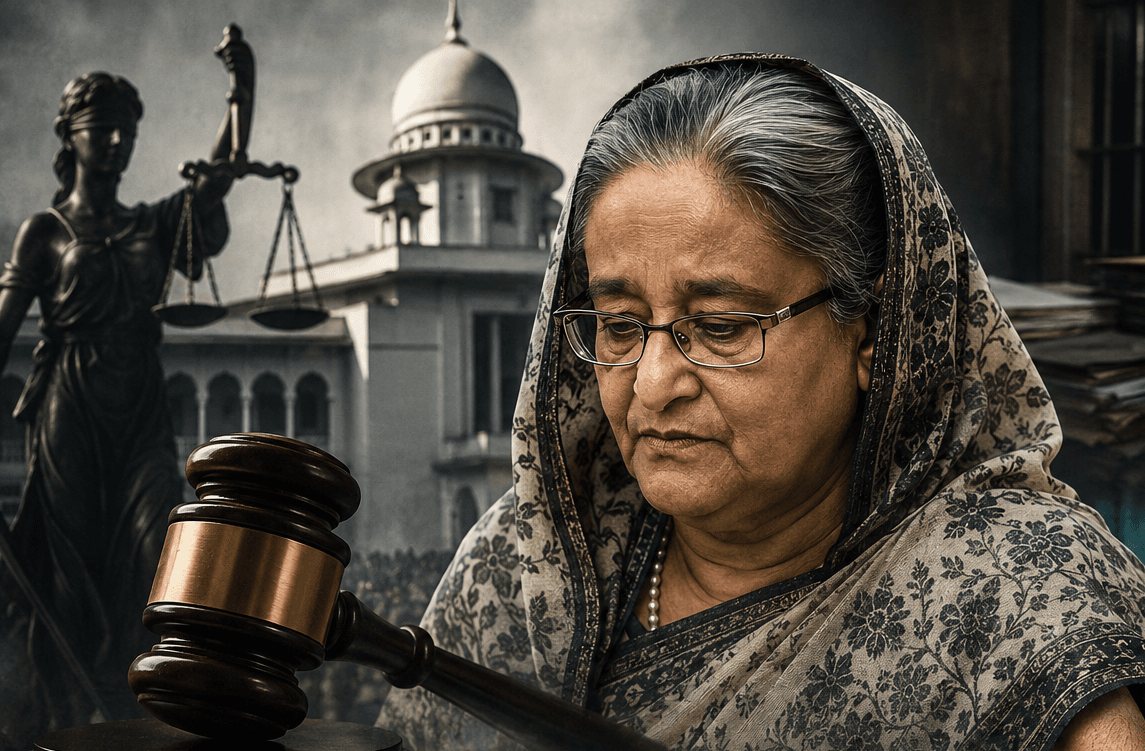

A recent statement by Chief Prosecutor Mohammad Aminul Islam of the International Crimes Tribunal (ICT) has reignited public debate over the possible return of former Prime Minister Sheikh Hasina, who has been sentenced to death. Speaking on Sunday, he said, "There is no legal barrier preventing Sheikh Hasina from returning to Bangladesh. In fact, the prosecution wants her to come back, face the court, and challenge the verdict against her through the legal process."
His remarks have raised an important question: if there is no legal obstacle to her return, what are the real challenges awaiting her? With a death sentence handed down by the International Crimes Tribunal, a pending death reference before the High Court, the possibility of an appeal, multiple arrest warrants, and hundreds of criminal cases filed across the country, how would her legal battle unfold? The answer lies within Bangladesh's complex judicial system.
The Right to Return vs. the Reality of Prosecution
Under the Constitution of Bangladesh, the scope for preventing a citizen from entering the country is extremely limited. Therefore, if Sheikh Hasina wishes to return, there is no legal basis to stop her from doing so.
However, the moment she returns, she would immediately enter a complicated legal process. From the International Crimes Tribunal to district courts across the country, she faces hundreds of cases involving allegations of murder, attempted murder, genocide, enforced disappearances, crimes against humanity, abuse of power, and other offences. Arrest warrants issued by various courts in many of these cases also remain in force.
According to Attorney General Ruhul Quddus Kajal, law enforcement agencies would be responsible for executing those warrants immediately upon her arrival. Thereafter, she would have to appear before multiple courts, face remand proceedings, seek bail, respond to formal charges, and undergo witness examinations—marking the beginning of what could be a lengthy and complex legal battle.
Does a Death Sentence Mean Immediate Execution?
Although many people assume that a death sentence automatically leads to swift execution, Bangladesh's judicial system follows a very different legal process.
A death sentence delivered by the International Crimes Tribunal is not immediately enforceable. The tribunal must first publish its full judgment. Subsequently, the death reference and all related judicial records are forwarded to the High Court Division for mandatory review. The High Court may uphold, modify, or overturn the sentence. Even after the High Court's decision, the convicted person retains the right to appeal before the Appellate Division of the Supreme Court. Until every stage of the judicial process has been completed, the death sentence cannot be carried out.
According to senior Supreme Court lawyer Ahsanul Karim, Sheikh Hasina's case could become even more complicated because she is currently outside the country and did not file an appeal within the prescribed time.
Has the Opportunity to Appeal Expired?
The Chief Prosecutor has stated that, since no appeal was filed within the statutory deadline, the matter now rests with the discretion of the court.
Under the law, an appellant may file an application explaining the reasons for the delay and seek condonation of that delay. If the court is satisfied with the explanation, it may allow the appeal to proceed. In other words, the door to an appeal is not completely closed, but neither will it reopen automatically.
Hundreds of Cases: A Rare Chapter in Bangladesh's Judicial History
The International Crimes Tribunal case is only one part of Sheikh Hasina's legal challenges. She also faces an unprecedented number of cases pending before courts across Bangladesh. These include allegations of murder, attempted murder, enforced disappearances, crimes against humanity, corruption, abuse of power, violence during the July–August mass uprising, the Shapla Chattar operation, and several other incidents. Many investigations remain ongoing, while additional complaints continue to be filed.
Consequently, if she returns, she would have to face simultaneous legal proceedings before multiple courts, tribunals, and investigative agencies. Legal experts believe that the simultaneous prosecution of a single individual in such a vast number of cases would be virtually unprecedented in Bangladesh's judicial history.
From Political Controversy to the Courtroom
Another significant aspect of Chief Prosecutor Mohammad Aminul Islam's remarks is that the prosecution intends to resolve the matter through judicial proceedings rather than political debate.
According to him, Sheikh Hasina has been prosecuted under the doctrine of superior responsibility, which holds senior leaders legally accountable for crimes committed under their authority. Therefore, the courtroom—not the political arena—will provide her with the opportunity to present her defence.
Meanwhile, discussions have also intensified regarding the legal accountability of the Awami League. Referring to provisions of the International Crimes (Tribunals) Act, 1973, and the Anti-Terrorism Act, 2009, the prosecution argues that if sufficient evidence is established during the investigation, even a political party may be brought under judicial scrutiny.
The Biggest Question: What Comes Next?
Whether Sheikh Hasina will actually return to Bangladesh has long been the subject of political speculation. From a legal perspective, however, the more pressing question is different.
If she does return, how will Bangladesh's judiciary simultaneously manage the death sentence handed down by the International Crimes Tribunal, the pending High Court death reference, any potential appeal, hundreds of criminal cases pending before different courts, and ongoing investigations?
Bangladesh's judicial system has witnessed many high-profile political cases over the decades. Yet the prospect of a former prime minister simultaneously facing a death sentence, conviction by the International Crimes Tribunal, and prosecution in hundreds of criminal cases across multiple jurisdictions would be entirely unprecedented.
For that reason, Sheikh Hasina's possible return is no longer merely a political issue. It has become a crucial test of Bangladesh's Constitution, its criminal justice system, the prosecution of crimes against humanity, and the practical application of the rule of law. The course of these judicial proceedings in the coming days is likely to determine the outcome of one of the most consequential chapters in Bangladesh's contemporary political history.
Leave A Comment