
Spain punish Lammens error to set up France semifinal: Is this the real final?
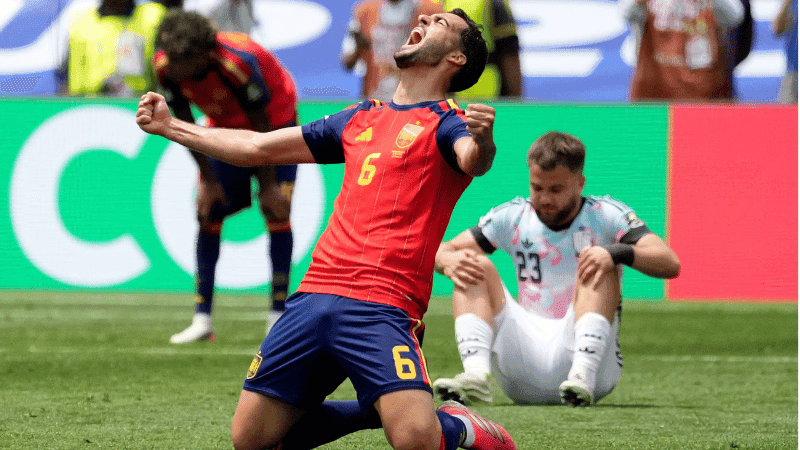

Mikel Merino capitalized on a late blunder by substitute goalkeeper Senne Lammens to send Spain into the World Cup semifinals with a victory over Belgium.
Spain broke Belgian hearts late in the match when Lammens spilled a shot from Pau Cubarsi. Merino, who had just come off the bench, reacted quickest to poke the rebound home with only his second touch of the game. Lammens had only entered the pitch in the 71st minute after Belgium's star goalkeeper Thibaut Courtois was forced off in tears with what appeared to be a severe thigh injury. Though Lammens has enjoyed an impressive debut Premier League season with Manchester United, he could not recover in time to stop Merino from sealing the win on his third international appearance.
Belgium, who reached the quarterfinals after demolishing the USMNT, faced adversity before kickoff when key midfielder Youri Tielemans was injured during the warm-up. Spain took advantage of the disruption on 30 minutes when Fabian Ruiz pounced on a rebound to open the scoring. The goal ended a spectacular defensive run for Spain, who had not conceded a goal for nearly 11 hours. However, Belgium fought back, breaking Spain's clean-sheet streak when a clever pass from Kevin De Bruyne eventually set up Charles De Ketelaere to power a superb header past Unai Simon.
Controversy struck when Belgium passionately appealed for a penalty after the ball struck Rodri’s arm inside the box. However, referee Michael Oliver and a VAR review deemed the handball accidental, as the ball had deflected off a teammate at close range.
Following the dramatic finish, Spain advances to face France in a highly anticipated semifinal matchup in Dallas on Tuesday. Meanwhile, the remaining semifinalists will be decided on Saturday as Norway faces England, and Argentina takes on Switzerland.

Is France vs Spain the ‘real’ final?
The upcoming World Cup semifinal between France and Spain in Dallas on Tuesday is already being hailed by many as the "real" final of the tournament.
This blockbuster matchup brings together what are arguably the two finest teams in the competition, echoing a familiar World Cup trend where the ultimate showdown takes place just ahead of the actual final. The clash is being billed as a classic battle between an unstoppable force and an immovable object. Didier Deschamps’ French side boasts the most formidable frontline in the tournament, with Kylian Mbappé, Ousmane Dembélé, Michael Olise, and Désiré Doué forming an attack that looks practically irresistible to any defense.
If any backline is equipped to resist them, however, it is Spain's. The goal Luis de la Fuente's men conceded to Charles De Ketelaere in the quarterfinals was the very first they allowed in the entire tournament, following an incredible run of five consecutive clean sheets against Cape Verde, Saudi Arabia, Uruguay, Austria, and Portugal.
Tactically, a strong school of thought suggests that the best way to nullify France's attacking threat is simply to deny them possession. While fans have been captivated by Lionel Messi and the gripping football of Argentina, Spain remains the absolute best team in the tournament at controlling the ball and dominating the tempo of a game.
With both sides operating at the peak of their powers, the fixture possesses all the hallmarks of a legendary World Cup encounter. Whichever heavyweight emerges victorious on Tuesday will undoubtedly enter next weekend's final as the overwhelming favorite to lift the trophy, regardless of who wins the opposite side of the bracket.
How costly was Courtois’ injury?
Thibaut Courtois’ second-half injury proved catastrophic for Belgium, directly leading to the late error that crashed them out of the World Cup.
Already coping with the absences of Youri Tielemans and Amadou Onana, Belgium suffered a definitive blow when Courtois succumbed to an apparent left thigh injury. The 34-year-old goalkeeper desperately attempted to push through the pain but was forced to give up after a hydration break. Leaving the pitch reluctantly and in tears, Courtois' exit raises looming questions about how many more World Cups the veteran star—alongside talisman Kevin De Bruyne, who also exited shortly after with severe cramp—will ever see. Ahead of the match, Spain coach Luis de la Fuente had lauded Courtois as one of the world's top five goalkeepers, and his departure instantly stripped manager Domenico Tedesco's side of its biggest defensive anchor.
Belgium turned to Manchester United’s Senne Lammens, who was fresh off a quality debut season at Old Trafford, but the young substitute was immediately punished on the world stage. Faced with his first proper test, Lammens fumbled a long-range effort from Pau Cubarsí, spilling the ball directly into the danger zone.

Arsenal midfielder Mikel Merino, acting as Spain's ultimate super-sub just as he did in the previous round against Portugal, reacted quickest to smash home the rebound. While Courtois rarely commits such errors, his forced departure ultimately cost Belgium their place in the tournament.
Should Belgium have had a penalty?
Refereeing experts have backed the decision to deny Belgium a late penalty, confirming that the match officials correctly applied official guidance regarding Rodri’s controversial handball.
While Belgian players passionately appealed for a spot-kick after the ball struck Rodri's arm inside the penalty box, referee Michael Oliver and the VAR team opted not to penalize the Spanish midfielder. Refereeing expert Graham Scott explained that the decision was rooted firmly in the specific technical guidance provided to officials by FIFA and UEFA, rather than a rigid interpretation of handball law.

According to Scott, the official guidance dictates that a player cannot be expected to avoid contact when the ball deflects off a teammate at such close quarters. Because the ball struck Rodri from immediate proximity, he had absolutely no chance to move his arm out of the way. Furthermore, the Spanish midfielder did not make his body unnaturally bigger, nor did he deliberately place his arm in an unjustifiable position to block the ball. Scott concluded that dismissing the penalty appeals was entirely the correct decision, aligning perfectly with both the letter of guidance provided to officials and the true spirit of the law.
Did the decision to pick Ruiz pay off?
Luis de la Fuente’s surprise tactical gamble fully paid off as Fabián Ruiz justified his selection with an impactful, goal-scoring performance before making way in the second half.
The Spain manager raised eyebrows ahead of kickoff by dropping Barcelona midfielder Pedri to the bench in favor of Ruiz. When fit, Pedri is typically a guaranteed starter for La Roja, and despite a middling tournament, he was widely expected to retain his place for the heavyweight clash against Belgium. However, Ruiz—who was one of Spain's standout performers during their Euro 2024 triumph—seized the opportunity immediately. The Paris Saint-Germain midfielder was deployed to help Spain overload the left flank, a tactical move that successfully freed up Álex Baena to drift across the pitch and cause persistent problems for the Belgian defense.
While Pedri often plays a more withdrawn role to recycle possession and aid the counter-press, Ruiz adopted a much more positive, advanced position. This forward-thinking approach paid massive dividends in the 30th minute. Capitalizing on some lax Belgian marking, Ruiz displayed sharp instincts to pounce on a rebound after Dani Olmo's initial shot was saved, breaking the deadlock to give Spain the lead.

The goal led to a lighthearted moment when Mikel Oyarzabal enthusiastically kicked the match ball high into the stands in celebration, unaware that Ruiz wanted it. Undeterred, Ruiz quickly grabbed a replacement ball from behind the goal to perform a baby tribute in anticipation of the upcoming birth of his first child. Ruiz continued to find dangerous spaces early in the second half before his evening cut short, as he lasted just 10 minutes after the restart before being replaced by Pedri.
Why was Tielemans missing and how much did it hurt Belgium?
The sudden withdrawal of Youri Tielemans during the pre-match warm-up inflicted a monumental blow on Belgium's midfield, severely undermining their chances against Spain.
Belgium’s engine room was already heavily depleted prior to kickoff, as Amadou Onana had been ruled out for the remainder of the tournament after suffering a knee injury against the USMNT in the round of 16. The loss of Tielemans right before the match compounded manager Rudi Garcia's selection crisis. There had been no prior indication of fitness issues when the Aston Villa midfielder took the pitch with his teammates, but he tweaked his hamstring during a routine practice drill while reaching for the ball. After alerting the backroom medical staff, Tielemans was forced to withdraw from the starting lineup, leaving Garcia with no option but to draft in Hans Vanaken.
The consecutive losses of Onana and Tielemans—who are not only crucial international starters but also club teammates at Aston Villa—stripped Belgium of two highly experienced Premier League players. While their replacements, Vanaken of Club Brugge and Nicolas Raskin of Rangers, are solid professionals, they simply lack the elite caliber of the missing duo.
Spain were already strong favorites entering the quarterfinal, but the announcement of Tielemans' absence caused their odds to skyrocket. Tactically, the late change completely disrupted Garcia’s carefully planned blueprint. The manager frequently structures his team around a definitive starting lineup and a designated "finishing" lineup—which includes strategic bench options like Romelu Lukaku to close out games. Because Tielemans is an indispensable starter, his absence significantly diminished Belgium's tactical setup and weakened the overall quality of the matchup.
How did the referee stop Olmo?
In a bizarre first-half sequence, Dani Olmo’s elusive movement managed to completely catch out referee Michael Oliver, resulting in an accidental mid-pitch collision.
Midway through the opening half, the Spanish playmaker cleverly drifted into a dangerous attacking midfield pocket. As Olmo shaped to thread a pass out to the left wing, he ran directly into a hefty body check from Oliver, who had failed to clear the passing lane.

The collision was entirely accidental, and Oliver immediately blew his whistle to halt play, raising his hands to apologize to the midfielder. While Olmo was visibly frustrated after absorbing the impact from the referee's shoulder, he was unhurt, and play quickly resumed without further incident.
Leave A Comment