
Spanish armada quells French revolution to sail into World Cup final
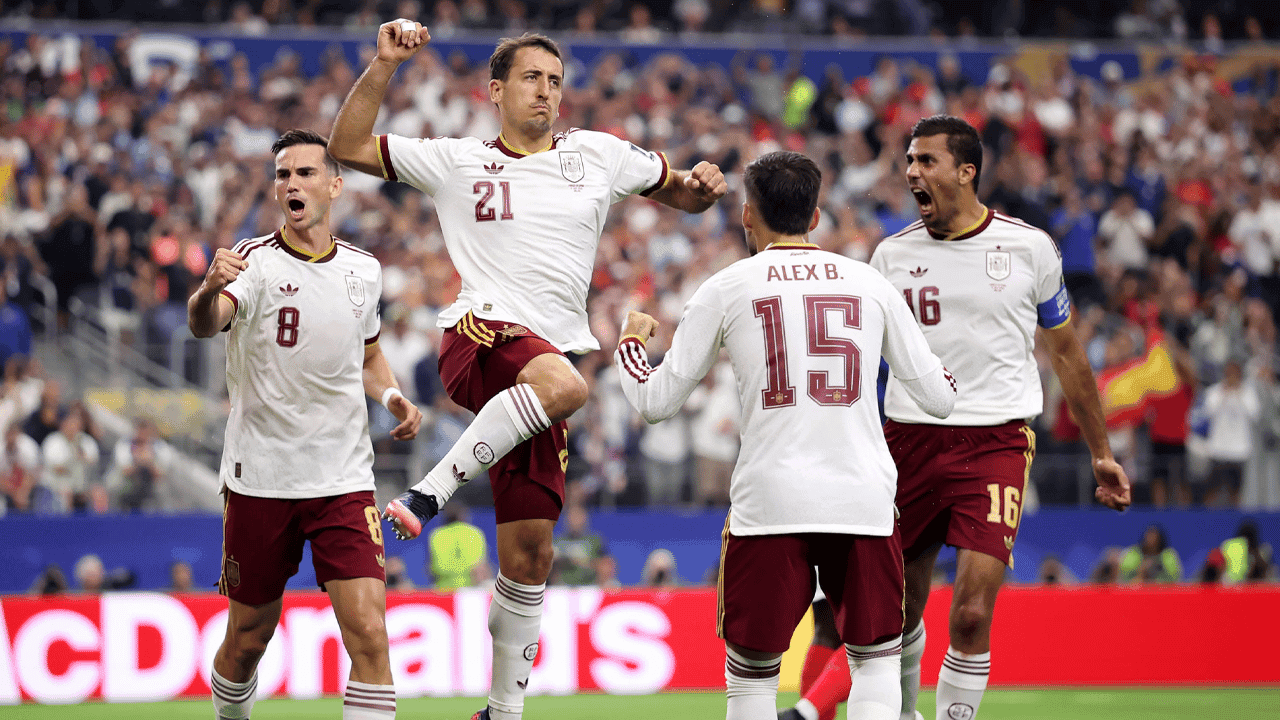

Spain has advanced to its first World Cup final since 2010 after a commanding 2-0 semifinal victory over Kylian Mbappe and France.
Spain, who entered the clash protecting a 36-game unbeaten streak, opened the scoring in the first half from the penalty spot. France defender Lucas Digne committed a careless foul inside the area, swinging a leg without looking and bringing down Lamine Yamal. Mikel Oyarzabal stepped up to roll in the penalty, marking his fifth goal of the tournament.
France’s defensive struggles compounded when Arsenal centre-back William Saliba was forced off with an injury. Spain quickly took advantage of the reshaped French backline early in the second half, with Pedro Porro finishing off a slick team passing move to double the lead.
Les Bleus struggled to mount any threat, failing to register a single shot on target until the 81st minute when substitute Desire Doue's underhit lob was easily dealt with. As frustrations boiled over in the closing stages, Mbappe was booked for a late challenge on Spanish goalkeeper Unai Simon.
Spain will now travel to MetLife Stadium in New Jersey for Sunday's final, where they will play the winner of the semifinal between England and Argentina. France will head to Miami on Saturday to play the loser of that match in the bronze final.
Has Spain historically been the dominant force in the World Cup?
A masterclass in possession and defensive rigidity has forced a widespread rethink of Spain's World Cup credentials, following a 2-0 semifinal triumph that completely overshadowed Kylian Mbappe and France's heavily hyped attack.
Prior to the match, Spain had largely flown under the radar at this tournament. An opening-match draw against Cape Verde was widely branded an embarrassment, and subsequent group-stage victories over Saudi Arabia and a weak Uruguay side failed to generate significant excitement. Additionally, a lingering hamstring injury had heavily restricted star forward Lamine Yamal's early involvement, preventing him from becoming the tournament's expected headline act.
However, Spain's semifinal performance served as a definitive reminder of their status as world football's premier passing side, culminating in a dominant display that even drew "oles" from the crowd as they toyed with the French team in the closing minutes. The victory also extended an incredible run of form; excluding a penalty shootout defeat to Portugal in last year's Nations League final, Spain has not lost a match since March 2023.
Crucial to the victory was Spain's defensive unit, which currently boasts the best record in the tournament. The backline entirely neutralized the free-scoring French offense, limiting them to a solitary shot on target prior to added time. Furthermore, Yamal's dazzling performance suggests he is peaking at the perfect moment, leaving French defender Lucas Digne thoroughly exposed throughout the evening.
With coach Luis de la Fuente’s pre-match prediction that "Lamine’s great day is still to come" looking increasingly prophetic, a newly appreciated Spain team now marches into the final as the team to beat.
What tactical issues caused Kylian Mbappé and France's forward line to underperform?
A stark lack of execution and mounting frustration saw France’s highly lauded attack fall completely flat in their 2-0 World Cup semifinal defeat to Spain.
The match initially promised a lively display from the French front line, labeled the tournament's premier "demolition crew." In the opening moments, Bradley Barcola successfully lured Spanish right-back Pedro Porro into a rash challenge, clipping the ball over his marker and driving toward the penalty area before seeing his left-footed cross blocked. However, that burst of energy proved to be France's solitary moment of true incision during the first hour of play.
As the match progressed, poor decision-making plagued France's creative stars. Michael Olise missed a crucial opportunity to release an isolated Kylian Mbappe through a stretched Spanish defense, failing to deliver the correct pass. A definitive pattern soon emerged for Olise, Barcola, and Ousmane Dembele, as promising attacking ideas were consistently undone by overhit passes and misdirected execution.
French frustrations quickly became visible across the pitch. Olise shifted to the right wing in an attempt to find space but was entirely contained by Spanish defender Marc Cucurella. The mounting tension showed when Olise escaped a booking after a heavy challenge on Rodri. Meanwhile, Mbappe remained largely starved of service up front and was repeatedly caught by the assistant referee's offside flag.
Manager Didier Deschamps attempted to spark a comeback before the hour mark by introducing Desire Doue for Barcola, later adding Rayan Cherki in place of Olise. By then, a dominant Spain had already established a comfortable two-goal cushion, leaving France entirely stifled.
France’s technical breakdown was ultimately encapsulated in the 81st minute when they finally registered their first shot on target. After Spanish goalkeeper Unai Simon rushed out to deny Mbappe, the loose ball fell to Doue. His subsequent effort—a low, scuffed shot that was easily gathered—fell miles short of the elite standards expected from the French squad, sealing a disappointing exit for the pre-match favorites.
What was the opening goal that put Spain ahead?
A defensive miscalculation by Lucas Digne gifted Spain a crucial early breakthrough in their World Cup semifinal victory, adding to a growing list of tournament penalties conceded by misjudged clearances.
The decisive moment mirrored previous high-profile incidents, such as Luka Modric being penalized for catching Noni Madueke during a volley attempt against England, and Harry Kane clipping Brian Gutierrez on the heel.
The sequence began when the ball flicked off the head of the French left-back, who is set to join Paris Saint-Germain this summer. With Lamine Yamal charging forward from behind, Digne instinctively swiveled to clear the ball but instead delivered a blind swipe that caught the incoming Spanish winger through the thigh.
Yamal appeared to anticipate the reckless challenge, launching himself toward the ball and ensuring he absorbed the contact. The collision left referee Ivan Barton with no alternative but to point to the penalty spot.
Mikel Oyarzabal capitalised on the mistake, drilling the resulting penalty firmly to the goalkeeper's left to put Spain ahead.
Was Lamine Yamal guilty of a handball infraction in the buildup to the penalty?
The controversial penalty sequence in the World Cup semifinal also raised brief questions regarding a potential handball by Lamine Yamal immediately before he was fouled by Lucas Digne.
Under official regulations, the threshold for a handball offense rests at the "green zone," which aligns with the bottom of the armpit. Any contact on or above this line cannot be penalized as an infraction. While frequently described as the "T-shirt line," official rules dictate a tighter threshold, as standard jersey sleeves typically extend much further down the arm.
Match analysis indicates that while the ball appeared to strike the Spanish attacker lower than the armpit line, his arm remained completely within his bodyline with the elbow tucked inward. Either factor provides sufficient mitigation under the laws of the game to rule out a handball offense.
Consequently, the officiating crew made the correct technical decision to play through the handball appeal and strictly penalize Digne’s subsequent foul inside the area.
Did France miss a clear warning?
A severe breakdown in France's midfield organization allowed Spain to seize total control early in the second half, paving the way for Pedro Porro to double the Spanish lead.
Warning signs flashed for French manager Didier Deschamps as his midfield grew increasingly fatigued and disorganized under sustained Spanish pressure. The shift in momentum was anchored by an imperious performance from Rodri, who won every duel and effortlessly distributed the ball to bypass sporadic bursts of French pressing.
The structural collapse of the French midfield became particularly evident in the 57th minute. Spanish defender Aymeric Laporte easily stepped out of the backline to filter a simple forward pass to Dani Olmo. The midfielder let the ball run across his body and advanced freely into open space.
Olmo’s advanced positioning behind France's midfield line caused persistent tactical issues, as he repeatedly found pockets of space directly in front of the French back four. His creative link-up play on the edge of the penalty area proved highly effective, highlighted by a clever first-half back-heel to Lamine Yamal and his perfectly weighted second-half assist. Porro collected the pass, darted inside to complete a sharp one-two with Olmo, and confidently lifted his finish over French goalkeeper Mike Maignan.
The uncharacteristic central collapse by a historically sturdy French side highlighted the effectiveness of Spain’s tactical approach. The Spanish victory was ultimately secured through relentless off-the-ball movement and a snappy counter-press that completely wore down the opposition.
Why was William Saliba forced off the pitch so early?
The sight of William Saliba limping off during the first half of France's World Cup semifinal defeat to Spain compounded a miserable night for Les Bleus, though the injury comes as little surprise given the Arsenal defender's recent admission of ongoing fitness struggles.
Saliba, a defensive pillar for both club and country, has been playing through pain for several months and previously revealed he was not at 100 percent physical capacity earlier in the tournament.
"I’ve had some minor niggles for several months," Saliba stated prior to France’s group-stage match against Iraq. "I’ve been gritting my teeth because there was the Champions League and the Premier League. But the coaching staff are handling it very well."
His departure severely disrupted a French defense that relies heavily on his composure, reading of the game, and established partnership with Dayot Upamecano—a pairing central to France's system. In contrast, his replacement, Maxence Lacroix, entered the high-stakes semifinal earning only his sixth international cap.
The injury will also spark immediate concern for Arsenal. The Premier League champions are scheduled to begin their title defense against Coventry City in just over a month, and their star center-back now appears to be a player in desperate need of an extended period of rest.
Is Rodri finally playing like a Ballon d’Or winner again?
DALLAS — Rodri’s triumphant return to peak form has anchored Spain’s march to the World Cup final, overcoming a series of injury-plagued periods for both club and country since he guided his nation to the Euro 2024 title.
Under manager Luis de la Fuente, Spain operates as a meticulously organized machine, with every player executing clear roles both in and out of possession. At the absolute center of this system is their 30-year-old captain, who dictated long spells of possession with perceptive passing while spearheading Spain’s immediate counter-press.
Rodri’s defensive anticipation was on full display just before halftime. As France enjoyed a rare spell of possession in the Spanish half, the midfielder stepped across to nick the ball away from Ousmane Dembele, before racing to the left flank moments later to block a Lucas Digne cross.
On the ball, Rodri dominated the central areas through seamless link-up play with midfield partners Fabian Ruiz and Dani Olmo. Michael Olise, deployed as the closest French player to Rodri, was largely left chasing shadows. The Bayern Munich playmaker's growing frustration was evident early in the match when he committed a late challenge on Rodri that narrowly escaped a yellow card.
While Rodri's starring role in Spain’s European Championship victory two years ago earned him the Ballon d'Or, a repeat of that individual acclaim seemed unlikely earlier in this tournament as superstar forwards dominated the headlines. However, Spain's semifinal masterclass served as a reminder that the biggest competitions are often won by the teams with the best midfielders—and no player in the tournament has controlled high-stakes matches quite like Rodri.
So, who is currently leading the race for the Golden Boot after this?
DALLAS — Despite France’s comprehensive semifinal defeat, Kylian Mbappe will have one final opportunity to bolster his tournament tally as Les Bleus prepare for the bronze final.
The 27-year-old forward has accumulated eight goals so far this summer, placing him squarely in the middle of a high-stakes race for the tournament's top individual honors. France will now face the losing side of tomorrow's highly anticipated semifinal clash between England and Argentina.
While FIFA officially bills the third-place play-off as the "Bronze Final," the fixture is traditionally regarded as a match that teams are reluctant to play. However, should Mbappe start the encounter, he could find opportunities to expand his goal count against a deflated opponent. Conversely, his primary rivals—such as Lionel Messi or Harry Kane—will likely be locked in what is anticipated to be a far tighter, more cautious championship final.
Using the third-place match to secure individual records has precedent in tournament history. Most notably, French legendary forward Just Fontaine famously added four goals to his record-breaking single-tournament tally of 13 during the 1958 third-place play-off against West Germany.
The individual standings heading into the final stages of the tournament highlight a tightly contested field:
Kylian Mbappe: 8
Lionel Messi: 8
Erling Haaland: 7
Jude Bellingham: 6
Harry Kane: 6
Ousmane Dembele: 5
Mikel Oyarzabal: 5
What was the referee's mistake?
A brief moment of embarrassment paused play during the World Cup semifinal when referee Ivan Barton realized he had forgotten his vanishing spray.
Barton was forced to delay a free-kick while he walked over to retrieve a spare canister from the fourth official on the touchline.
Such an oversight, while uncommon at the international level, is not unprecedented. Former professional officials note that forgetting the spray can carry stiff penalties in domestic leagues; one former English Football League referee recalled being fined an amount exceeding their post-tax match fee for the same mistake during a Championship fixture at Leeds United.
While Barton is highly unlikely to face a similar financial penalty for his minor indiscretion, his officiating fee for a high-profile World Cup semifinal is expected to far exceed standard English domestic league rates.
Leave A Comment