
Supreme Court cases to be settled outside court as legal aid ready
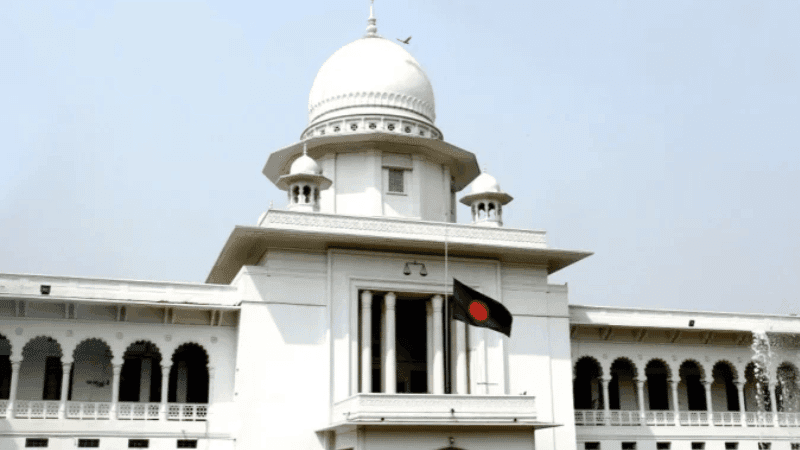

In Bangladesh, justice often means years of waiting. The same reality exists even at the country’s highest court. The long corridors of the Supreme Court have witnessed countless sighs of litigants, repeated hearing dates, legal fees, and the exhausting journeys of people travelling from districts to the capital. For many, pursuing a case eventually costs more than the amount of money involved in the dispute itself.
Against this backdrop, an alternative dispute resolution (ADR) system is set to be introduced at the Supreme Court to settle cases outside the traditional courtroom process. The Supreme Court Legal Aid Office will oversee the initiative, facilitating settlements through mediation between the parties involved.
A woman from Ramjanpur village in Kalkini upazila of Madaripur has been fighting a case over a Tk300,000 kabin claim that has remained pending before the High Court for the past two years. Even her lawyer cannot say when the case will be resolved. During this period, she has had to repeatedly travel from Madaripur to Dhaka, bearing the financial and emotional burden of transportation, accommodation, food, and legal expenses.
But if the dispute could be resolved within minutes through a discussion between the two parties at a table, does such a lengthy legal journey remain necessary? Seeking answers to this question, the Supreme Court Legal Aid Office is preparing to introduce Alternative Dispute Resolution (ADR), or out-of-court settlement mechanisms.
The system, which has been operating at district levels for years, is now being expanded to the Supreme Court Legal Aid Office. Officials believe that introducing ADR at the apex court will reduce the suffering of litigants, help ease the backlog of cases, and allow courts to use their time more effectively.
According to Supreme Court sources, 4,500,000 cases are currently pending across Bangladesh. To address this overwhelming backlog, the government has been taking steps to make the justice system more efficient. The latest government data shows that a total of 561,044 cases are pending at the Supreme Court alone. Of these, 522,331 cases are pending before the High Court Division, including 101,168 civil cases and 421,163 criminal cases.
Meanwhile, the Appellate Division has 38,713 pending cases, including 21,652 civil cases and 17,061 criminal cases.
On the other hand, Legal Aid Offices across the country have disposed of 230,503 cases between 2009 and March 2026. In this context, ADR is now being introduced at the Supreme Court as part of efforts to reduce case backlogs.
Chief Legal Aid Officer of the Supreme Court Legal Aid Office Imtiazul Islam told Views Bangladesh that millions of cases are currently awaiting trial at the Supreme Court, while hundreds of new cases are filed every day.
“ADR can become an important part of the initiative to reduce the number of pending cases at the Supreme Court. District Legal Aid Offices have already successfully resolved family disputes, civil cases, partition disputes and even some criminal matters through mediation. Introducing this system at the Supreme Court is a significant step,” he said.
He added that the initiative would help reduce case backlogs at the highest court and ease the suffering of litigants.
Law Minister Md. Asaduzzaman told Views Bangladesh that there is no longer any legal barrier to introducing ADR at the Supreme Court.
“After bringing the matter to the attention of the Chief Justice, instructions have been given to prepare the necessary proposal. The process has already begun,” he added.
However, he said the Chief Justice had suggested expanding the scope of ADR beyond the four categories of family disputes initially considered and including other civil and criminal cases that can be settled through compromise.
According to the proposal, disputes relating to dower, maintenance, restoration of conjugal rights, and custody of minor children may be included in the first phase of ADR.
Disputes involving dowry demands, maintenance of parents, and cases of minor injuries caused by dowry-related conflicts are also being considered. Later, some compoundable offences under the Penal Code and civil matters such as partition and declaratory suits may also be brought under the system.
The minister said the biggest feature of the initiative is that judicial authority will remain with the courts.
“The Legal Aid Office will only bring both parties to the discussion table. If a settlement is reached, the report will be sent to the concerned bench. If no settlement is reached, the case will continue through the existing legal process. This will create an additional pathway for speedy resolution while keeping the authority of the court intact,” he said.
Supreme Court lawyer and human rights activist Fawzia Karim Firoze told Views Bangladesh that in many cases, an acceptable solution through discussion can be more beneficial for society than a prolonged courtroom battle.
“Minor disputes between spouses or disagreements over small pieces of land often remain pending in courts for years. This affects not only finances but also family relationships, social dignity and mental peace. ADR can help break this deadlock,” she said.
However, she also raised concerns about the existing capacity of the Legal Aid Office.
“At present, the Supreme Court Legal Aid Office has only one officer and five employees. Its infrastructure is also inadequate compared to its needs. For a long time, the office did not even have sufficient computer facilities. Necessary rooms, record management systems and basic services for applicants remain limited,” she added.
She questioned whether the office would be able to handle increased demand once ADR begins, as more people from across the country are expected to seek assistance.
Meanwhile, the condition of panel lawyers working under Legal Aid is also not very satisfactory. A lawyer receives only Tk6,000 as an honorarium even after handling a case for years. As a result, many lawyers participate in legal aid services not for financial gain but as part of their social responsibility.
Fawzia Karim suggested that if lawyers were required to provide a certain portion of their services on a pro bono basis, the Legal Aid system would become stronger.
She also stressed the need for greater transparency and a competitive selection process in appointing Legal Aid lawyers. Without ensuring skilled lawyers and proper remuneration, the expected benefits of ADR may not be achieved, she added.
Attorney General Ruhul Quddus Kazal told Views Bangladesh that the concept of alternative dispute resolution is not new in Bangladesh’s justice system.
“However, introducing this system at the Legal Aid Office of the Supreme Court could open a new chapter for litigants. If quick and acceptable solutions can be achieved through discussion instead of lengthy trials, uncertainty and high costs, it will benefit litigants, bring relief to courts, and reduce the long-standing burden of pending cases,” he said.
Leave A Comment