
The all-time Spain dream team
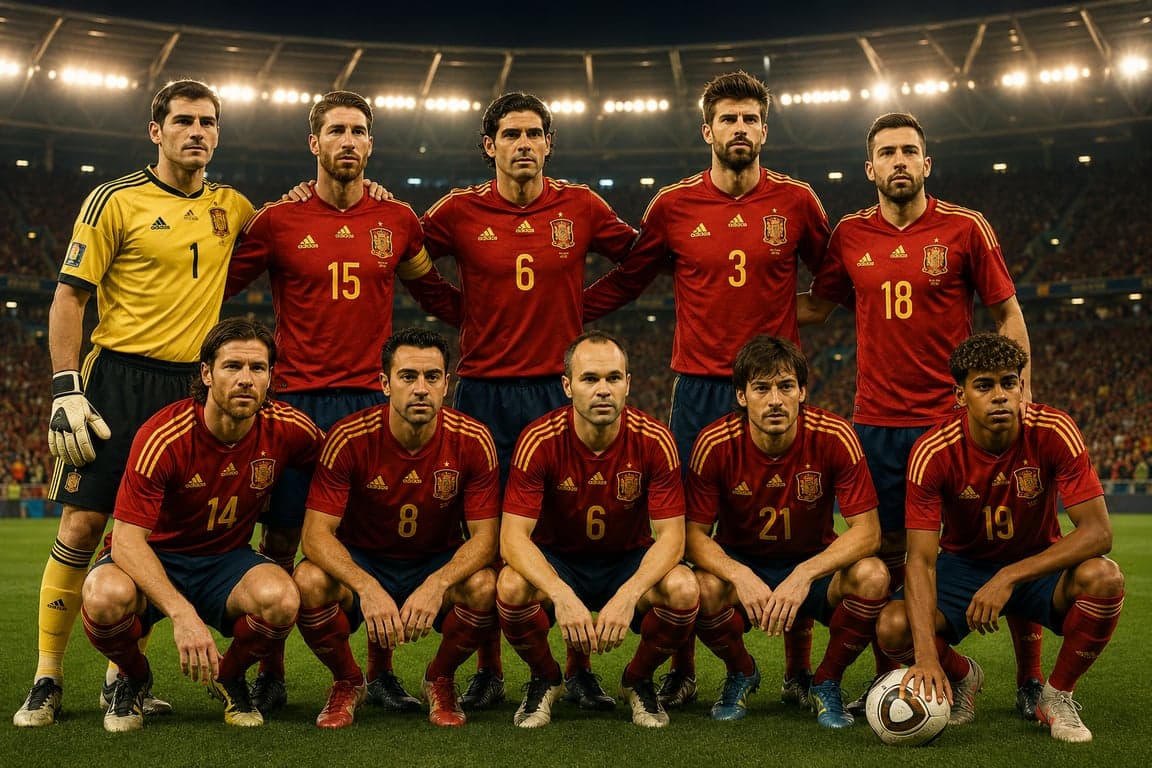

Spain defeated Austria 3-0 in the last 32 match of the World Cup that started at the first hour of Bangladesh time on Friday at the Sophie Stadium in Los Angeles. This is their first knockout victory since winning the 2010 World Cup. However, countless legends have emerged throughout the history of Spanish football. Some have triumphed in the World Cup, others have dominated Europe, and some have transcended mere trophies, elevating football to an art form. Certain players have served as formidable defenders, while others have orchestrated the game in midfield, and some have netted goals, securing a lasting place in the hearts of millions of supporters.
It is a challenge to accommodate all the stars within such a rich and seasoned team at present. Nevertheless, as an aficionado of football, I endeavor to construct a dream Spanish XI featuring those I have witnessed play over the past two decades. The selection of this XI is influenced not only by statistics but also by performance in crucial matches, leadership qualities, strategic significance, the varying football philosophies across different eras, and the personal experience of observing each player. This does not aim to represent the greatest Spanish XI of all time, but rather a fictional lineup composed of the finest players in Spanish football, as perceived through my own lens.
Just as Iker Casillas, who has played 167 international matches, is in this team, so is Lamine Yamal, who has shown extraordinary potential in just 23 international matches. On the one hand, the architects of Spain's 'Tiki-taka' era, on the other hand, representatives of modern dynamic football - I have imagined a team by weaving these stars of different generations into the same thread, who will not only win matches, but also make football beautiful.
The starting XI of this team, built in a 4-3-3 or 4-5-1 formation:
It was an easy decision to put Iker Casillas in goal, because he was not only a shot-stopper, but also a reliable performer in big matches, who is called the backbone of Spain's golden era. After making his debut at Real Madrid as a teenager, he played 510 matches for them and later led Spain to win 1 World Cup and 2 Euros. He kept a clean sheet in 102 matches, with a percentage of 61% in international matches.
In front of him, I have Sergio Ramos, Fernando Hierro and Gerard Pique in defence. Ramos, who has played a maximum of 180 international matches for Spain, played as a right wing-back early in his career, so I have given him this position; so that Spain can use the strength of three centre-backs against strong teams if necessary.
The old-fashioned Hierro's 29 international goals and his ability to score over 100 goals for Real Madrid, the positioning intelligence of the 6ft 4in Pique, who has won 10 LaLiga titles, and Ramos' aggression and leadership - these three combine to make the defence not only defensive, but also ideal for creating play.
On the other hand, Jordi Alba is a perfect fit as a left wing-back, because his overlapping skills will make the opposition suffer.
The midfield is the real life of this team. The trio of Xabi Alonso, Xavi Hernandez and Andres Iniesta together means they will have complete control over the ball, and the opposition will be left gasping for breath as they move around. Alonso will set the pace of the game from the front of the defence, while Xavi will control the tempo of the game, and Iniesta will work his magic when he gets a little space. The trio have scored 13-16 goals in 114-133 international matches, which is why they will be in the starting XI together.
The addition of David Silva, who has scored 35 goals in 125 matches, will add to their attacking creativity and consistency. With the left-footed Silva, Alonso, Xavi and Iniesta together, it is only natural for Spain to maintain 65-70% of the ball possession. However, realistically speaking, having three playmaker-type players together will be a beautiful game, but the dynamics may be hampered a bit.
In attack, it makes sense to keep David Villa, Spain's top scorer with 59 goals, as the sole striker, as he is equally skilled with both feet, a great finisher and a master of exploiting space.
Behind him, it is a bit of a surprise to have Lamine Yamal, who is used to playing on the left, as an inverted right winger - someone who will be busy getting in from the right around the opponent's penalty box and fooling their defense. Here, although the left-footed Silva and Yamal are together, they will play on different wings. Their creativity and Yamal's ability to do something unexpected will add a new dimension to the team.
Substitute bench
I have also tried to give considerable importance to the bench arrangement. There are players in every position who can maintain the quality of the starting eleven at any time, and even in many cases can completely change the course of the match.
In the goalkeeper department, the current generation of Unai Simon and David De Gea will be ahead of the old era of reliability and experience, Andoni Zubizarreta and Santiago Canizares. Because where Simon-De Gea managed to keep a clean sheet in 53-57% of matches, Zubizarreta-Canizares' rate was only 40-50%. On the right side of the defense, the names of Jesus Navas, Dani Carvajal, Michel Salgado, Alvaro Arbeloa, Cesar Azpilicueta and Albert Ferrer come to mind as right wing-backs. Just looking at the lineup, it is clear that defensive skills, overlapping speed and experience have all been taken into account here. They have represented in 36-56 international matches. Navas adds attacking pace and wing-play, current international Carvajal is a reliable big-match fighter, Salgado is a solid defensive player, and Azpilicueta and Arbeloa can play on either side as full-backs. Ferran was a disciplined defender of the old Barcelona school, who also won a gold medal at the Olympics.
The centre-back section is even stronger. With 100-cap Carles Puyol, the epitome of leadership and sacrifice, Rafael Nadal's uncle Miguel Angel Nadal, versatile power, Carlos Marchena and Raul Albiol, stability, and Aymeric Laporte, a modern-day tactical defender with the ability to build play with the ball. Also notable are the names of Manolo Sánchez, Abelardo Fernández, Ivan Helguera, Rafael Alcorta and Robin Le Norman - from the old-fashioned 'sweeper' like Sánchez to the modern ball-playing defender Laporte.
As left wing-backs, Sergi Berjuan, Marc Cucurrera and Juan Capdevila - these three represent three different styles. Capdevila is more balanced, with 60 international appearances; Cucurella, who has played 27 games so far, is a modern attacking full-back (can also play on the right); and Barjuan, who has played 56 internationals, is a stable player of the old school.
The depth in midfield is also excellent. Sergio Busquets, who has 143 caps for Spain, would add to the defensive balance of the team, while Josep Guardiola could bring both technique and control, while David Albelda would play a hard-working defensive role. Rodri Hernandez is one of the best deep-lying playmakers of the modern era, and his presence would make the team more stable and controlled. Fabian Ruiz, who is in the current team, and Jorge Koke, who recently retired, would add both creativity and hard work to the midfield.
In the box-to-box role, Luis Enrique, Mikel Merino and Ruben Barajas can all contribute strength, running and both attack and defence. All three have represented Spain on three separate occasions.
In the playmaker positions, the current team will feature 21-year-olds Gavi Martin and Pedri Gonzalez, 23, alongside 33-year-old Isco Alarcón, along with the lesser-known Juan Balerón. All of them can take the creative side of the game to another level. Of the four, Isco has the highest goal-scoring rate.
In the attacking midfield, Cesc Fabregas, Santi Cazorla, Juan Mata, Julen Guerrero, Guisca Mendieta, Thiago Alcantara, Luis Garcia and José María Baquero can all add pace, creativity and goals. This will make the transition from midfield to attack much smoother.
On the right wing, Ferran Torres, Pedro Rodriguez, Nico Williams and Joaquin Sanchez are proven to score goals with their speed and dribbling.
On the other hand, left wingers Dani Olmo, Mikel Oyarzabal and José Antonio Reyes are skilled at creating and scoring inside the box.
Finally, in the forward line, there will be Raúl González, who has scored 44 goals in 102 matches, Fernando Torres, who has scored 38 goals in 110 matches, Fernando Morientes, who has scored 27 goals in 47 matches, 6ft 3in tall 33-year-old Alvaro Morata (37 goals in 87 matches so far), Emilio Butragueno, who has scored 26 goals in 69 matches and Julio Salinas, who has scored 22 goals in 56 matches. There are all kinds of options here, from classic goal scorers to fast strikers and intelligent movement forwards.
All in all, the bench is such that if the main XI gets a little tired or fails, it is possible to bring anyone out and completely change the style of play. Sometimes it is slow and controlled like Barcelona, sometimes fast and direct like Real Madrid, and sometimes completely offensive—it is possible to play the team in any formation.
In short, this is a team that will represent the 'beauty of football', and if desired, it can also give more importance to intelligence, strategy and control along with power or speed.
If a little tactical refinement can be made—especially the spread of play across the left and right sides of the field, that is, how much the team is playing on a large area, and the defensive balance can be maintained—then this team could become practically unstoppable.
Leave A Comment