
The 'Cockroach' uprising: How a movement born from mockery shook Delhi's throne
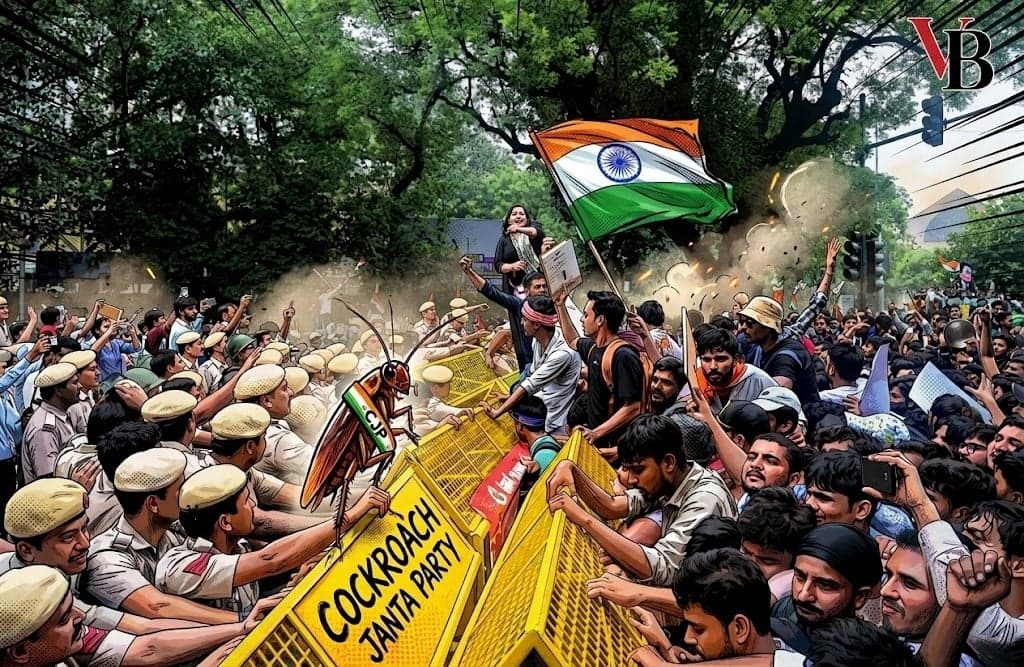

We had a mathematics teacher named Dilip Kumar Ghosh. Whenever we found a problem difficult to solve, he would reassure us by saying, "This too is a problem! A puti fish is still a fish, a cockroach is still a bird!" We would laugh at his sarcasm, forgetting the complexities of equations. Now, after India's Education Minister Dharmendra Pradhan resigned in the face of the unstoppable Cockroach Janata Party (CJP) movement, I am reminded of Sir's words. A mockery indeed—one that turned into a protest that shook the fortified throne of New Delhi.
How it all began
The story begins in a courtroom. On May 15, during a hearing, India's Chief Justice Surya Kant, while reprimanding a lawyer, remarked that some unemployed youth in the country were like cockroaches—finding no work, no place in their profession, they pose as media or social media activists and start attacking everyone. The remark sparked a storm of criticism, though the Chief Justice later claimed his words were misquoted. But by then, the insult had already struck deep.
This very insult was wielded as a weapon by Abhijit Deepke. The 30-year-old graduate in journalism from Pune was pursuing a master's in public relations at Boston University. He had previously worked as a volunteer in the Aam Aadmi Party's social media team from 2020 to 2023. On May 16, the day after the Chief Justice's remark, Deepke launched the "Cockroach Janata Party" online—a satirical parody of the ruling political establishment. He said he just thought there was a need for a platform to bring people together. What followed exceeded his own expectations.
Thousands of young people began joining the party through Google Forms. The hashtag "#IAlsoAmACockroach" flooded social media. Within just five days, the CJP's Instagram followers crossed 10 million—surpassing the 143-year-old Congress and the 46-year-old BJP. Within a week, that number reached 22 million, while the BJP, considered the world's largest political party, had only 9 million followers. A party that didn't exist a week ago had become India's most talked-about political voice.
The government was naturally rattled. On May 23, the CJP's website was shut down, and their Instagram and X accounts were suspended. Deepke also lost access to his personal Instagram. He accused the government of orchestrating the hacks out of fear, publicly calling the administration "authoritarian." But by then, the wave among the youth was impossible for the Modi government to contain.
The wave of protest
Amid this turmoil, the CJP found a concrete, real-world cause for street protests—the NEET medical entrance exam paper leak scandal. Students erupted in anger over allegations that the very exam on which millions of young people's dreams of becoming doctors depend was compromised. Some even chose suicide out of despair. Channeling this pain and rage, the CJP led a prolonged sit-in at Delhi's Jantar Mantar. The main demand was singular—the resignation of Education Minister Dharmendra Pradhan.
The sit-in continued for 36 days. Protests spread to various states, including Kolkata. Police used tear gas and lathi-charges on the protesters. Sixteen to seventeen metro stations in Delhi were closed, and markets around Jantar Mantar remained shut for months. Sonam Wangchuk went on a hunger strike. Bollywood stars also stood by the protesters—Prakash Raj, Alia Bhatt, Priyanka Chopra Jonas, Shabana Azmi, Naseeruddin Shah, Diljit Dosanjh, Salman Khan, Arijit Singh and many others voiced their support. Actress Swara Bhasker's husband was also detained in connection with the movement.
The Modi government initially remained firm, with state leaders declaring they would stand by the Education Minister. The reason was clear—they did not want to send a message that they had bowed to any protest group's pressure, fearing that yielding today would lead to demands for the Prime Minister's resignation tomorrow. But no amount of aggression could reduce the pressure. The National Testing Agency, which conducts the NEET exam, underwent a major reshuffle with 47 officials dismissed. An amendment bill ensuring strict punishment for paper leaks was passed in Parliament. Yet, with the main demand unmet, the 'cockroaches' did not stop.
Finally, victory
On Saturday, July 25, the deadlock finally broke. Education Minister Dharmendra Pradhan himself announced his resignation on social media and submitted his letter to Prime Minister Narendra Modi. Not only that, the government also accepted the CJP's two other demands—withdrawal of all FIRs filed against protesters and ex-gratia compensation for the families of NEET students who had committed suicide. Following a meeting with government representatives that day, with assurances that all their demands would be met, the CJP announced the end of the movement in a joint statement, calling on protesters to return home.
Reacting to the news of the resignation, Abhijit Deepke said, "If there is no Hindu-Muslim politics and only issue-based politics, then even the biggest thrones can tremble. This is just the fall of the first wicket; the fight won't stop here. A government that was said to have no concept of resignation in its dictionary was forced to bow down—we just needed people who could make them bow."
"We will not stop here. This is only the beginning. I salute all the students and volunteers who have been here for the past 36 days," he added. His remarks highlight the core strength of the movement—when ordinary people, especially the youth, unite around issue-based politics, no powerful government can ignore their demands.
The irony of rise and fall
Another fascinating aspect is that Education Minister Dharmendra Pradhan's political rise began with the very issue that forced his resignation. Three decades ago, in 1997, a young Pradhan hit the streets in Odisha protesting a paper leak. He was then a leader of the RSS-affiliated student organisation ABVP. He led the movement against the Congress government in Bhubaneswar. Despite being beaten by police and suffering several broken bones, he did not retreat from the movement. That agitation gave him national recognition, which later helped him become a powerful BJP leader and central minister.
The same issue that gave him his rise led to his fall—this paradox is a tragic conclusion to Pradhan's political career. He was once an agitator; today he was a representative of the very establishment being protested against. Perhaps, as CJP protesters chanted for his resignation at Jantar Mantar, Pradhan remembered those days of 1997 when he himself was a leader of a similar movement. That memory of his own battle against paper leaks might have helped him decide to resign. Because he knows firsthand that an education minister must take responsibility on issues like paper leaks!
A new paradigm of democracy
To understand the significance of this victory, one must look back. A government that had paid no heed to any opposition party or institutional movement was forced to bow to an online platform born out of mere mockery—one that was not even a registered political party.
The CJP's victory is an unprecedented event in India's political history. Its significance is not limited to the resignation of one minister; it has opened new horizons for India's democratic spirit. First, this movement has proven that united public protest can compel even a powerful government to yield, without the backing of any established political party or formal structure. Second, this is a shining example of how the power of social media and the organised anger of the younger generation can transform any issue into a national movement. Third, this movement has re-established the importance of issue-based politics, prioritising the real problems of ordinary people over communal and partisan divisions. Fourth, it has proven that powerful protest can be built through humour and satire, which can inspire the oppressed and the hopeless. Through this victory, a clear message has been sent—in a democracy, the voice of the people is final, and when the people unite, no power remains invincible.
This movement of the 'cockroaches' proved that no matter how great the power, the courage to mock it is the real weapon—if an insult is turned around properly, it can become the sharpest form of protest. The combination of social media power, the organised anger of the young generation, and the courage to turn a joke into a political identity—this mix is what shook the throne of New Delhi. Sir Dilip Kumar's words no longer seem like mere jokes—the 'cockroaches' have truly shown they can fly like birds.
Leave A Comment