
The darkness media never dares to look into
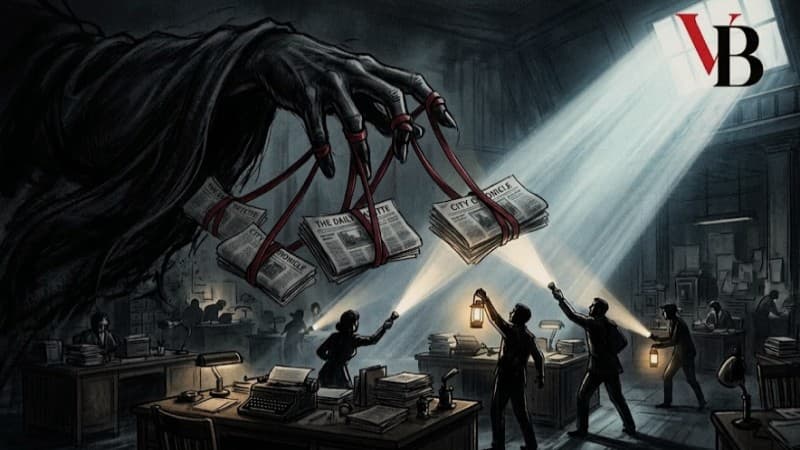

Today, I wish to share a narrative regarding a darkness that the media in Bangladesh is hesitant to confront. It is a realm afflicted by exploitation, disdain, and humiliation, yet none of the nation’s prominent editors, tenacious investigative journalists, esteemed columnists, or well-known talk-show commentators appear capable of addressing its suffering.
Nevertheless, those who wield power in this obscure domain are lauded as celebrities. They instruct society on the principles of journalism and, in certain instances, attain greater influence than even the most formidable editors. The same editor who confronts a minister, challenges a seasoned bureaucrat, takes on politicians, and boldly writes against mafia leaders and merciless criminals will still bow, flatter, and even host lavish parties in honor of the lowest-ranking member of this very mafia network.
I have resolved to narrate this story at significant personal risk. Prior to composing this piece, I consulted individuals I trust, and their cautions were both grave and entirely logical. "If you publish anything against them, you will not only jeopardize your position as an editor; you may also find it impossible to secure employment with another media organization in the future." In essence, a journalism career painstakingly cultivated over nearly thirty years could face an abrupt termination.
Yet, I have chosen to proceed with my writing. For years, this shadowy realm has been appropriating a considerable portion of what journalists rightfully deserve. It has been siphoning off a significant share of the funds that should be allocated to the media while its beneficiaries indulge in opulent lifestyles.
In contrast, journalists labor far more diligently than those operating behind the scenes, expending their intellect and energy, yet subsisting on meager salaries and in degrading conditions. Many are compelled to toil year after year for the same remuneration despite their relentless day and night efforts.
I am no longer willing to live in fear. As a professional journalist, I am determined to expose this darkness to the best of my ability. My initial encounter with its influence I first observed the power wielded by individuals operating in this obscure realm in 2005, during my tenure at Janakantha.
At that time, I authored a series of investigative articles that revealed the hypocrisy of multinational corporations marketing skin-whitening creams and other products that posed significant health risks to the public. This series attracted considerable attention. However, despite dedicating nearly a month to the investigation, my name was not credited in the reports.
The chief reporter informed me: "This series will not merely target a couple of companies; it will confront the nation’s largest advertising agency. They possess immense power and could jeopardize your promising career. Janakantha is a substantial institution capable of withstanding the pressure, but you may not be able to." Thus, my name was omitted.
Nevertheless, the advertising agency soon learned that I was the journalist behind the investigation. After the publication of the third installment, a woman contacted the office.
Without disclosing her identity or the organization she represented, she immediately addressed the subject of my reports.
"Did you conduct the report independently, or were you merely assigned to it under pressure from your office?" I politely inquired about her identity. She insisted that I answer her question first, claiming that only then would she consider revealing who she was. She added another point: "When we choose to, we can halt the salaries of many major newspapers. Therefore, my identity is irrelevant. What is important is that you respond to my question." I responded firmly: "I do not engage with anyone who refuses to disclose their identity."
I informed the then-adviser editor of Janakantha, the esteemed journalist Toab Khan, about the conversation. He replied in a serious tone: "Proceed with the series."
Two days later, I received a call from one of the senior executives at the agency. He was a well-known figure throughout the country, and I had long admired his numerous talents. Upon realizing his identity, I became significantly more respectful.
He referenced the discussion I had with the female employee the day before and expressed his apologies regarding it. He spoke favorably about various elements of Bangladesh's media sector and ultimately extended an invitation for lunch at a later date.
Following the fifth installment of the series, considerable pressure was exerted to halt its continuation. However, due to the steadfast determination of adviser editor Toab Khan and editor Atikullah Khan Masud, the series was successfully completed in full, comprising eight installments.
I share this account to highlight the remarkable influence that advertising agencies possess. The darkness I refer to is encased by a brilliant, almost enchanting barrier of light produced by these agencies. For the media, peering through that barrier into the intricate darkness beyond is exceptionally challenging.
You might be curious as to why I have not disclosed the name of the agency. It is Asiatic.
Asiatic is Bangladesh’s largest advertising agency. It began its journey in 1966, during the Pakistan period, under the name East Asiatic.
In 1968, the celebrated actor Aly Zaker joined the organisation as an English copywriter. He was also one of my own favourite actors.
After Bangladesh became independent, Aly Zaker acquired the company in 1972. In 1973, the then Lever Brothers became an Asiatic client. From that point onwards, there was no looking back.
In 1981, another towering figure from Bangladesh’s cultural world, Asaduzzaman Noor, joined the organisation, adding a new dimension to Asiatic’s growth. Over time, Asiatic also became a meeting place for prominent figures from the country’s cultural sphere.
Yet this company, built with the contributions of so many eminent people, eventually grew into something resembling a giant.
First, newspapers large and small in Dhaka became increasingly dependent on its power. Then television channels and online news outlets followed.
Most major multinational companies that regularly advertise in the media are clients of Asiatic. As a result, editors and owners of television channels had little choice but to keep everyone connected to Asiatic—from its senior executives to its office guards and peons—well pleased if they wanted a steady flow of advertising.
There were other advertising agencies, of course, but few could compete with Asiatic. The commission demanded for securing advertising consequently continued to rise.
Eventually, the situation reached the point where agencies were taking as much as 70 percent of the value of an advertisement.
The present scenario is not significantly altered. Consider a newspaper that receives a Tk100 advertisement from a prominent brand. Out of this, approximately Tk55 may be allocated to the advertising agency immediately. However, large agencies typically do not place advertisements directly with newspapers; instead, these advertisements are funneled through sub-agencies.
Often, the concealed principals behind these sub-agencies are powerful individuals within the marketing departments of the media outlets or television channels that are receiving the advertisements.
An additional Tk15 is directed there. From this amount, Tk5 is allocated to the sub-agency, while Tk10 is given to a marketing executive of the brand that initially placed the advertisement. Consequently, the newspaper is left with only Tk30. This explains why one might observe a newspaper where journalists have not been compensated for three months, relying on loans and debts, while the executives in its marketing department are frequently upgrading their vehicles.
Despite its considerable size, Asiatic has not managed to significantly broaden its business beyond Bangladesh. The rationale behind this is quite clear. When substantial revenues are readily available, there is minimal motivation to pursue innovation or explore new markets.
Asiatic has, however, emerged as the local partner of a multinational advertising network. It became Asiatic Mindshare through its association with the British advertising company Mindshare. And that has made the situation even worse.
Based on my own professional experience, I can say with responsibility that one of the organisations most notorious for delaying payments to the media—and whose employees frequently treat journalists and media organisations with contempt—is Asiatic Mindshare.
There was a time when we reported stories about files disappearing from government offices such as RAJUK. Today, files seem to disappear at Mindshare.
Three months ago, an advertising bill for a multinational company was sent to them. One Mindshare employee informed us that it would take approximately six months to receive payment.
A month later, another employee called and, in an almost commanding tone, said that they had lost the previous bill and instructed us to send another copy to their office.
Then the phone was abruptly put down. Even officials in government offices apologise when they make a mistake. But among some Asiatic Mindshare employees, even that minimum standard of professional courtesy appears to be missing.
They lost the bill. The mistake was theirs. Yet they spoke to the media organisation as though they were issuing an order to someone responsible for their own error. What extraordinary arrogance.
Anyone visiting the Asiatic Mindshare office in Banani would be disappointed. It is difficult to find many multinational-style corporate offices in Dhaka that appear so poorly managed.
Speak to some of the employees and, in my experience, their limited professional preparation becomes apparent in the way they interact with others. It raises a serious question: how can a company controlling such a large share of the advertising market operate with such a low standard of service? Perhaps the answer lies in the economics of the system itself.
Keeping employees on low salaries means more money remains with those at the top.
And yet, this organisation controls a huge share of Bangladesh’s advertising market. It takes roughly 55 percent of the advertising budgets allocated to news media. Companies like Asiatic Mindshare are at the heart of one of the biggest crises facing journalists in Bangladesh today: salaries and allowances.
What happens when a newspaper or television channel has to wait six months for its advertising revenue? The consequences can be devastating, particularly for medium-sized media organisations.
If a media outlet receives three advertisements in a month and all three come through Mindshare, it is hardly surprising if the salaries of its journalists are delayed that month. In effect, this system places every media organisation—and every journalist—in a vulnerable position.
The only way to confront such dominance may be for Bangladesh’s media organisations to unite and collectively refuse to accept such exploitative terms.
If advertisements came directly from the brands, media organisations could potentially receive at least 60 percent of the allocated advertising budget.
Mindshare also operates in India, alongside several other international agencies. Yet Madison Media, an Indian company, has emerged as one of the country's largest advertising agencies.
It has achieved this without becoming dependent on a foreign advertising conglomerate. It has built itself into a self-sufficient enterprise.
Let me be clear: I am not opposed to advertising agencies. An advertising agency is, by definition, an intermediary. There is nothing inherently wrong with that. A major brand may very well need an agency to plan and execute its advertising.
But there is no compelling reason why a Bangladeshi advertising agency must become merely an agent for a foreign commercial giant.
When a company operates as an agent of a foreign corporation, money inevitably flows out of the country. And unlike industries that create substantial innovation or make a major direct contribution to national GDP, advertising agencies primarily facilitate the movement of existing commercial spending.
That is why the government should consider a clear policy framework to discourage excessive dependence on foreign advertising agencies operating in Bangladesh.
Instead, selected domestic agencies should be supported through appropriate policy incentives and developed within a transparent regulatory framework—one that prevents excessive discrepancies in commission structures between advertising agencies and media organisations and ensures that payment delays cannot become a vehicle for corruption.
In 2005, during the BNP government, government advertising was freed from the Bangladesh Department of Films and Publications’ (DFP) monopoly.
That move reportedly eliminated a substantial portion of the corruption surrounding government advertising. If the present government now takes the initiative to free Bangladesh’s advertising sector from the grip of powerful intermediaries such as Asiatic Mindshare, it could become another major milestone in the country’s media history.
Because the issue is ultimately bigger than one company. It is about who controls the money that keeps journalism alive. It is about why journalists who work relentlessly to inform the public are forced to live on stagnant wages while those controlling the flow of advertising revenue accumulate wealth and influence.
And, above all, it is about whether Bangladesh’s media will continue to live in fear of this darkness—or finally dare to turn on the light.
Rased Mehedi, Editor, Views Bangladesh
Leave A Comment