

Rajshahians build first Shaheed Minar of language movement, first blood shed here

Among all the struggles in world history for establishing ethnic identity, our language movement holds a unique place. Such an unparalleled instance of sacrificing lives for the mother tongue shines brightly only in the history of Bangladesh throughout the latter half of the twentieth century. Today marks the 75th anniversary of our glorious Amar Ekushey. On this day, the Central Shaheed Minar was inaugurated in Rajshahi. The central Shaheed Minar has been constructed on approximately one acre of pre-designated land at the site of the old Survey Institute in the city. The foundation stone of the central Shaheed Minar was laid on December 16, 2020, under the management of Rajshahi City Corporation. Language veteran and Bir Muktijoddha Golam Arif Tipu inaugurated the foundation stone.
Rajshahi had to wait until the platinum jubilee of the language movement to get a central Shaheed Minar. Yet, the first Shaheed Minar in the country, built to pay tribute to the martyrs of the language movement, was constructed right here in Rajshahi city. On the night of February 21, 1952, students of Rajshahi College, staying awake all night with lanterns, torches and hurricane lamps, built a memorial with bricks and mud on the Rajshahi College hostel grounds. After construction, the Shaheed Minar was named 'Shaheed Smriti Stambha' (Martyrs' Memorial Pillar). Two lines from Rabindranath Tagore's poem 'Suprabhat' were inscribed on the minar :
"Whose words do I hear on the way to dawn,
There is no fear, he has no fear.
He who gives his life to the uttermost,
There is no decay, he has no decay."
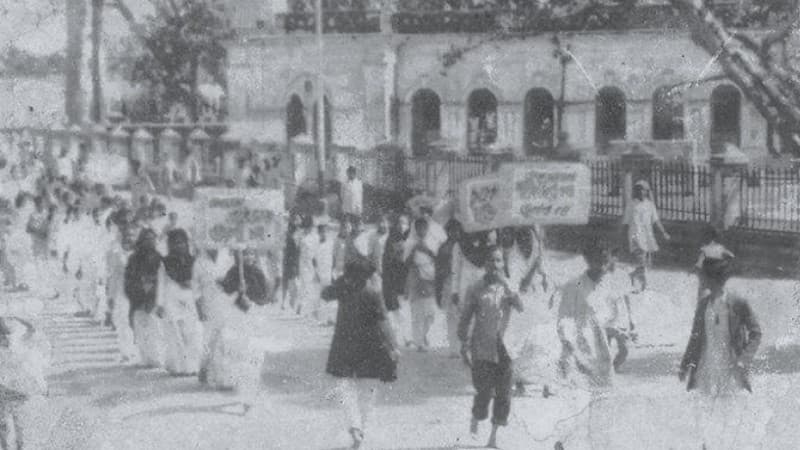
In this struggle to protect the existence of the Bengali language from 1948 to 1952, the most vigorous movement after Dhaka took place in Rajshahi. The cradle of this movement was Rajshahi College, and its playground was Bhuban Mohan Park. In February 1948, after the rejection of Dhirendranath Dutta's proposal in the Pakistan Constituent Assembly to include Bengali as a procedural language, the student community protested in Rajshahi. That same year, on March 11, a hartal was observed demanding the Bengali language. Protesting students took out a procession from Rajshahi College with the slogan 'We want Bengali as the state language'. When the procession reached in front of the Varendra Museum, police opened fire on the students, injuring many. This was the first instance of bloodshed in the history of our language movement. However, despite firing on students, the Pakistani rulers and their cronies failed to suppress the movement. From 1948 to 1952, the struggle continued regularly in Rajshahi demanding that Bengali be declared the state language .
From the beginning of 1952, when the language movement began to gain momentum, students, teachers, intellectuals, cultural activists and the general public of Rajshahi took to the streets. Processions, meetings and rallies continued daily. These processions were usually brought out from Rajshahi College, parading through the city and ending with protest rallies at Bhuban Mohan Park. On February 10, 1952, the first public meeting of the movement was held at Bhuban Mohan Park .
On February 21, 1952, the activists in Rajshahi had already anticipated that agitated students in Dhaka would break Section 144 to press their demands, and police would open fire on them. By the afternoon, news reached Rajshahi railway station that police had fired on a student procession in Dhaka, killing many students. That day, as part of the central programme, a day-long hartal was observed in Rajshahi. When the news of the students' martyrdom arrived, a public meeting was still ongoing at Bhuban Mohan Park. Upon hearing the news of the killings, the agitating students erupted in protest. Everyone chanted in unison, 'We will not let the martyrs' blood go in vain. We want Bengali as the state language.' From this public meeting, students were asked to gather at the New Hostel ground of Rajshahi College. Students emerged from all messes and houses across the city. Hundreds of students gathered at the field in front of the New Hostel of Rajshahi College .
Two decisions were taken immediately: 1. A student action committee would be formed to advance the language movement; 2. A Shaheed Minar would be constructed in memory of the martyrs. That very night, with the help of everyone, students of Rajshahi College, staying awake all night with lanterns, torches and hurricane lamps, built the 'Shaheed Smriti Stambha' with bricks and mud on the Rajshahi College hostel grounds. This was the first Shaheed Minar in Bangladesh .
In the struggle to preserve the honour and existence of the mother tongue, the common people and student community of Rajshahi suffered indescribable persecution. Jail and torture were daily occurrences. Once arrested, the Pakistan government would keep activists in jail for long periods; even after bail, they would be rearrested at the jail gate .
Women were not left behind in this movement either. Dr Begum Jahan Ara, Begum Monowara Rahman, Dr Mohsena Begum, Hafiza Begum Tuku, Firoza Begum, Hasina Begum, Rawshan Ara, Khurshida Begum, Akhtar Banu and others were pioneers of this movement. Among them, Dr Mohsena Begum would lead processions and inspire activists with fiery speeches .
Among those who led this movement were social worker Madar Bakhsh, Captain Shamsul Haque, public leader Ataur Rahman, Shaheed Birendranath Sarkar, Mohammad Sultan, Professor Muhammad Ekramul Haque, Dr Kazi Abdul Mannan, Dr Abul Kashem Chowdhury, Justice Habibur Rahman Shelley, Dr M Latif, Justice Mohammad Ansar Ali, Advocate Mohsin Pramanik, playwright Momtaz Uddin Ahmed, Advocate Abul Kalam Chowdhury, Lutfar Rahman Mallik Dollar, Dr SMA Gaffar, Dr Mesbaul Haque, Advocate Md Abbas Ali, MA Saeed, Advocate Ahmad Ullah Chowdhury, Abdul Malek Khan, journalist Said Uddin Ahmed, Mojibur Rahman, Dr Azizul Bari Chowdhury, Advocate Syed Amir Hossain Spain, Jamal Uddin Ahmed, writer Muhammad Shukur Uddin Ibne Khayyam, Ashraful Abedin, Mohiduddin Ahmed, Professor Mohammad Abul Hossain, Advocate Md Shamsher Uddin, Advocate Mohammad Ziarat Ullah, Abdus Sattar Master, Mosharraf Hossain Akhunji Nilu, Golam Arif Tipu, Anwarul Azim, Yasin Ali, Dr Golam Maqsud Hilali and Tasikul Islam .
Sources:
Andolon o Nirjataner Ponchas Doshok
Rajshahi te Bhasha Andolon 1948-1952
Rajshahi te Bhasha Andolon
Leave A Comment
You need login first to leave a comment