
The physical paradox: Messi leads golden boot race despite walking 63% of tournament
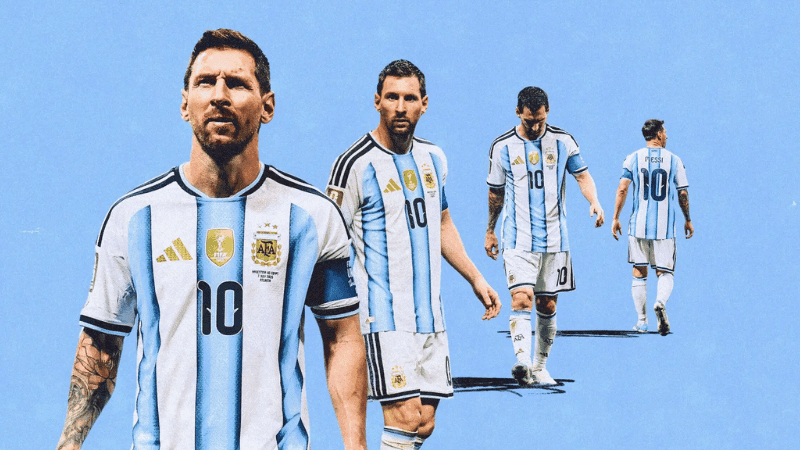

The best soccer players have an innate ability to make the beautiful game look entirely effortless. For Lionel Messi, it literally resembles a stroll in the park.
As Argentina prepares for a high-stakes 2026 FIFA World Cup quarterfinal clash against Switzerland, much of the tactical discourse centers on a baffling statistical anomaly. Argentina’s dramatic 3-2 comeback victory against Egypt in the round of 16 took a massive emotional toll, leaving Messi uncharacteristically in tears at the final whistle. Physically, however, the talismanic captain hardly broke a sweat.
According to tracking data from the tournament, Messi has spent a staggering 63 percent of this World Cup simply walking. This share of low-energy movement is far clear of any other outfield player in the competition. To complement those leisurely strolls, Messi spent an additional 25 percent of his time on the pitch standing completely still. He breaks into a jog just 8.6 percent of the time—lagging far behind the tournament average of 23 percent—and almost never fully accelerates into a high-speed sprint.
It is highly tempting to attribute this to his age. At 39, it would be logical for a veteran to carefully manage his body and conserve energy for decisive moments. While he admittedly no longer possesses the explosive burst over short distances that defined his youth, ambling about has actually always been a foundational part of Messi’s game. He jokingly admitted in a 2024 interview that even during childhood running drills for his boyish side Newell’s Old Boys, he used to hide behind a tree to avoid the conditioning.
Behind this apparent idleness lies a terrifyingly ruthless efficiency. Despite barely running, Messi ranks third in the tournament for touches in the attacking third, has created the third-most big chances with 15, and currently co-leads the race for the Golden Boot alongside Kylian Mbappe with eight goals.
The method to Messi’s walking becomes clear when analyzing FIFA’s tracking heatmaps. His steps are heavily concentrated in his favorite inside-right pocket, situated precisely between the center circle and the opposition penalty area. This is where Messi operates at his most lethal, receiving the ball on the turn to drive directly at backlines. Before the quarterfinal stage, he had received the ball 97 times between the opponent's midfield and defensive lines, the sixth-highest total of the tournament.
Instead of drawing attention to himself with explosive runs, Messi creates space through subtle, micro-adjustments. He essentially lets his teammates do the running to manipulate the opposing structure. During a group-stage match against Cape Verde, rapid decoy runs by Argentine attackers dragged the defensive line out of position. Rather than following the play, Messi simply took two steps in the opposite direction, finding himself completely unmarked and floating in a pocket of space equidistant from four defenders who failed to claim responsibility for him.
Former Real Madrid and France defender Raphael Varane, who faced Messi 21 times throughout his career including the iconic 2022 World Cup final, noted that Messi is a master of drifting into these areas of uncertainty. Varane explained that playing against him requires constant communication, as defenders are left perpetually confused over whether a midfielder, full-back, or center-back should step up to mark him.
This acute spatial awareness is particularly useful when Argentina transitions at speed. As forward runners push defenders deep into recovery runs, Messi intentionally hangs back at the edge of the box. This exact sequence yielded his opening goal in a 2-0 group-stage win over Austria, where he sauntered to the edge of the D completely unnoticed by a scrambling defense before applying his trademark clinical finish.
Furthermore, this slow-motion positioning allows Messi to effectively manipulate the offside trap. When opposing defensive lines push up aggressively, he is in no rush to run back onside, lingering out of view until the exact moment the defense loses track of him. A single sharp movement then puts him back onside just as a pass is released, a tactic that successfully unlocked Cape Verde’s defense for a goal assisted by Lisandro Martinez.
This dynamic creates a psychological trap for opponents, lulling them into a false sense of security before a sudden, devastating burst leaves defenders flat-footed. Years ago, Pep Guardiola perfectly summarized this phenomenon, noting that while Messi looks like he is just ambling around and running the least in the league, he is actually creating a complete time-space X-ray of the pitch in his mind before striking.
These bursts of acceleration are preserved strictly for areas where Messi can inflict maximum damage. Tracking data reveals that 71 percent of his runs with Argentina in possession end in the final third, with 21 percent finishing directly inside the penalty box. Rene Meulensteen, who faced Argentina as Australia’s assistant coach in 2022, recalled that Messi spent 80 percent of that match just wandering before coming to life exclusively in the final third where it mattered most.
Attempting to counter this by assigning a defender to smother him tightly often backfires spectacularly. Former Arsenal defender William Gallas pointed out that getting tight to Messi is a losing battle; if a defender steps up aggressively to stop him from receiving the ball, it instantly opens up massive space behind the defensive line for Argentina’s other attackers to exploit.
Ultimately, Messi’s stillness feeds his extraordinary footballing intelligence, granting him a calm perspective to digest the chaotic movements around him. Guardiola famously noted that Messi often uses the opening ten minutes of a match to stroll and build a mental map of the opposition. However, Messi continues to update this map dynamically. In the grueling 3-2 win against Egypt, with Argentina trailing by two goals with 15 minutes left, Messi altered his approach entirely. Shifting from his central pocket out to the right touchline, he rolled back the years by initiating an elite dribbling display that Egypt’s left flank simply could not contain.
This economy of movement does come with a tactical trade-off. Messi offers virtually zero defensive pressure or tracking back, which forces his teammates to absorb a much heavier physical burden out of possession. Yet, as his former international teammate Pablo Zabaleta explained, it is a compromise the squad embraces gladly. The team understands that running twice as hard defensively is a minor price to pay for the moments of pure magic Messi delivers whenever the ball reaches his feet. To the untrained eye, Messi's strolling looks like total detachment, but it is precisely the illusion required to set up his next clinical strike.
Leave A Comment