

Interim government term
Three mobile operators make Tk4,000crore hitting pockets of customers!
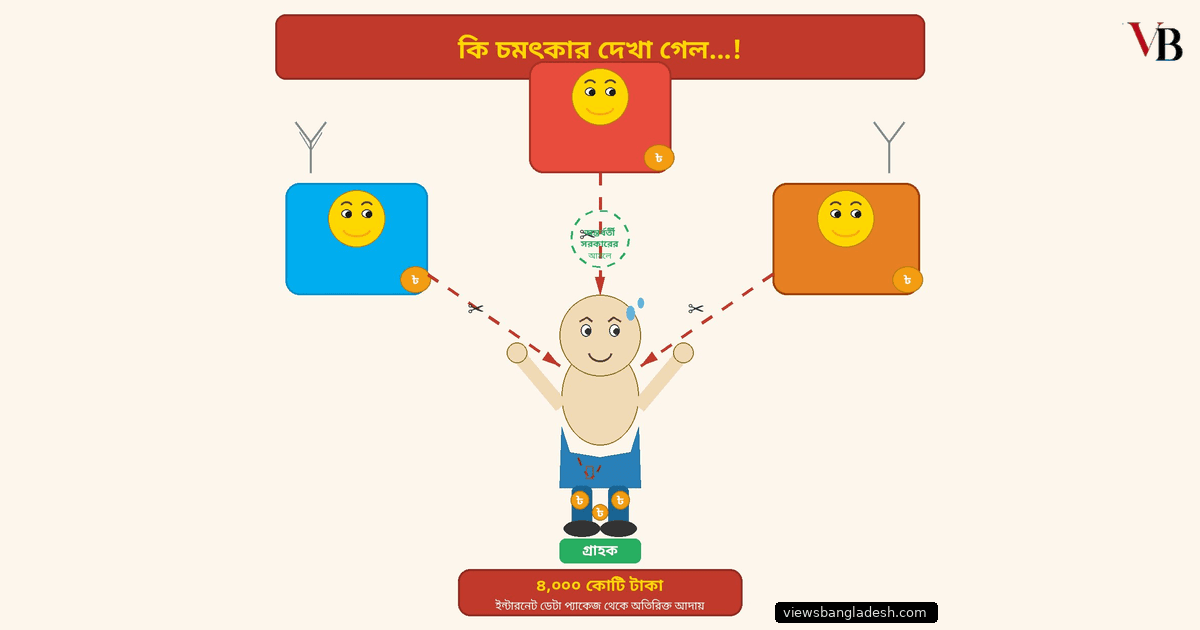

During the preceding interim government, on January 12, 2025, the Bangladesh Telecommunication Regulatory Commission made a decision that permitted mobile operators to offer data packages. This implies that mobile operators will have the autonomy to design their own packages and market them to consumers. As a result of this decision, mobile operators are enabled to provide data packages of varying durations and volumes, ranging from one hour to unlimited access.
An investigation by Views Bangladesh has revealed that, by leveraging this opportunity, three foreign-owned mobile operators have accrued an additional approximate revenue of Tk4,000 crore from customers throughout 2025 by strategically pricing their packages. In contrast, the domestic operator Teletalk has refrained from employing this strategy for generating extra income. Furthermore, mobile operators are also seizing the chance to charge a minimum of 45 paisa and a maximum of Tk2 per minute for voice calls. While no other country in the world has a floor price for voice calls, Bangladesh stands out as the only nation where the regulatory authority has permitted mobile operators to impose higher charges for voice calls on customers rather than fostering competition.
Experts indicate that in Bangladesh, the policies and regulations set forth by the regulatory authority regarding mobile data packages and voice calls primarily favor affluent customers, enabling them to derive extra profits from low-income individuals. For instance, mobile operators impose the highest charges on low-income users who opt for small three-day packages. In the current landscape dominated by OTT applications, the most frequently utilized 'voice calls' are made by low-income individuals who lack smartphones. Nevertheless, mobile operators continue to levy the highest fees on these users due to the 'floor price' policy.
Additional income opportunities for the three operators
In October 2023, the BTRC made the decision to eliminate the three-day and 15-day packages for mobile operators, thereby reducing the total number of available packages to forty. Previously, approximately 90 different package types were available for mobile operators. In response to reports of operators exploiting low-income customers through an excessive variety of packages, the BTRC opted to discontinue the three and 15-day packages and restrict the total to 40. The three mobile operators initially reacted strongly against this decision. They first raised the prices of the seven-day and 30-day packages significantly.
Subsequently, the data volume in the packages was decreased to below 10 GB, with the price of the 30-day package set at around Tk500. However, when the BTRC took decisive action, mobile operators were compelled to lower the price of a 10 GB data package for a 30-day period to Tk300, which then served as the benchmark for pricing other packages. Later, during the tenure of the interim government, a directive was issued on January 12, 2025, which lifted the 40-package limit for mobile operators and removed all restrictions on the validity and data volume of the packages. This newfound freedom provided mobile operators with an unrestricted opportunity to exploit customers financially.
Calculation of additional income of Tk4,000 crore
The price of 10 GB package of the country's leading mobile operator Grameenphone is currently Tk399 for a period of 30 days. As it appears in the list of standard packages, the cost of internet services is also established in the Flexiplan at the same rate. Nevertheless, there are variations in bundles (packages that combine internet and voice calls) and tailored packages based on the customer's spending habits. The extent of this variation is minimal; for instance, the price for 10 GB of data over a 30-day period in the package available to all customers is Tk399, which serves as the primary reference point.
Likewise, the calculation for creating a personalized package (Flexiplan) indicates that if you select 10 GB of data for a duration of 30 days, the cost amounts to Tk399. This calculation can be regarded as the fundamental basis and average for Grameenphone's monthly package at this time, as it represents the lowest priced package for a 30-day period. No mobile operator in Bangladesh reveals the number of its data subscribers or the revenue generated from data services. Although the BTRC provides an estimate of the number of subscribers for an operator, it does not disclose the specific number of data subscribers for any operator. Consequently, the assessment of the internet business of mobile operators in Bangladesh remains unclear.
For this reason, Views Bangladesh has offered a reasonable estimate based on various information and data published by global organizations and mobile operators. Previously, according to information released by GSMA, the global organization representing mobile operators and equipment suppliers, 60 percent of the total mobile subscribers in Bangladesh utilize the internet.
Accordingly, the current number of Grameenphone subscribers (data published by BTRC) is 84.33 million. That is, 55.98 million subscribers of Grameenphone use mobile internet. According to the information given at the press conference of the mobile operators' organization AMTOB earlier, 40 percent of the total internet subscribers use 30-day packages. That is, 22.39 million of the total internet subscribers of Grameenphone use 30-day packages. Earlier, the price of 10 GB data package (the lowest priced package) for 30 days for Grameenphone, Robi and Banglalink was Tk300. From January 2025, the price of Grameenphone's package has increased to Tk399. This means that each of Grameenphone's 22,309,200 customers has paid Tk99 more per month. As of 2025, customers have spent at least Tk2,404 crore extra in 12 months. If we calculate the three-day and seven-day small packages, this additional income will increase further.
Similarly, the current number of Robi Axiata Limited subscribers is 57.24 million. Out of this, the number of mobile internet subscribers is 34.34 million. Out of this, the number of 30-day package subscribers is about 13.737 million. According to Robi's open internet package and Easy Plan, the minimum price of a 30-day package is Tk380. Thus, if we calculate the additional cost of Tk80 for each of the 13,737,600 customers, the total additional cost in 12 months stands at Tk1,318 crore. Robi's generally open internet package offers only one option for a duration of 30 days, which includes 85 GB of data for a cost of Tk798. In the bundle offer, the minimum price for 3 GB of data along with 100 minutes of voice calls is Tk309 for a 30-day period.
However, the least expensive package available in the list of internet packages on the My Robi app is 15 GB for 30 days at a price of Tk418. This means that if you purchase an internet package without an easy plan on Robi for less than Tk400, you will only be able to utilize three GB of data each month. Furthermore, if you wish to access data ranging from 10 GB to 15 GB, you will need to spend more than Tk400. From this analysis, it is evident that the pricing of Robi's internet package is currently relatively high due to the complexity of the calculations.
Similarly, Banglalink has a total number of 37.4 million subscribers. As 60 percent of GSMA, this operator's total mobile internet subscribers are 22,440,000. Out of this, 40 percent of the 30-day package subscribers are 8,976,000. According to Banglalink's My Plan, 10 GB of internet for 30 days is priced at Tk350. The price of the 30-day package of 8 GB data in this operator's normal package is Tk329. If this is increased to 10 GB, the price stands at Tk411. However, for the convenience of the lowest calculation, the 10 GB of My Plan has been set at Tk350 for a 30-day period. As a result, 8,976,000 customers have spent at least Tk538 crore extra, i.e. Tk50 per month.
Now, if we calculate the additional income of Grameenphone, Robi and Banglalink, the total stands at Tk4,260 crore.
Burden of higher expenditure on the shoulders of low-income people
Previously, when the three-day and 15-day packages were discontinued in 2023, the mobile operators' organization, AMTOB, consistently stated that individuals with low incomes predominantly utilize the three-day package. An analysis of the packages offered by the three operators indicates that low-income users of the three-day package are compelled to incur the highest expenses. Grameenphone's basic 7 GB data package for a three-day duration is priced at Tk118. Consequently, if a customer accesses the internet for an entire month, they must spend a minimum of Tk1,180. Similarly, Robi's basic three-day package provides an 8 GB data for Tk118. In this scenario as well, if utilized over a month in segments, the customer is required to pay Tk1,180. The most affordable package from Banglalink offers 2GB of data for a three-day period at a cost of Tk50.
Only Banglalink customers can maintain their internet expenses at the lowest rate, which amounts to Tk500 for 30 days when used in segments. In this context, the three operators argue that customers of the three-day package do not purchase packages on a regular basis. However, according to AMTOB's calculations, 60 percent of all internet users repeatedly utilize this three-day package.
Therefore, there is no significant difference in the monthly expenditure between the two mobile operators, which is Tk1,180, and Banglalink's Tk500. The data volume available per month through the three-day package can range from 40 to 70 GB. Nevertheless, since any unused data does not carry over in this package, the reliability of the data amount is questionable. At the conclusion of the primary month, each customer generates Tk1,180 and Tk500 from their respective packages, which is nearly three times greater than the cost of the 30-day package.
Voice calls also face additional costs
Prior to the implementation of the 'floor price' policy for voice calls, customers had the chance to communicate at rates as low as 25 paisa per minute or even lower. At present, in accordance with the BTRC policy, mobile operators are prohibited from setting prices below 45 paisa. Analysis indicates that, with the exception of Teletalk, the other three operators are currently charging an average of Tk1.20 for voice calls. Consequently, low-income individuals who don't have smartphones are incurring the highest expenses on voice calls.
In response to this matter, former Managing Director of Robi Axiata and telecommunications expert Mahatab Uddin Ahmed informed Views Bangladesh that this 'floor price' for voice calls is a relic from a bygone era in the mobile telecommunications sector. Such a floor price is nonexistent in any other part of the world. Consequently, while mobile operators reap the benefits, low-income individuals are the ones who suffer. This floor price is also a significant contributor to the digital inequality present in Bangladesh. It should be abolished without delay.
Telecommunications policy specialist Abu Nazam Tanveer Hossain conveyed to Views Bangladesh that competition within the Bangladeshi market is primarily confined to three mobile operators. Therefore, as per legal standards, a fair price for data should be established by evaluating the costs incurred by mobile operators. The existing floor price policy allows the three mobile operators to collect excess charges. This situation necessitates reform.
Grameenphone's statement
In response to Views Bangladesh's question, Sharfuddin Ahmed Chowdhury, Head of Communications at Grameenphone, the country's top mobile phone operator, said: "We have earned an additional Tk2,400 crore in the data sector. The claim made in the report is not consistent with the company's actual financial statements. This additional revenue is completely baseless and misleading. Grameenphone regularly discloses all information related to its business through quarterly and annual reports."
"In 2025, Grameenphone's total internet usage (in terabytes) increased by about 12.4 percent compared to the previous year (2024), while total data revenue increased by only 2.2 percent. This happened in a macroeconomic environment where overall inflation was more than 9 percent. Like other sectors of the economy, the price of mobile services also depends on various factors including energy prices, infrastructure costs and local taxes," he added.
He further stated that Grameenphone's primary objective is to guarantee that the citizens of the nation receive appropriate value for every taka they expend, and that everyone has access to dependable connectivity at reasonable prices. Maintaining affordable internet does not imply that it will be entirely detached from the overall market inflation; instead, the aim is to ensure that the price increase of internet and mobile services is more gradual than that of other goods, thereby keeping connectivity accessible to all. Furthermore, when evaluating the trend in internet pricing, it is crucial to consider the entire portfolio rather than focusing on a few specific packages. Grameenphone also transfers customers' unused internet in accordance with BTRC regulations.
Banglalink's statement
In this context, Banglalink's Chief Corporate and Regulatory Officer Taimur Rahman told Views Bangladesh: "All Banglalink's operations are carried out in complete adherence to the policies and regulations established by the Bangladesh Telecommunication Regulatory Commission (BTRC). We diligently comply with all relevant directives from the commission while delivering internet services to our customers. Any allegations of irregularities in this matter are entirely unfounded and misleading."
Robi's statement
In this regard, Robi's Chief Corporate and Regulatory Affairs Shahed Alam said, 'We provide internet services to our customers in accordance with BTRC's policies. Any allegation of irregularity in this regard is entirely irrelevant, untrue, baseless and fabricated.
Leave A Comment
You need login first to leave a comment