

Stakeholders at Discussion meeting
Tobacco Control Ordinance Must Be Enacted into Law, Not Remain on Paper
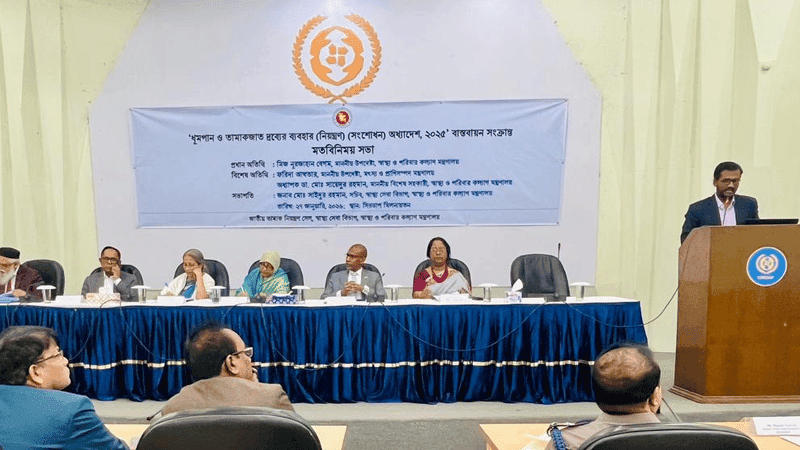

Although the approval of the Tobacco Control Ordinance is a major achievement, the real challenge lies in transforming it into a law. Stakeholders emphasized that the ordinance must not remain merely a document on paper; it must be enacted into law and effectively reflected in practice.
These views were expressed at a discussion meeting titled “Measures for the Effective Implementation of the Smoking and Tobacco Products Use (Control) (Amendment) Ordinance, 2025”, held on Tuesday (27 January) at the CIRDAP International Conference Centre (CICC) in the capital. The meeting was chaired by Syedur Rahman, Secretary of the Health Services Division. Ms Nurjahan Begum, Honorable Adviser to the Ministry of Health and Family Welfare, attended as the Chief Guest. Special guests included Farida Akhter, Honorable Adviser to the Ministry of Fisheries and Livestock; Dr Md Abu Jafar, Director General of the Directorate General of Health Services (DGHS); and Dr Ahmed Jamshed Mohammad, Representative of the World Health Organization (WHO).
The meeting noted that, according to the WHO Tobacco Atlas 2025, more than 21.3 million adults (aged 15 and above) in Bangladesh use tobacco. Each year, nearly 200,000 people die from tobacco-related diseases—an average of more than 545 deaths per day. Tobacco use also causes an estimated economic loss of BDT 392 billion annually. Given this all-encompassing impact, stakeholders described tobacco use as nothing less than a tobacco epidemic.
Against this backdrop, at the most recent meeting of the Advisory Council on 24 December 2025, the Smoking and Tobacco Products Use (Control) (Amendment) Ordinance, 2025, proposed by the Health Services Division under the Ministry of Health and Family Welfare, was approved.
The approved ordinance bans the use, production, and marketing of emerging tobacco products—such as e-cigarettes/electronic nicotine delivery systems (ENDS) and heated tobacco products (HTPs); includes nicotine pouches within the definition of tobacco products; prohibits the use of all tobacco products in public places and public transport, alongside smoking; places the provision for designated smoking areas (DSA) under conditions set by government directives; expands the definitions and scope of public places and public transport; bans all forms of tobacco advertising, promotion, and display, including at points of sale and via the internet or any other medium; and increases the size of health warnings on tobacco packaging from 50% to 75% of the surface area.
Stakeholders stressed that to ensure effective implementation, the ordinance must be passed by Parliament and enacted into law without delay.
In her welcome remarks, Sheikh Momina Moni, Additional Secretary (WHO Wing), Health Services Division, said that 564 people die every day due to tobacco use. “If such a number of people were dying daily in plane crashes, we would be shocked. But these deaths are silent—slow like smoke—and we have become accustomed to them,” she said. While the government earns around BDT 400 billion in annual revenue from the tobacco sector, losses due to healthcare costs, productivity loss, and premature deaths exceed BDT 870 billion. “This loss is not only economic—it destroys families and shatters dreams,” she added, noting that the ordinance reflects the government’s firm commitment to protecting public health.
Farida Akhter said the ordinance was approved through collective efforts, but warned that tobacco companies are also actively protecting their interests. With elections ahead, she urged advocates to secure commitments from political parties so that, once in power, they move swiftly to pass the ordinance into law.
In her address as Chief Guest, Ms Nurjahan Begum said the success of approving the ordinance belongs to everyone involved. “However, there is no room for complacency. If the next elected government does not pass the ordinance in Parliament, all our efforts will be in vain,” she cautioned. She emphasized the need for continuous advocacy to ensure the ordinance is enacted into law and called on all stakeholders to work from their respective positions. She also urged secretaries of various ministries to make their ministries smoke-free.
Other speakers included Md Mostafizur Rahman, former Chairman of BCIC and Lead Policy Advisor of CTFK-Bangladesh; Md Shafiqul Islam, Senior Consultant, Vital Strategies Bangladesh; Dr Rajesh Narwal, WHO Representative to Bangladesh; and Advocate Syed Mahbubul Alam, Senior Technical Advisor, Vital Strategies Bangladesh. They emphasized the importance of building broad public support so that the demand to enact the ordinance into law becomes a people’s movement, making it impossible for the government to ignore.
Leave A Comment
You need login first to leave a comment