

TowerCo working to reduce internet costs; Indoor infrastructure sharing crucial
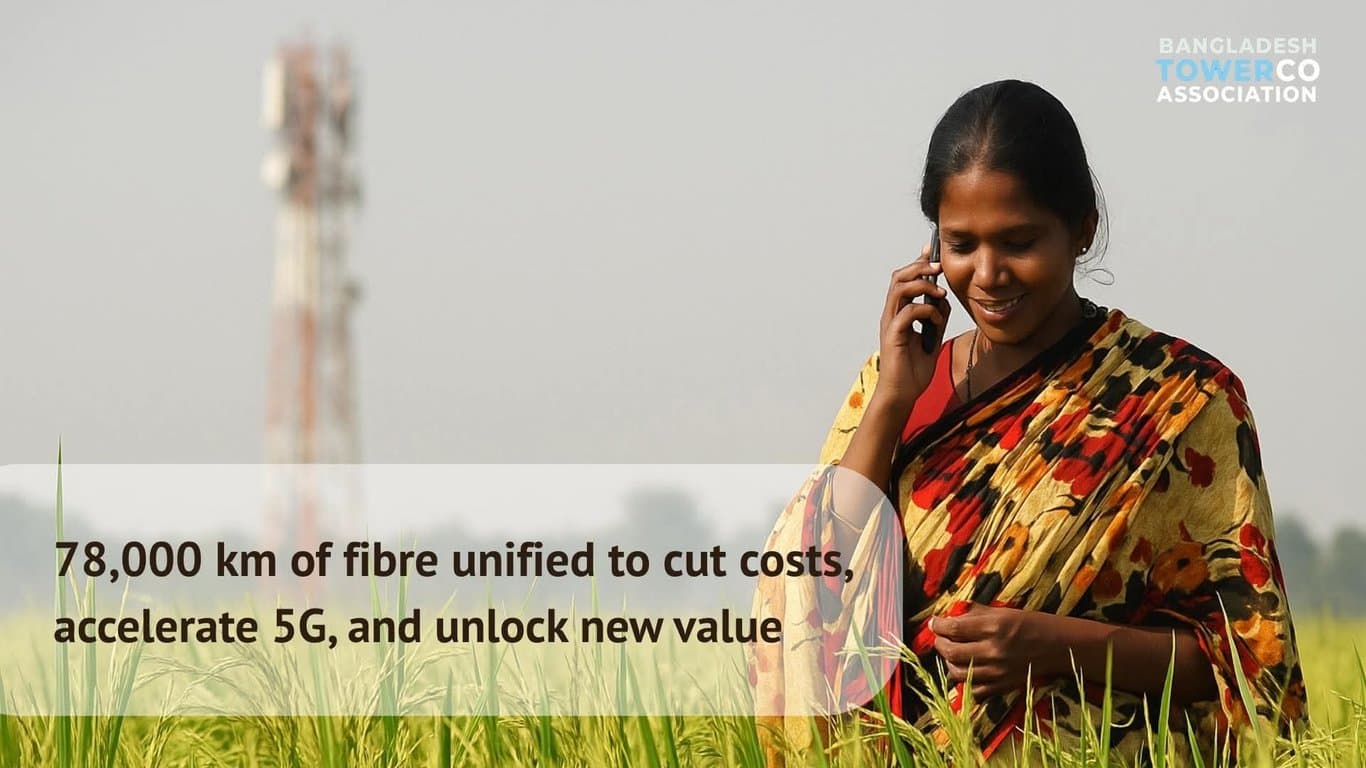

In the backdrop of ongoing disputes between operators and tower companies over telecom infrastructure sharing, the formation of the TowerCo Association, 5G rollout, internet pricing, and broader telecom policy issues, Views Bangladesh sat down with Sunil Isaac, Managing Director of Edotco Bangladesh and President of the TowerCo Association, to discuss the state and future of tower infrastructure in Bangladesh. The interview was conducted by Al-Amin Dewan.
Al-Amin Dewan: Why was the Bangladesh TowerCo Association (BTA) formed?
Sunil Isaac: Professionally, I have been based in Bangladesh for the past two and a half years, but my connection with this market goes back much further. I first began working here in 1997, and since 2014, I have been professionally involved from Malaysia. In that sense, this market is not new to me; it is very familiar and well understood.
We established the BTA to give the tower industry a unified voice and platform. The challenges we face in network rollout, spectrum allocation, energy, and long-term investment cannot be tackled by any single company alone. As seen in countries like India with DIPA or in European Wireless Infrastructure Associations, when tower companies come together, they can influence policy, attract investment, and accelerate digital readiness.
Our core objective is to establish tower infrastructure in Bangladesh as a distinct industry. This means strong policy advocacy, encouraging both foreign direct investment (FDI) and local capital. The aim is to create confidence among investors that Bangladesh’s digital infrastructure is investable. At the same time, we want to reduce the cost per gigabyte of data. By sharing infrastructure—towers, power systems, fiber backhaul, or DAS—operators can lower costs and accelerate rollout, making mobile broadband affordable for consumers and keeping the market competitive.
Al-Amin Dewan: Grameenphone and Robi have launched 5G in some areas. Is Bangladesh prepared in terms of infrastructure?
Sunil Isaac: From an infrastructure perspective, 5G is technology-agnostic. Our existing towers are already 5G-ready. Operators can install new antennas or radio units and upgrade power systems if necessary. 5G primarily depends on spectrum allocation, software activation, and radio devices, rather than building new towers.
However, there are changes in indoor systems. Most currently use passive antennas, but 5G requires active in-building solutions. So while outdoor sites are ready, indoor coverage and power investment will be a next priority.
Al-Amin Dewan: What is the difference between towers owned by mobile operators versus tower companies? How does it impact the industry?
Sunil Isaac: If a tower is owned by an operator, it becomes costly. To make a mobile tower 5G-ready, operators must invest in additional DC power, battery upgrades, and other enhancements—these are expensive.
But if we own the tower, the operator only pays a monthly fee. This allows operators to invest their capital in spectrum, radios, and customer devices, which ultimately benefits end-users.
For example, if an operator has BDT 10 billion:
Owning their towers might require 40% for tower upgrades, 30% for active devices, and the rest for spectrum.
Using a tower company’s infrastructure shifts most of these costs to the tower company. The operator can then invest nearly all of the BDT 10 billion into active devices, spectrum, and customer rollout.
As a result, more 5G sites can be deployed within the same budget, coverage grows faster, and costs decrease.
Al-Amin Dewan: Is spectrum allocation and policy support adequate?
Sunil Isaac: Spectrum is the oxygen for 5G. BTRC is currently planning to release the 700 MHz and 3500 MHz bands. However, relying solely on the 700 MHz band has failed in many countries. A sustainable approach is to use both bands together: 700 MHz for wide coverage and 3500 MHz for speed and capacity. This spectrum must also be priced affordably.
High upfront fees in traditional auctions are not effective. Spectrum allocation should be accessible and affordable. Successful 5G markets, like India, China, and South Korea, have followed this path. Regulators in Bangladesh should learn from this. Adequate spectrum at the right price benefits both the telecom industry and consumers.
Al-Amin Dewan: The government recently approved the New Telecommunication Network and Licensing Policy 2025. What is BTA’s view?
Sunil Isaac: We see this as a major and promising step for Bangladesh’s telecom sector. The policy legally recognizes tower companies as national infrastructure providers, elevating towers from just an additional asset to a distinct industry.
The policy encourages fiberization, rural coverage incentives, IoT, edge computing, private networks, and smart city initiatives. While this is positive, more clarity is needed in areas like foreign investment limits, indoor systems, and small cell deployment freedom. Clear guidelines and proper implementation can attract new investment, reduce per-GB costs, and position Bangladesh as a digital infrastructure leader.
Al-Amin Dewan: How can IBS, DAS, and the neutral-host model improve in-building coverage for 5G?
Sunil Isaac: In Bangladesh, tower companies can share outdoor sites, but indoor infrastructure (IBS/DAS) can only be shared by operators. This often results in weak indoor coverage, higher costs, and consumer inconvenience.
In other countries, tower companies or third parties implement a neutral-host model shared by all operators. This reduces costs, enhances coverage, and provides consumers with uninterrupted services. Currently, Bangladesh’s policy does not yet include this type of sharing—this is a significant gap.
Al-Amin Dewan: Electricity is often cited as the biggest challenge in Bangladesh’s telecom sector. How critical is this for 5G?
Sunil Isaac: Extremely critical. A 4G site consumes 3–6 kW, whereas a 5G site requires 10–20 kW. Scaling 5G nationwide could cost several thousand crore BDT.
We have advocated bulk power purchase agreements with utility companies, hybrid system investments, and tax incentives for green energy equipment. Long-term power management planning is essential.
Al-Amin Dewan: Networks often fail during heavy rain, floods, or cyclones. Can BTA play a role in solving this?
Sunil Isaac: Mobile towers are rarely damaged in natural disasters. Network failure mainly occurs due to power outages. Backup batteries last only 4–6 hours. Beyond that, generators are needed, but access is often blocked during floods or cyclones.
To address this, we have coordinated with BTRC. We are implementing solar, smart batteries, and elevated platforms. In the long term, community-based solutions like micro-grids could provide localized power.
Al-Amin Dewan: Are there practical 5G examples Bangladesh can learn from?
Sunil Isaac: In the Philippines, 5G fixed wireless access delivers high-speed internet to homes. In India, Jio and Airtel bundle it with Wi-Fi routers, TV channels, and streaming apps. Malaysia has shared networks.
Bangladesh can adopt similar models for garment factories, ports, and households, provided indoor coverage improves and policies support it.
Al-Amin Dewan: What will be BTA’s main focus going forward?
Sunil Isaac: We are planning not just for next year but for the next decade. Our towers are 5G-ready and will support 6G in the future.
The most important indicator is cost per GB. Reducing costs ensures that every rural student, RMG worker, and small entrepreneur can participate in the digital economy. Our goal is to build a sustainable and inclusive telecom infrastructure system. If 5G rollout increases per-GB costs, it would be extremely disappointing for the public. Our aim is to prevent that from happening.
Leave A Comment
You need login first to leave a comment