
Tradition of Kali Puja in Bengal
Hindus are said to have 330 million gods and goddesses. Within the religious imagination of Sanatan Dharma, however, these deities are arranged in distinct hierarchies and categories, much as they are in Greek and Egyptian mythology. In ancient Egypt, Ra, Isis, Horus and Anubis belonged to the foremost ranks of the pantheon. Among the Greeks, the principal deities were those believed to dwell on Mount Olympus, including Zeus, Hera, Athena and Poseidon.
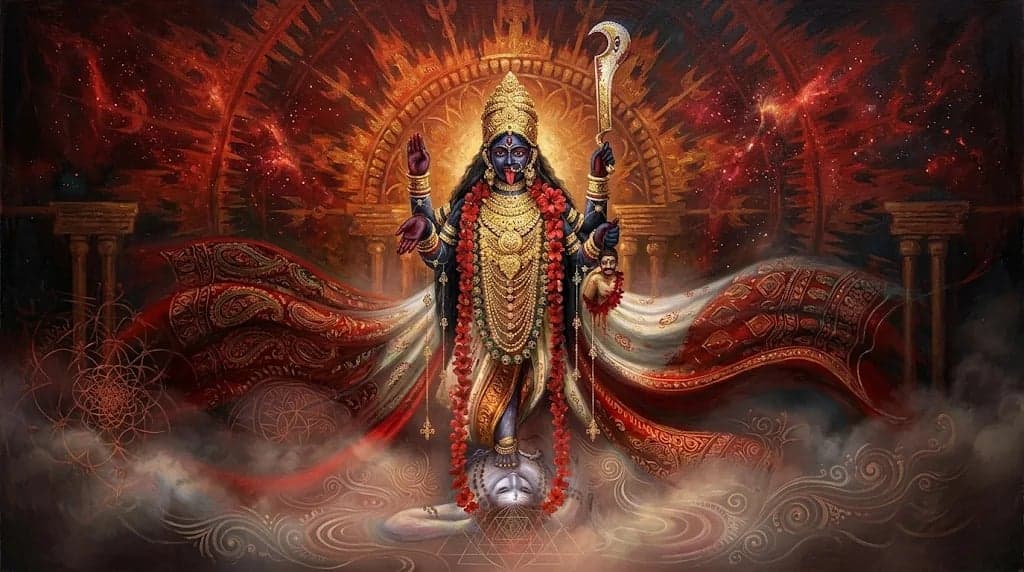
In Indian mythology, Brahma, Vishnu (Krishna) and Maheshwar (Shiva) occupy a comparable position. Among the goddesses, the most prominent are Durga, Lakshmi and Saraswati. Kali is regarded as another manifestation of Goddess Durga. The earliest reference to her name appears in the Atharva Veda. She is associated with the hymn known as the Kalasukta, which celebrates Kala, or Eternal Time. One of the seven flaming tongues of Agni, the god of fire, is also called Kali. The Mundaka Upanishad names these seven tongues, the first of which is Kali. Much later, the Markandeya Purana, composed in the sixth century, offers a detailed account of the goddess. There, she is identified as the first of the ten Mahavidyas, the great wisdom goddesses who embody and encompass the three dimensions of time: past, present and future.
Followers of Sanatan Dharma are traditionally divided into five principal sects: Shaivism, Shaktism, Ganapatya, Vaishnavism and the worshippers of Kartikeya. In other words, some worship Shiva, others Shakti (Durga and Kali), Ganesha, Krishna or Kartikeya, popularly known as Kartik. Devotees who worship Kali exclusively are therefore Shaktas. The very name of this tradition reflects their faith in Kali as the embodiment and source of divine feminine energy.
Over the centuries, Goddess Kali has appeared in numerous evolving forms, each associated with different names and attributes. The ten Mahavidyas mentioned earlier are Kali, Tara, Shodashi, Bhuvaneshwari, Bhairavi, Chhinnamasta, Dhumavati, Bagalamukhi, Matangi and Kamala. The word Vidya here is essentially synonymous with the goddess herself. Each of these manifestations has its own mythology and stories, many of which are associated with the Kalika Purana.
Kali is, on the one hand, the embodiment of supreme power and, on the other, a destroyer of demons, much like Durga. Among the demons she is said to have slain are Raktabija, Shumbha and Nishumbha, two brothers; Chanda and Munda, also brothers; and Darukasura, among others.
The slaying of demons by goddesses carries several layers of meaning. First, it is not the male gods but the power and wrath of the goddesses that drive the destruction of demons and other forces of evil. Second, feminine strength and capability are portrayed as surpassing those of men.
Even in Samkhya philosophy, one of the six classical schools of Indian thought, the male principle, Purusha, is regarded as passive and inert, while the female principle, Prakriti, is seen as the primary creative force behind the universe and all existence. Modern science, through the distinction between XY chromosomes in males and XX chromosomes in females, has also established that it is the mother who determines the sex of a child.
Samkhya philosophy speaks of the courage required to confront a shark in the depths of the ocean and declares that women possess that courage. It is astonishing to consider how a thoroughly patriarchal society could elevate the feminine principle to such extraordinary heights. Here, woman is known as Prakriti, while her other designations include Adyamata, the primordial mother; Narishakti, feminine power; and Jagatmata, the mother of the universe. The term Jagatmata carries within it the profound resonance of eternal motherhood.
There is another curious aspect of Hindu religious practice. In the worship of certain goddesses, including Durga, Lakshmi and Saraswati, and later the folk deity Manasa, offerings of non-vegetarian food are traditionally made. By contrast, worship of Krishna, Ramachandra or Shiva generally calls for vegetarian offerings.
During Durga Puja, the sacrifice of a buffalo is traditionally considered appropriate, alongside that of a goat (not a castrated male goat). Hilsa fish is associated with Lakshmi and Saraswati worship. Some devotees also observe vegetarian practices during Saraswati Puja, but this is rarely the case during Lakshmi Puja.
There is another distinction. In the homes of Brahmins, cooked food may be offered to Lakshmi, Saraswati and other deities as bhog prasad, or consecrated food. Non-Brahmins, however, are traditionally entitled only to offer fruits as prasad. The caste system remains one of the most incongruous features of Hindu society.
Goats are sacrificed, and their meat is subsequently cooked and consumed. Eating buffalo meat is not prohibited for Hindus. Yet the consumption of meat from sacrificed buffaloes is rarely mentioned. In the writings of the medieval poet Mukundaram and the modern writer Tarashankar Bandyopadhyay, there are references to buffalo sacrifices during religious ceremonies and the consumption of their meat. Such practices, however, are depicted as customs associated with lower-caste Hindus.
Goat sacrifices are also associated with Kali and Manasa worship. These cruel practices, however, have declined considerably under the pressure of changing social attitudes and a growing sense of humanity. In their place, symbolic sacrifices involving ash gourds, sugarcane, watermelons, cucumbers and even effigies have become increasingly common.
Before embarking on their raids, bandits would often worship Kali. In some instances, these rituals involved the horrific practice of human sacrifice. Near the temple of Rankini Devi, close to Ghatshila in Bihar, numerous human bones have reportedly been discovered at a site associated with such sacrifices.
The British colonial administration eventually outlawed these practices through legislation. Rabindranath Tagore wrote his novel Rajarshi in opposition to animal sacrifice during Kali worship. Yet the practice has not disappeared entirely.
Now, let us turn to the extraordinary popularity of Kali worship in Bengal.
There is a Bengali saying: Kanu bishe geet nei—roughly suggesting that there is no song without Kanu, another name for Krishna. Krishna, or Kanu, occupies a central place in the religious lives of Bengali Hindus. He is remembered in daily prayers, celebrated in Vaishnava poetry, invoked through devotional songs and sacred name-bearing cloths, and even accompanied by chants of 'Hare Ram' during funeral processions on the way to the cremation ground.
After Krishna, Kali holds a particularly prominent place in the Bengali religious imagination.
Just as Hindu families often give their children names derived from Krishna's many epithets—Basudev, Govinda, Gopal, Madhav and Giridhari, among others—girls are also named after Kali and her various manifestations. Such names include Shubhra, Krishna, Shyama, Tara, Bhavani, Elokeshi, Narayani, Parameshwari and Savitri.
Although Kali Puja is celebrated on the new moon night of Kartik, the goddess is worshipped throughout the year on various auspicious dates. One example is Ratanti Kali Puja, observed on the fourteenth lunar day of the month of Magh—a departure from the usual practice of worshipping Kali on a new moon night. Another is Phalaharini Kali Puja, celebrated in the month of Jyeshtha. Notably, it was on this occasion in 1873 that Sri Ramakrishna performed the ritual worship of Sarada Devi.
The widespread popularity of Kali Puja in Bengal today is largely associated with Krishnananda Agamavagisha. This seventeenth-century Tantric scholar from Nabadwip studied 170 Tantric manuscripts and compiled his celebrated work, Tantrasara, which laid down the rituals and procedures for Kali worship.
It was after this that Kali worship spread extensively across Bengal, accompanied by the construction of countless temples dedicated to the goddess. Temples devoted to Kali, however, existed long before that period.
The famous Kali temple in Kolkata is mentioned in the writings of the fifteenth-century poet Mukundaram. He writes:
"At Kalighat, the merchant's son came ashore; There he moored his boat and beheld the goddess."
The merchant Dhanapati Sadagar is said to have anchored his vessel at Kalighat and offered worship to Kali.
Moreover, the tradition of the 51 Shakti Peethas, which has been part of Indian mythology since ancient times, extends across the Indian subcontinent. These temples are associated with manifestations of the goddess, while each Peetha has its own Bhairava—a guardian deity who is himself a manifestation of Shiva.
Bhairava deserves a closer look. Just as the goddesses worshipped at the 51 Peethas have different names, so do their accompanying Bhairavas, or manifestations of Shiva, who serve as their protectors. At Kalighat, for instance, the goddess is known as Ambika, while the Bhairava is Nakuleshwar.
The ancient geography of India seems to unfold through a pilgrimage to these 51 Peethas, scattered across the vast expanse of the subcontinent, including what are now Pakistan and Bangladesh. Among the sites are those in Sylhet, Jessore (Jashoreshwari) and Barishal (Shikarpur). Together, they form part of the sacred landscape associated with Sati and the goddess Kali.
A brief explanation of Sati is necessary here.
According to Hindu mythology, Sati was the daughter of Daksha and the wife of Shiva. At a wedding ceremony involving another daughter of Daksha, Sati was present when her father began publicly insulting Shiva. Deeply wounded by the humiliation, Sati took her own life.
When news of her death reached Shiva, he was consumed by rage and grief. Carrying his wife's body on his shoulders, he began a cosmic dance of destruction, threatening to plunge the world into chaos. Krishna then used his discus to cut Sati's body into 51 pieces, which fell at different locations across the subcontinent. This brought Shiva's devastating dance to an end.
Over time, the sacred sites associated with Sati came to be known as Shakti Peethas and, in popular religious imagination, as centres of Kali worship as well. This, too, may be understood as a process of the reinvention and transformation of deities.
In Kolkata, apart from Kalighat, there are several other famous temples dedicated to Kali, including Thanthania, Dakshineswar—established by Rani Rashmoni, where Sri Ramakrishna served as a priest—and the Firingi Kalibari. These temples, however, are not among the 51 Shakti Peethas.
Finally, there is the story of Shiva and the poison that emerged during the churning of the cosmic ocean.
Before the nectar of immortality appeared during the Samudra Manthan, or the churning of the ocean, many other things emerged, including Halahala, also known as Kalakuta—a deadly poison. Its effects spread through the air and across the heavens, threatening all existence. The image inevitably recalls modern disasters such as Chernobyl and the Bhopal gas tragedy.
Shiva then appeared as the saviour. He drank the entire poison, but did not swallow it. His consort Parvati seized his throat to prevent the poison from entering his stomach. Shiva retained it in his throat, which turned blue, earning him the name Neelkantha, or the blue-throated one.
But even if the poison never reached his stomach, surely it must have left its mark? To soothe Shiva's bitter, poisoned mouth, Parvati offered him her breast and nursed him with her milk.
This is one of the most remarkable and audacious imaginings in Hindu mythology. A sculpture depicting Shiva suckling at Parvati's breast exists at Tarapith. It is not, however, accessible to ordinary visitors.
As the old saying goes: "Only the fortunate few are granted the sight."
Leave A Comment