
Reuters report
Trump administration set to unveil new tariffs on 16 global trading partners
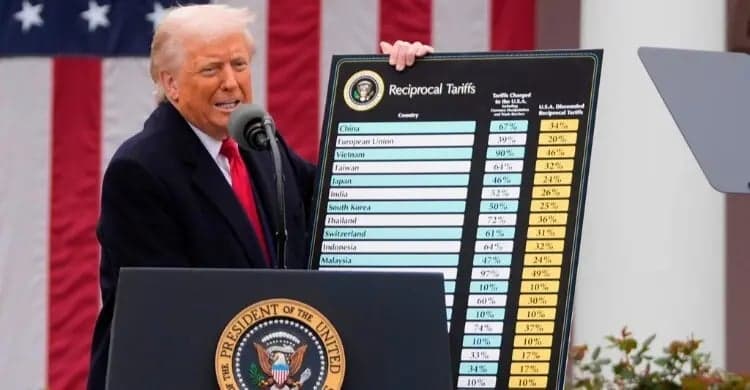
The administration of US President Donald Trump is preparing to impose new tariffs on goods from 16 major trading partners, including Bangladesh, following investigations into alleged excess industrial production capacity beyond domestic demand. The move could further increase the cost of exporting Bangladeshi goods to the US market.
According to a Reuters report published on Tuesday (November 24), the Office of the United States Trade Representative (USTR) may release its investigation findings and recommend additional tariffs on imports from the countries concerned. Citing three sources familiar with the matter, Reuters said the findings could be announced as early as Tuesday afternoon or by Wednesday.
The investigations were conducted under Section 301 of the Trade Act of 1974. Washington alleges that several countries are producing far more goods than their domestic markets require, increasing global supply and putting US manufacturers at a competitive disadvantage.
The countries under investigation include China, India, Japan, South Korea, Mexico, Vietnam, Taiwan, Thailand, Malaysia, Indonesia, Switzerland, Norway, Singapore, Bangladesh and Cambodia. The European Union is also included in the investigation.
Reuters reported that the tariff rates have yet to be finalised, but separate rates could be set for each country. Ryan Majerus, a former senior official at the US Department of Commerce, said recommendations could involve tariffs ranging from 15% to 25%, depending on the industrial sectors concerned.
However, the administration could initially recommend lower rates and subsequently increase them depending on progress made by the countries in reducing excess production capacity.
The terms of recent trade agreements between the US and several trading partners could also influence the new tariff decisions. Under these agreements, tariffs on goods from the European Union, Japan and South Korea are capped at 15%, while the ceiling for Malaysia is 19%.
For Chinese goods, the maximum tariff is also expected to remain capped at 20%. However, this arrangement will continue only if the trade understanding between Washington and Beijing, which expires on January 10, is renewed. If the agreement lapses, the US could have scope to raise tariffs further on Chinese imports.
Meanwhile, a source familiar with the matter said the likelihood of immediate additional tariffs on goods from Mexico and Norway was relatively low.
The Trump administration's tariff policies have also generated discontent within the United States. Higher duties on imported goods have pushed up consumer prices. A Reuters-Ipsos opinion poll found that 62% of respondents surveyed after the November midterm elections supported efforts to roll back tariffs.
In February, the US Supreme Court struck down several tariffs imposed by the Trump administration. Through the new investigations, the administration is seeking to establish alternative measures to replace some of the tariffs that were overturned. It also plans to add new duties to tariffs that were already in place during Trump's second term.
Ryan Majerus, a partner at the law firm King & Spalding and a former US Commerce Department official, said existing tariffs of 10% or 12.5% imposed over allegations of inadequate measures to prevent imports of goods made with forced labour could remain in place alongside the new duties.
China is considered the biggest concern for the Trump administration over excess industrial production capacity. Washington alleges that China produces more than its domestic market requires in sectors including steel, aluminium, electric vehicles, household appliances and solar energy equipment, supplying the surplus to international markets. The US argues that this affects global prices and distorts competition.
China has rejected the allegations, arguing that its competitive position in international markets stems from production efficiency and commercial capabilities.
Chinese investment in several Southeast Asian countries has also featured prominently in the US investigations. Washington alleges that Chinese companies are setting up factories in Vietnam, Indonesia and Cambodia to manufacture goods for the US market, seeking to circumvent existing tariffs on Chinese products.
In March, the USTR launched investigations into 16 trading partners over alleged excess industrial production capacity. At the same time, it opened a separate investigation into 60 countries and the European Union to assess whether they were adequately enforcing laws prohibiting imports of goods made with forced labour.
Following the second investigation in July, the US set a 10% tariff on goods from several countries, including Bangladesh. If additional duties are imposed under the recommendations of the latest investigation, Bangladeshi exporters could face further cost pressures in the US market.
Leave A Comment