

Trump urges allies to seize Hormuz strait, France rejects
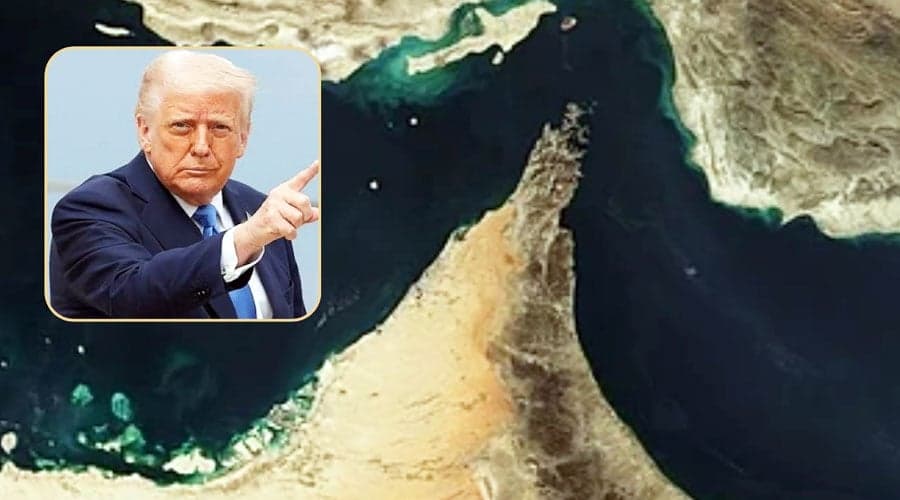

Tensions between the United States and Iran over the Strait of Hormuz have intensified. US President Donald Trump has called for a 'coalition of allies' of several countries to counter Iran's blockade. However, France has made it clear that they are not deploying any new warships to the region.
This strategically important waterway remains virtually closed on the 15th day of the conflict between the United States and Israel with Iran. This is increasing concerns about energy supply and food security worldwide, reports Al Jazeera.
In a post on his social media 'Truth Social' on Saturday, Trump claimed that countries affected by Iran's blockade will work with the United States to keep the Strait of Hormuz safe and open. He expressed hope that China, France, Japan, South Korea and the United Kingdom will join this initiative.
Direct rejection by France
However, immediately after Trump's claim, the French Foreign Ministry completely denied the news of sending additional warships to the Middle East. In a statement, they said that France is not deploying any new warships and that its aircraft carrier strike group is on the defensive in the eastern Mediterranean.
In a post on the social media platform X, the French Foreign Ministry said, “No. Our aircraft carrier strike group is in the eastern Mediterranean. France’s position remains unchanged – defensive and protective.”
This position by France is being seen as a major setback to Trump’s claim to form an alleged “alliance.”
Counter-statement
Trump claimed in the same post that the United States has destroyed almost all of Iran’s military capabilities. However, he also acknowledged that Iran could still launch attacks by sea using drones, mines or missiles. He warned that the United States would bomb the coast and destroy Iranian ships if necessary.
Meanwhile, Alireza Tangsiri, the chief of the Iranian Islamic Revolutionary Guard Corps (IRGC) Navy, has called Trump's statement a lie. He claims that the Strait of Hormuz has not been closed militarily, but is only being controlled.
On the other hand, US Energy Secretary Chris Wright said last week that the US has no plans to provide direct escorts to ships passing through the strait.
Iranian Foreign Minister Abbas Araghchi said that the Strait of Hormuz is closed only to enemy ships and their allies. At the same time, Mohsen Rezaei, a member of Iran's influential Expediency Discernment Council, commented that no US ship has the right to enter the Gulf.
Exemptions for India and Turkey
Meanwhile, after talks with India and Turkey, Iran has granted special exemptions to some ships. Two Indian-flagged LPG tankers and a Turkish-owned ship have safely passed through the strait.
Special Secretary in the Indian Ministry of External Affairs Rajesh Kumar Sinha said that two Indian tankers have safely crossed the Strait of Hormuz. Iranian Ambassador to India Mohammad Fathali said that this permission was given as a result of direct talks between Indian Prime Minister Narendra Modi and Iranian President Masoud Pajhwokian.
In addition, a Turkish ship has been allowed to pass after talks with Turkey. It is reported that about 14 more Turkish ships are awaiting clearance.
Impact on global food and energy security
According to analysts, about 20 percent of the world's liquefied natural gas (LNG) is transported through the Strait of Hormuz. This gas is an important raw material for making nitrogen-based fertilizers, which is directly related to the production of food grains around the world.
According to the 'Center for Strategic and International Studies', if this route is closed, global food security could also be threatened.
India has already been forced to take special measures to deal with the cooking gas crisis. The country has about 330 million LPG-dependent households.
The UN's humanitarian chief, Tom Fletcher, has warned that millions of people will be at risk if humanitarian aid cannot pass through the strait safely.
Doubts over military solution
Security analysts say there is no effective military way to quickly open the Strait of Hormuz without a diplomatic solution.
Andreas Krieg, a security expert at King's College London, told Al Jazeera that Trump's call for a coalition is actually just a strategy to manage the situation.
In his opinion, sending warships without a diplomatic solution means putting very expensive military ships at risk from Iran's relatively cheap but effective missiles and drones.
Leave A Comment
You need login first to leave a comment