
No remedy available in app
Uber sending 'Phantom bills' to customers in Dhaka
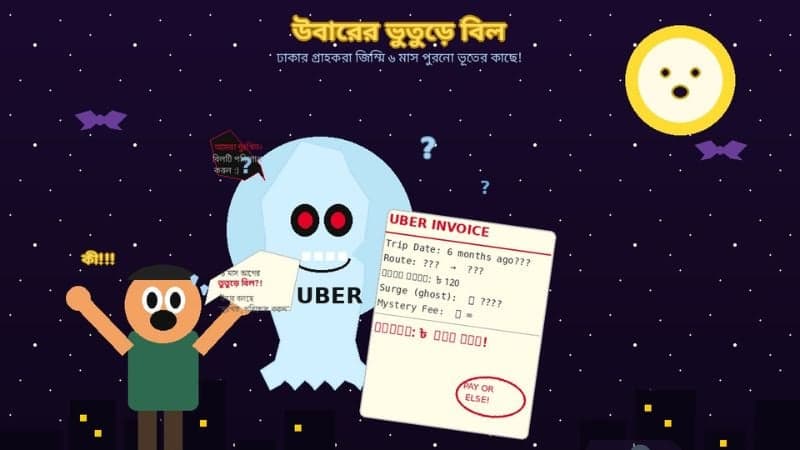

Ride-sharing platform Uber is reportedly sending phantom bills to customers under the pretext of settling outstanding dues for trips taken approximately five to six months ago. Furthermore, Uber has shown a reluctance to address customer complaints concerning these bills. Consequently, users in Dhaka find themselves trapped by Uber's ghost bills.
Customers are already expressing significant dissatisfaction with the quality of Uber's services in the capital city. There have been numerous complaints from customers regarding the absence of a customer service center, the lack of a straightforward method for addressing complaints via the app, the exposure of all information to drivers, which causes distress to customers, and frequent discrepancies between the fare displayed at the beginning and the end of the journey. This time, the emergence of insubstantial or ghost bills has exacerbated that dissatisfaction even further.
When Uber was approached to resolve this issue through the app, the relevant authorities conveyed their regret in an email and requested that the customer pay the fraudulent bill as they did this time. In the meantime, a reliable source indicated that Uber's authorization to operate in Bangladesh is set to expire next June. Uber officials submitted a request for an extension of this authorization in the first week of March. However, due to Uber's failure to meet several prior conditions, the government has granted special consideration for the renewal of their authorization this year. Investigations reveal that customers began receiving fraudulent bills following Uber's 'renewal application' in March.
About fake bills
An investigation has uncovered that numerous customers have received fraudulent Uber invoices. Anan Farabi, a frequent user of Uber, reported that on March 16, while utilizing the Uber application to request a vehicle, he encountered a notification indicating an outstanding payment of Tk409 for a prior journey. He asserted that he had no unpaid bills from any previous trips, having consistently settled his fares in cash as required by the drivers. During this time, he also received an email from Uber. This correspondence informed him that Uber had identified an unpaid amount of Tk409 from a total fare of Tk467 for a trip within Dhaka at 7:40 PM on November 10, 2024, to a driver named Abdur Rashid (vehicle number: DHM: GA- 23-4420). Consequently, to continue using Uber's services, he must settle this bill according to the instructions provided in the app. Alternatively, as stated by Uber, any disputes regarding this 'unpaid' bill will be communicated through the app.
Anan Farabi expressed that despite Uber's assertion of an outstanding bill for the trip on November 10, he had not received any billing notifications for five months until March 14 and had successfully completed numerous trips using the Uber app without any issues. Nevertheless, under Uber's policy, even if there is an outstanding bill from a previous trip, it should be reconciled during the next trip. Therefore, it raises the question of how a bill from five months ago is now presented as a notification in the app. Furthermore, it is noteworthy that 99 percent of Uber drivers do not accept trips unless payment is made in cash. Consequently, it is impossible to exit the vehicle after a trip without compensating the driver. Thus, the notion that a bill from a trip five months prior remains unpaid is utterly absurd. He mentioned that after navigating through approximately twenty steps in the app, he finally found an option to formally dispute this bill from Uber. Following his objection, he received an email from Uber three days later requesting additional information regarding the trip. Three days after supplying all the requested details, he received another email.
The message said, 'Uber has confirmed that this trip took place on November 10, 2024 and the cash payment option was used. However, Uber has nothing to do with the unpaid bill that is being shown. This trip was about four months ago and Uber does not have the technical capacity to provide a solution to such previous trips. As a result, it is advised to pay unexpected bills like this one and file a complaint within three days of the trip in the future.
Anan Farabi remarked that if a ghost bill is issued six months post-trip, how can a customer lodge a complaint within three days? How is it possible for a state-of-the-art technology-driven service like Uber to send such perplexing emails? Another customer, who experienced a similar situation as Anan Farabi and wishes to remain anonymous, reported receiving a notice for a bill of approximately Tk350 for a trip taken in the third week of October 2024, which he received in the second week of March. After considerable effort, he attempted to find a resolution through the app.
In a correspondence, Uber representatives conveyed their apologies, stating that they could not address issues related to a trip that occurred six months prior. His inquiry is, if they are unable to assist, why is an outstanding bill from six months ago being issued? Nevertheless, this customer has requested that specific details remain confidential.
He mentioned that he was compelled to cease using the Uber app associated with his previous mobile number, which he had utilized for an extended period. He is now in the process of creating a new Uber account with a different mobile number to continue using the service. He prefers not to share further details, as his new account has also been deactivated! Despite all the challenges faced, he finds it necessary to rely on Uber for various transportation needs in the taxi-free city of Dhaka.
How Uber works
Engaging with regular users reveals that the quality of Uber services on the streets of Dhaka is significantly inferior when compared to other global cities, as well as neighboring cities in India and Sri Lanka. Notably, approximately 90 percent of drivers in Dhaka lack proper training and are ineffective in utilizing technology. In Dhaka, customers are required to conduct a two-minute initial interview with the driver over the phone before confirming an Uber trip, and the fare is paid in cash as per the driver's request.
Moreover, the trip must be validated by providing comprehensive details about the destination. In the Uber application tailored for Dhaka users, drivers gain access to the customer's destination and other personal information only after accepting the trip; however, no trip can be initiated without the phone interview with the drivers.
In this context, a former associate of Uber indicated that neither the Uber management nor the Bangladesh Road Transport Authority has offered adequate training for drivers in Dhaka to effectively use a technology-driven application.
Conversely, in Sri Lanka, new drivers who join the Uber platform undergo initial training before being introduced to customer service. Additionally, if a driver is reported for policy violations or misconduct with road authorities in Sri Lanka, several stringent measures are implemented, including the suspension of their Uber service. Unfortunately, there is no recourse for customer complaints regarding these drivers in Dhaka.
As a result, customers are facing hardships from untrained drivers almost every trip. He further said that there are also some complaints about customers in Dhaka. In fact, no arrangements have been made to inform customers about Uber's policy in Bengali easily. The chaotic Uber service like Dhaka cannot be found anywhere else.
No remedy in the Uber app
Previously, Uber operated a call center in Bangladesh. If a customer encountered difficulties filing a complaint through the app, they could reach out to the call center. There was a feature known as Trip Help in the Uber app, which allowed users to easily obtain assistance regarding any trip. However, in the modified Uber app currently utilized in Dhaka, navigating from the 'Help' option to Uber's Trip Help requires several steps. Consequently, many customers are unable to seek resolution through the Uber app. Uber effectively lacks customer service operations for any users in Dhaka. Both Uber management and untrained drivers are compelled to endure various challenges and utilize the Uber app service at the discretion of the passengers.
Conversely, Uber has granted drivers nearly complete autonomy. For instance, if they are dissatisfied with the passenger's destination and fare after accepting a trip request, many Uber drivers will contact the passenger to request a cancellation of the trip. If the passenger refuses, some drivers will either forward or cancel the trip request after traveling a short distance from the pick-up location. This situation results in the customer incurring a delay fee of Tk30.
The Uber application does not provide a means for passengers to quickly report grievances or seek resolutions for such issues. As a result, passengers are compelled to face difficulties during urgent trips and must request a new ride while incurring an additional delay fee of Tk30.
Frequently, when encountering a traffic jam, the vehicle abruptly 'stops' or the driver 'halts' in the middle of the road. The passenger is then compelled to disembark at that location. Even if the journey concludes prematurely, Uber typically displays the fare to the original destination, leaving the passenger with no choice but to pay. In such instances, passengers find themselves powerless.
Views Bangladesh reached out to Uber's public relations agency in Dhaka concerning these service-related complaints. However, no response was received regarding this matter even after a week.
Leave A Comment