
BRICS seeks alternatives for cross-border transactions
Under Trump’s shadow, dollar era facing difficult times
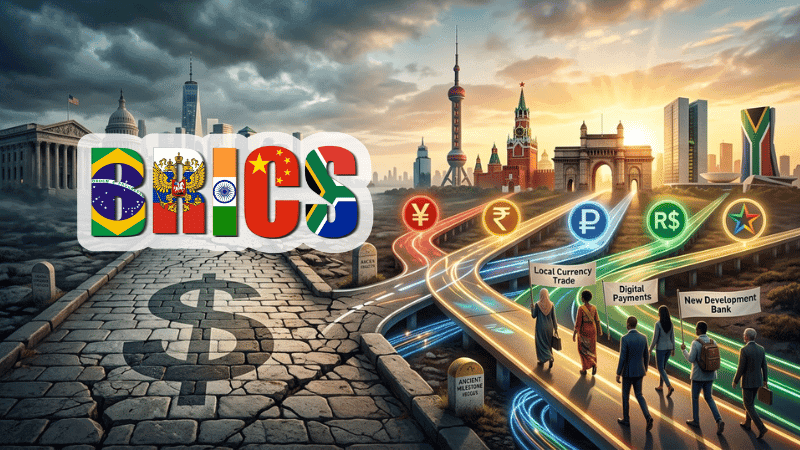

The dollar’s troubles are no longer coming entirely from outside. Some of them, increasingly, seem to be coming from within the system itself. Donald Trump wants to make America great again—by raising tariffs, tightening the gates of trade and keeping the key to sanctions firmly in his hand. But global markets are a strange place. Push someone too hard, and sooner or later they begin looking for another door. BRICS is now looking for that side door.
None of its members has either the courage or the capacity to bid farewell to the dollar overnight. The US currency remains deeply embedded in global reserves, lending, oil trade and international transactions. Yet BRICS has now raised an uncomfortable question in New Delhi: if India buys goods from Brazil, China trades with Russia, or two developing countries settle accounts between themselves, why must the US currency appear in the middle every time?
It is not a small question.
Because the dollar is not merely money. It is power. The currency in which much of the world keeps its accounts gives its issuer more than a printing press. It gives Washington the power to impose sanctions, influence the global banking system and control a major switchboard of the world economy. For decades, that switchboard has largely been in American hands. BRICS is now asking: why should the switchboard remain only in Washington? What is wrong with having a few more switches in our own homes?
Trump does not like BRICS efforts to reduce dependence on the dollar. Yet it is under his administration that tariff wars, sanctions and fears of economic pressure have encouraged many countries to explore alternatives to the dollar. The stronger the effort to guard the dollar, it seems, the greater the curiosity about finding new routes beyond the wall.
There was no revolution against the dollar at this year’s BRICS summit in New Delhi. No new BRICS banknote was printed. What happened was perhaps more practical: efforts began to make the rupee, yuan, ruble, real and other local currencies communicate more directly with one another. Digital currencies, payment networks and local-currency trade are among the small bridges now being designed.
The dollar is still king. The throne remains intact. But outside the palace, the ground is being cleared for several new roads.
And history tells us that the troubles of old kingdoms do not always begin with the sound of a throne collapsing. Sometimes they begin when people discover other roads.
The most significant development at the 18th BRICS Summit, held on September 12 and 13, may not have been any speech or handshake by a leader. It may instead have been a few seemingly innocuous sentences in paragraph 90 of the 45-page New Delhi Declaration.
The declaration says the BRICS Payment Task Force is exploring ways to connect the payment and financial messaging systems of member countries. Discussions will also continue on expanding trade settlement and investment in local currencies. The goal is to make cross-border payments faster, cheaper, more accessible, efficient, transparent and secure.
It sounds harmless enough—the language of a gathering of bankers. But many major changes in international politics begin with precisely such seemingly harmless sentences.
South China Morning Post described the development as another step by BRICS towards de-dollarisation. Its analysis said that amid growing concerns over tariffs, sanctions and the use of US financial power under Donald Trump, BRICS countries are seeking practical ways to reduce their reliance on the dollar among themselves. But they have not announced any “BRICS currency.” An Indian foreign ministry official also made it clear at the summit that there is currently no proposal for a common BRICS currency.
Creating a new currency is a romantic idea. It would have a flag, a symbol and perhaps an image representing the unity of 11 countries on its banknotes. But currency is not poetry. Currency is trust.
Behind it must stand a central bank, an interest-rate policy, an exchange-rate mechanism, debt markets and enormous liquidity. Above all, countries must trust one another. Within BRICS, that trust remains incomplete.
China wants to expand the international use of the yuan. India wants greater use of the rupee, but remains cautious about increasing China’s influence over financial infrastructure. Russia has been pushed to seek alternatives to the dollar and euro because of Western sanctions. Iran’s need is even more urgent. Brazil wants reform of the global financial architecture, but a China-dependent monetary system is not its objective either.
In other words, everyone has boarded the same bus, but not everyone is heading to the same destination.
Reuters reported that ahead of the summit, India proposed the idea of linking BRICS members’ central bank digital currencies in the future. But here, too, the problems are substantial. India has expressed security concerns about some payment infrastructure led by China, while political relations among BRICS members are not smooth everywhere. Currency-swap arrangements may also be needed to address trade imbalances between countries.
So there is still no magic button that can simply switch off the dollar.
But the door has opened.
The trade relationship between Russia and China offers a glimpse of what this could look like. According to Reuters, a large share of the roughly $240 billion in bilateral trade between the two countries is now settled in yuan and rubles. For Russia, this has become less a matter of preference than necessity since the imposition of Western sanctions.
Yet necessity is often how new systems are born.
BRICS now wants to turn these small bilateral routes into a broader multilateral highway.
The highway may not be called “BRICS Pay.” Perhaps it will not have a flashy name at all. If India’s UPI, Brazil’s Pix, various fast-payment networks, central bank digital currencies and banking messaging systems can learn to communicate with one another, an Indian importer buying goods from Brazil may no longer need to first convert rupees into dollars and then dollars into reais.
The two currencies could speak directly to each other.
Money, too, would need fewer translators.
This could reduce both time and cost. A 2026 study by the Bank for International Settlements also noted that major problems in cross-border payments include high costs, slow processing and limited interoperability between systems in different countries. Despite technological advances, legal frameworks, regulatory systems, anti-money-laundering requirements and differences in technical standards remain major obstacles.
In other words, BRICS has identified a real problem. But the solution is also difficult.
Another name for BRICS’ renewed interest in moving beyond the dollar is the fear of sanctions.
In the New Delhi Declaration, member countries took a strong position against unilateral tariffs, non-tariff barriers, economic sanctions and “secondary sanctions.” The declaration did not mention the United States by name. Diplomats are often polite enough to say, when there is an elephant in the room, that “a large animal appears to be present.”
But it does not take much detective work to understand whom they mean.
The shadow of the Trump administration was therefore also present at the New Delhi table.
Washington does not use the dollar merely as a currency. Standing behind it are the world’s deepest bond markets, the international banking system and enormous sanctions-enforcement capabilities. Countries whose banking transactions pass through the dollar system can, in many circumstances, also come under the reach of US law. The experiences of Russia and Iran have made that reality even more apparent to other BRICS members.
That is why it would be misleading to understand de-dollarisation simply as “anti-Americanism.” One part of it is political. Another is simply risk management: reducing excessive dependence on a single currency and a single financial system.
But here comes another interesting picture.
The BRICS group looking for ways to operate beyond the dollar still has plenty of dollars in the pocket of its own bank.
According to the New Development Bank’s 2026 investment presentation, about 59.5 percent of its active loan portfolio at the end of 2025 was denominated in US dollars. Chinese renminbi accounted for 21.5 percent, South African rand 6.8 percent, and Indian rupee just 1 percent.
Yet NDB President Dilma Rousseff has said that increasing financing in local currencies is an important priority of the bank’s new strategy. The New Delhi Declaration also encouraged the NDB to expand local-currency financing.
That single statistic neatly captures BRICS’ current predicament.
The dream exists. The blueprint has been drawn. But the bricks are still being bought in dollars.
That is also why moving the dollar aside is so difficult.
According to the latest figures published by the IMF, the US dollar accounted for 57.13 percent of global allocated foreign-exchange reserves in the first quarter of 2026. The euro accounted for 20.03 percent. The Chinese renminbi—which is discussed more than any other currency as a potential challenger to the dollar—accounted for just 1.99 percent.
The dollar is still a banyan tree. BRICS is planting several new saplings.
Whether the banyan tree should fear those saplings is impossible to say yet. But there is little reason to dismiss them either.
And that is where the 2026 BRICS summit differs from many of its predecessors. Earlier discussions often contained a grand political dream: creating an alternative to the Western-led system. This time, that dream has come down a little closer to the ground.
Instead of the grand and almost impossible declaration, “We will create a new global currency,” the language is now much smaller: interoperability, local currencies, digital payments, settlement, messaging systems.
BRICS has moved from the language of revolution to the language of plumbing.
And in economics, plumbers are often more useful than revolutionaries.
Another point became clear in New Delhi. BRICS is no longer a club of five countries. The expanded grouping now includes Brazil, Russia, India, China and South Africa alongside Egypt, Ethiopia, Iran, the United Arab Emirates, Indonesia and Saudi Arabia.
At the same table now sit major energy producers, major energy importers, some of the world’s largest manufacturing centres and rapidly growing consumer economies. This diversity is both BRICS’ strength and its weakness.
If China buys relatively little from India while India buys much more from China, what currency should be used to settle that trade? That question cannot be answered through speeches.
What will Chinese exporters do with excess rupees? Where will India use excess yuan?
Answers are needed.
For local-currency trade to become sustainable, there must be deep foreign-exchange markets, swap lines, investment opportunities and sufficient currency convertibility. And above all, there is the reality of competition between India and China.
New Delhi wants BRICS to become stronger, but does not want it to become “China’s BRICS.” Beijing, meanwhile, wants to deepen economic and technological connectivity within a “Greater BRICS.” At this summit, Xi Jinping proposed greater cooperation in artificial intelligence, special economic zones and trade in services.
China will also assume the BRICS presidency next year.
As the question of de-dollarisation moves forward, therefore, another question will become increasingly important: if the dollar’s role declines, whose influence will grow in the space it leaves behind?
For Bangladesh, this issue also matters considerably.
Although Bangladesh is not a full member of BRICS, it has been a member of the New Development Bank since 2021. By the end of 2025, the bank had approved around $450 million in financing for Bangladesh. New projects in the power and solar-power sectors were also approved in 2026.
During a visit to Dhaka by senior NDB officials in August, discussions also covered new railway, airport cargo-hub, road and energy projects, as well as support for Bangladesh’s Panda Bond issuance.
If BRICS’ financial infrastructure genuinely moves towards local-currency transactions, new options could eventually emerge for a dollar-dependent, import-reliant economy like Bangladesh.
But an alternative does not mean abandoning the dollar.
Bangladesh’s export markets, foreign borrowing, remittances, energy imports and reserve management remain deeply tied to the dollar. A pragmatic policy, therefore, would be to keep alternative doors open while keeping the main door functioning.
Perhaps that is the biggest lesson of this year’s BRICS summit.
The dollar is not going to wake up tomorrow morning and discover that it has lost its job. The printing presses in Washington are not shutting down. The bond market in New York is not being locked up. Central banks around the world are not throwing their dollars out of the window overnight.
But something is changing.
The world’s major emerging economies are beginning to ask why every road has to pass through New York.
Why should a journey from Delhi to Brasília require a ticket through Washington?
From Beijing to Moscow, Jakarta to Abu Dhabi, or perhaps, one day, Dhaka to Shanghai, countries are beginning to calculate whether there can be more direct routes for their transactions.
The dollar’s empire is unlikely to collapse one morning.
History is rarely that cinematic.
Empires change slowly.
First, a small road is built. Then another. Traffic continues to crowd the old highway. But eventually, people discover that there are other ways to get home without taking the old highway.
In New Delhi, BRICS may have made the map of those alternative routes a little clearer this time.
Leave A Comment