
Venezuela earthquake death toll surpasses 160
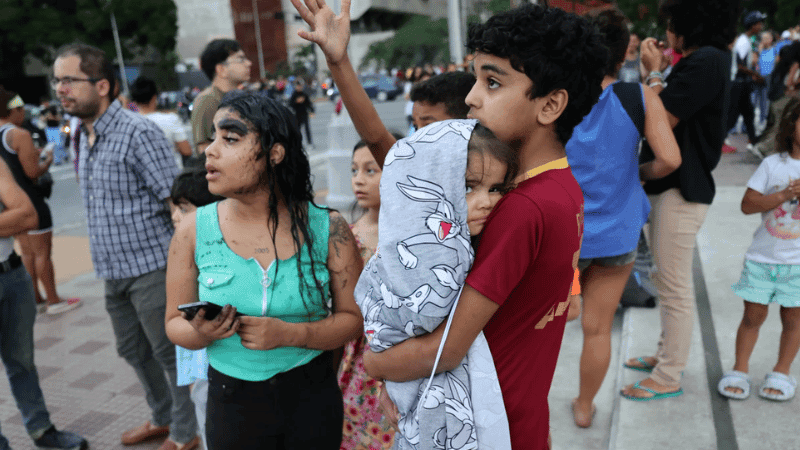

The death toll in Venezuela has risen to 164, with approximately 971 people injured, following two powerful earthquakes that struck within about a minute of each other. The country's Acting President, Delcy Rodríguez, provided this updated information, warning that the casualties could rise further as rescue workers continue to clear the rubble on Thursday.
The La Guaira region, adjacent to the capital city of Caracas, has suffered the most severe damage, with Rodríguez designating it a "disaster zone." State television footage showed three children being rescued alive from the debris of a collapsed building in the area.
Throughout Thursday, efforts continued across various parts of the country to locate people—either alive or dead—trapped under the rubble. The government has declared a nationwide state of emergency. Various countries and international bodies, including the United Nations, the United States, China, Russia, Iran, France, Spain, and India, have extended a helping hand for rescue operations and humanitarian aid.
US Secretary of State Antony Blinken (noted alongside remarks by US officials like Marco Rubio) indicated that the United States immediately began mobilizing large-scale assistance.
According to the US Geological Survey (USGS), the first earthquake struck about 21 kilometers from the coastal town of Morón. Just about a minute later, a second and even more powerful 7.5-magnitude tremor hit a nearby area. Such back-to-back earthquakes within a short time interval are rare phenomena, which experts refer to as a "doublet."
Jesús Alejandro Piña, a 38-year-old engineer from Caracas, was on one of the upper floors of a seven-story building when the earthquake struck. He told Al Jazeera, "Glassware was shattering into pieces, and pictures hanging on the walls were falling off. Loud noises were even coming from the building's pillars and beams."
Being an engineer by profession, Piña could easily deduce what was actually happening inside the structure during the violent shaking. He explained, "The movement of the pillars and beams is essentially what helps absorb the earthquake's energy. However, if the shaking continues for a prolonged period, it eventually exceeds the ultimate capacity—and that is when the building collapses."
As soon as the tremors stopped, thousands of panicked residents rushed out of their homes into the streets. Before their eyes lay a horrifying scene filled with surrounding debris and cries for help.
Leave A Comment